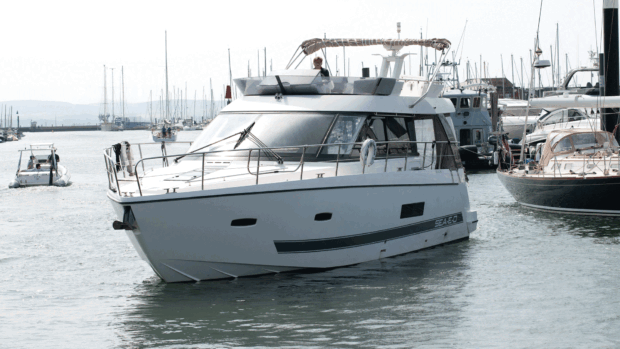

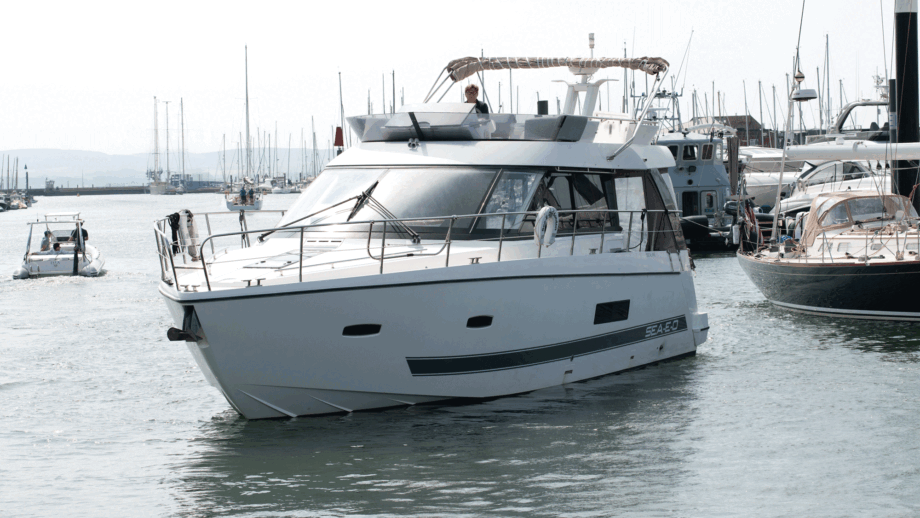
The Sealine F42 won the MBY award in 2011 for flybridges up to 55ft, we take a look at the Richard Crocker design
Sealine is now owned by the German group Hanse Yachts, but it used to be one of the big four British boat builders. A strong focus on accommodation, innovation and value for money allowed it to compete with Fairline, Princess and Sunseeker, while a broad range of models spanning 19ft to 60ft ensured there was a model to suit almost every budget.
The launch of the S35 sportscruiser in 2007 signalled the introduction of a new design language, featuring straight lines, hard angles and flat, almost vertical topsides. In 2009 that spread to the flybridge range with the introduction of the F46, followed a year later by this boat, the F42. There was almost no continuity between this and the previous F42/5.
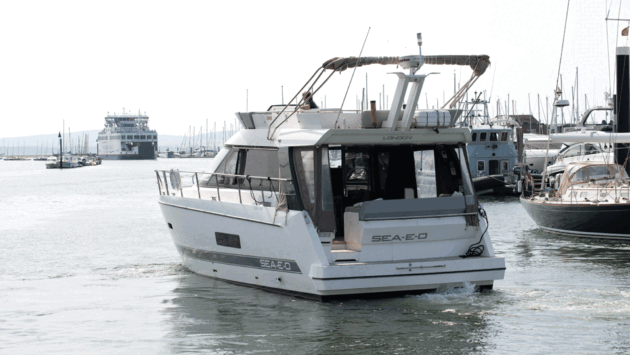
The F42 won the MBY award in 2011 for flybridges up to 55ft
The new model was leaps ahead, and not just in looks. Some would say it was more Fairline than Sealine. In fact, when MBY tested it in October 2010, we rated it Sealine’s best flybridge to date, and in 2011 it won the Motor Boat of the Year Award for flybridges up to 55ft.
We even considered it a better all-round package than the F46. Perhaps that’s because the F42 was actually designed first but Sealine decided to stretch the original concept by 4ft and launch the F46 first before following it up with the F42 a year later.
Production of the F42 only stopped in 2013 when Sealine fell into administration, and was taken over by Hanse Yachts, heralding the advent of a new German-built range.
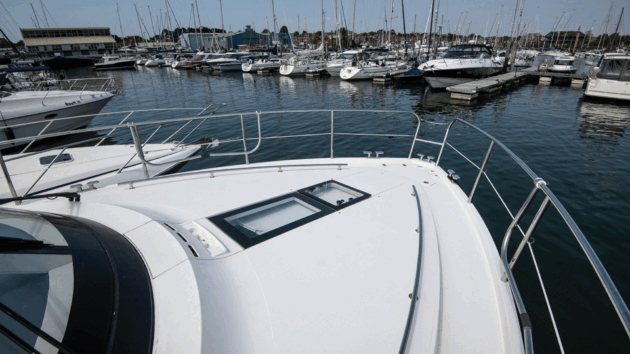
The V-shaped foredeck sunbed provides a decent space for two people
Performance
Engine options were all Volvo pod drives, either twin 370hp IPS500s or twin 435hp IPS600s. Both are based on the 5.5L in-line 6-cylinder D6 engine block. Though it provided a reasonable 28-knot top speed, few chose the IPS500 version, preferring to shell out the extra cost for the 30/32-knot top speed of IPS600.
IPS drives were still fairly new at the time but Sealine were early adopters of the concept due to the packaging benefits of having the engines closer to the stern and the extra performance and fuel efficiency offered by the forward-facing duo-prop drives. But the biggest asset of IPS drives was, and arguably still is, joystick berthing. It was an expensive extra at the time and remains a very desirable option in the market for secondhand F42s.
If you can find an F42 of this vintage with the optional joystick, that’s a valuable asset
During our original sea trial, we found the F42 to be a great sea boat. Weather conditions were pretty challenging on the test day but it steered well in confused water, maintaining a steady line. Impressively, for a beamy medium-vee boat, the ride into a head seas was soft and composed, more deep-vee than medium, no doubt helped by its sharper forward sections. That said, like quite a few IPS boats, it did have a tendency to run slightly bow-up.
Nick Paglia, whose boat is featured here, gave us his take on six years of ownership: “Our first delivery passage, from Swanwick to Lymington, was a baptism of fire. The sea was coming over the flybridge into the cockpit. It was not what we bought the boat for, but it gave us plenty of confidence from the start. Our cruising grounds have largely been from Portsmouth to Weymouth.
We have had plenty of testing moments, notably big rolling swells south of the Needles and punishing overfalls off St Alban’s Head. In terms of performance, she can hit 30 knots when loaded, but cruising at 20 to 25 knots is kinder to your bank account.”
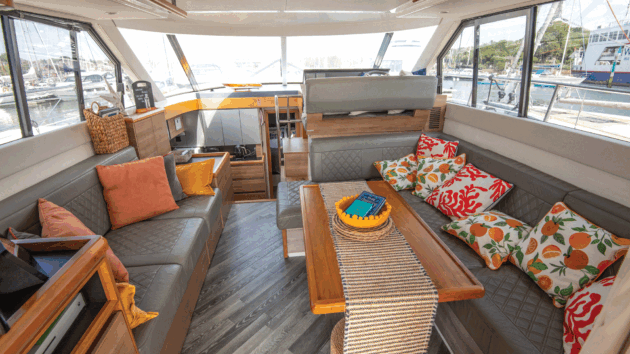
Our used example mixes light mahogany finish with real (rather than synthetic) leather
Points to consider
Nick has chartered his boat as well as renting it out as a static Airbnb so he knows the realities of keeping and using an F42. He bought his low-hours but neglected boat from Portugal at a bargain price, knowing he would need deep pockets. His first bill was a big one. Water had penetrated the seals on the propeller shafts, entering the gearboxes.
His first option was a rebuild, which an independent engineer offered to do for £15,000 but over the course of the season. For Nick, time is money, so he opted to exchange the pods for brand new ones from Volvo at £50,000 for the pair. The props had suffered too but were able to be refurbished.
The pain did not stop there, as the following year the engines’ heat exchangers had to be refurbished along with the two Eberspacher heaters. When he had to shell out the year after for new trim tabs and a battery charger, it paled into insignificance. The good news for any future owner is that all this has now been sorted.
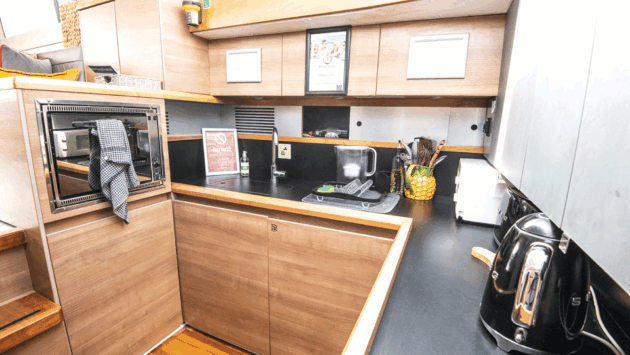
The galley-down layout feels like the arrangement of a proper cruising machine
From the outset, Nick found that the GRP benefits from regular cutting back to maintain its shine. This is something he found you need to keep on top of, as he doesn’t reckon the gelcoat is as good as that on his previous Fairline. The carpets needed replacing after seven years of heavy use too but the standard teak decking has proved hardwearing.
He also replaced all the external upholstery with Silvertex, as the original coverings were looking pretty tired. And he made a point of decommissioning the BBQ on the port quarter because, in the course of his Airbnb and charter operations, the underside of the flybridge overhang was repeatedly getting stained.
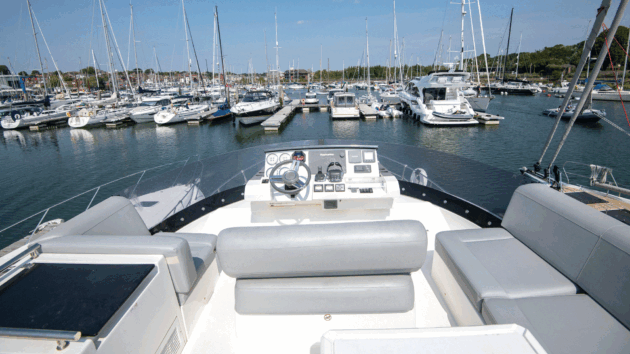
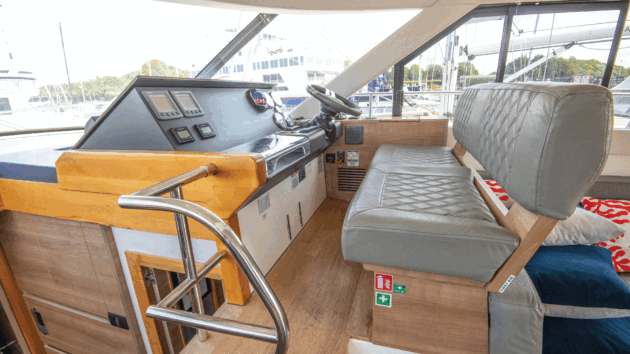
The upper helm gets a central position and some very useful companion seating
Another potential issue we were advised to look out for is the fitment of the windscreen. The large wraparound screen necessitated a box section moulding for extra rigidity. The screen was then bolted internally and screwed externally. The external fittings were sealed with UV-resistant sealant.
However, in a small number of cases, this sealant failed, allowing water ingress into the box section. With the water unable to escape, sunlight heated it, causing accelerated osmosis in this area, evident through blistering around the bottom of the windscreen. This is localised and doesn’t affect the hull but is worth looking out for.
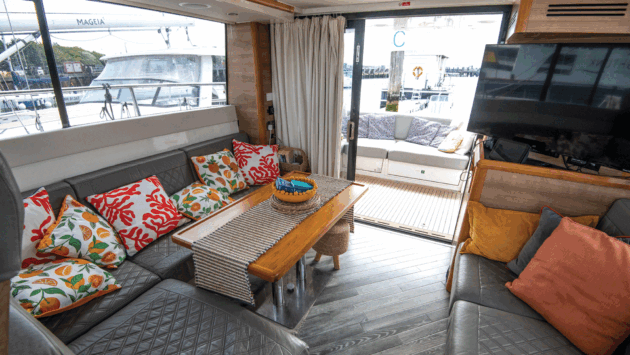
The saloon and cockpit are given over entirely to sitting, lounging and dining
Options and layout
In terms of joinery, cherry was the dark wood option, while light mahogany was the alternative, which in Nick’s boat is of a very high standard. Upholstery choices were Alcantara or UltraLeather, both synthetics. Nick did replace the original interior UltraLeather with real leather for aesthetics, so we can’t say how hardwearing it is after 15 years.
Out on deck, all-round access on the F42 is very good. Going forward on the wide side decks, assisted by tall guardrails and long handrails, is easy work.
The foredeck has the luxury of a large V-shaped sunbed, but the main attraction is the flybridge. The central helm provides great all-round views, and a sizable dash means you can have a proper suite of electronics. The social dimension up top is great too, with seating for nine – six around the table, two at the helm seat and one to port.
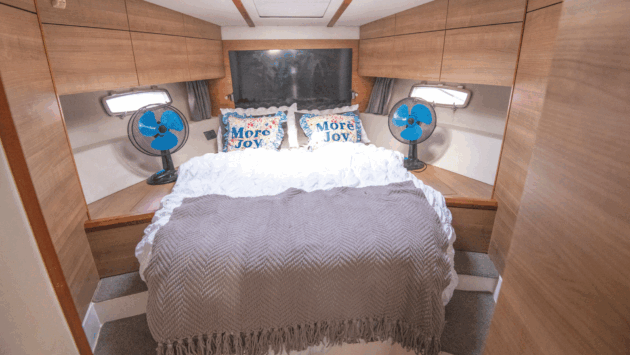
The big bow cabin gets an ensuite shower to port and an ensuite heads to starboard
A large draining storage locker sits at the aft end of the flybridge and an electric icebox looks after the drinks. The lower helm is an elevated double affair. There’s no headroom for standing but the seated view is pretty good. A dinette lies behind the helm, while catering is courtesy of a well-equipped galley-down design. The forepeak owner’s cabin is impressive.
Not only is it spacious with masses of headroom and plenty of storage but it has an ensuite shower to port and an ensuite heads to starboard. The full-beam mid cabin is unusual in that it has three beds, two of which can be joined to make a double. Headroom is limited but this hideout is really aimed at youngsters; and the starboard ensuite that serves this cabin is of a decent size.
Article continues below…

Sealine F530 used boat review: More bang for your buck

Sealine S390 review: This £480,000 sportscruiser is a delectable day boat
Surveyor’s report
Sealine has always been known for its excellent use of space and fair pricing. This Richard Crocker-designed model replaced the F42/5, many of which I have surveyed. The newer design aimed to increase quality, with a far more modern contemporary style and feel. At sea, they handle surprisingly well, despite the relatively shallow vee.
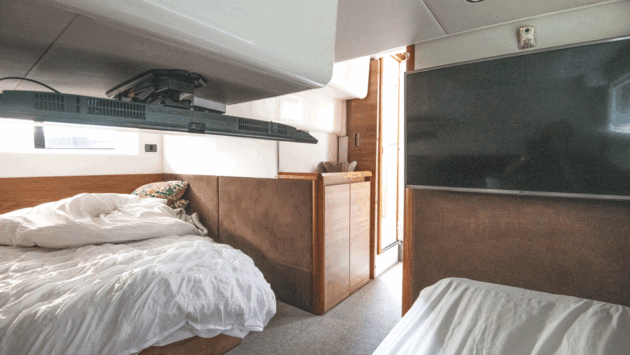
The three-bed mid-cabin is designed primarily for youngsters
Points to note when buying
Sharp angles are far more prone to cracking or stress-crazing in a seaway than curved ones, so look for signs of this around any stress points. The aft end of the flybridge is supported on angled pillars. The structural parts are hidden within the mouldings. The weight of the flybridge moulding aft of the pillars can flex in a heavy sea, so check these too.
Given the open-plan interior, make sure you are confident moving around the boat on passage. IPS drives require scrupulous maintenance, so ensure all Volvo scheduled maintenance has been carried out. Galvanic protection is also critical with these drives, so ensure all is sound when surveyed.
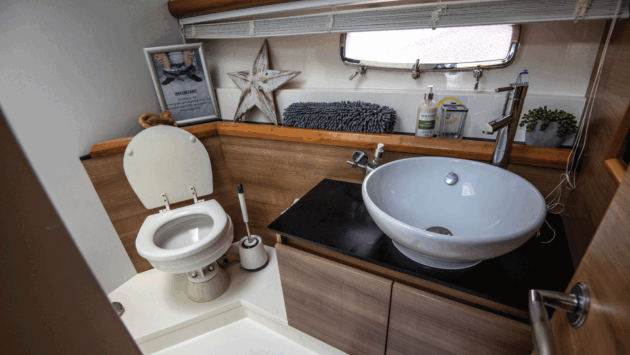
The day heads is also able to operate as a very private ensuite for the second cabin
Ensure the engine service history is up to date, including heat exchanger cleaning. A thorough sea trial is vital, with an extended run at maximum revs to ensure temperatures remain within specs throughout.
Even a small amount of fouling on the IPS props has a profound effect on efficiency so consider a mid-season lift and pressure wash. While it’s out, check the anodes and replace if necessary too.
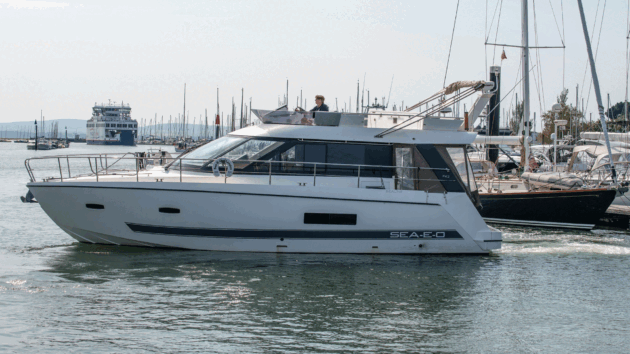
The big wraparound screen delivers great all-round views
Chris Olsen, Olsen Marine Surveying – Tel: +44 (0)7971 250105; www.olsenmarine.co.uk
 If you enjoyed this….
 If you enjoyed this….
Motor Boat & Yachting is the world’s leading magazine for Motoryacht enthusiasts. Every month we have inspirational adventures and practical features to help you realise your sailing dreams, as well as tests and news of all the latest motorboats.
Plus you’ll get our quarterly Custom Yachting supplement where we share the last on offer in the superyacht world and at the luxury end of the market.
Build your knowledge with a subscription delivered to your door. See our latest offers and save at least 30% off the cover price.
Note: We may earn a commission when you buy through links on our site, at no extra cost to you. This doesn’t affect our editorial independence.
Price as reviewed:
£259,998.00
Verdict
The F42 was one of several boats from this brand that marked a contemporary shift in design. This was matched by a closer focus on performance and handling, which made the F42 a more capable rival than the earlier F42/5. It managed to tick a lot of boxes, not least a large flybridge, which gave it a substantial topside presence without the appearance of being top heavy. As for its relatively short production run, that was no fault of the model itself. Had Sealine survived unscathed beyond the aftershocks of 2008, this boat would most likely be a much more familiar sight today.
Details
LOA: 44ft 10in (13.60m)
Beam: 14ft 8in (4.48m)
Draft: 3ft 11in (1.20m)
Displacement: 12,900kg
Fuel capacity: 1,200L
Water capacity: 450L
Designer: Sealine/Richard Crocker
Hull type: Medium-vee planing
Performance: 31 knots – based on MBY test and owner feedback
Range: 220nm at 25 knots with a 20% reserve