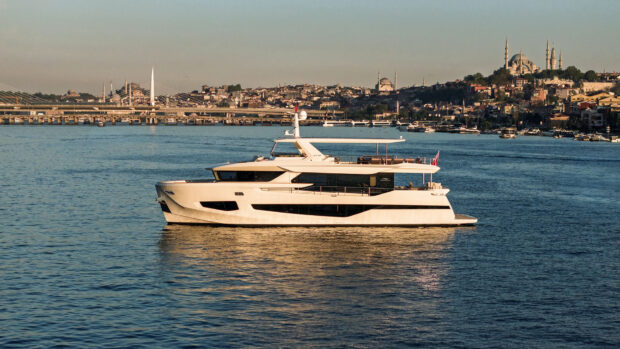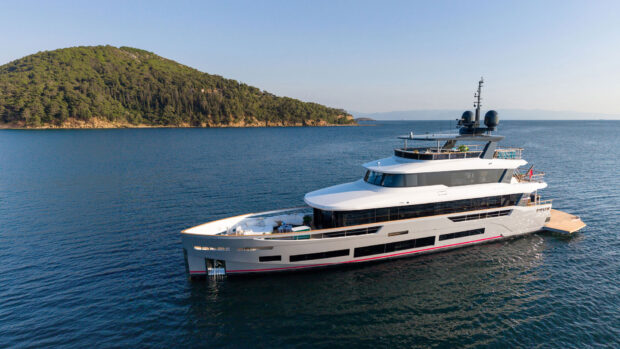


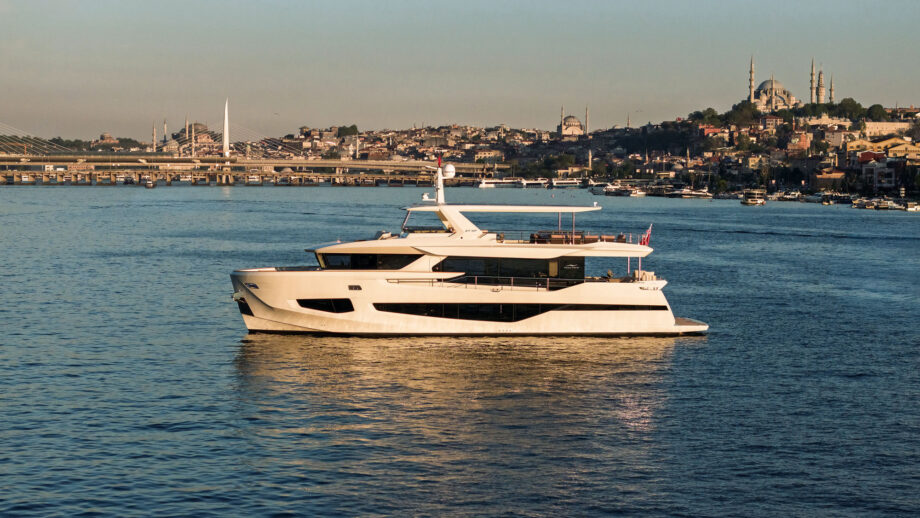
A decade after the debut of its first explorer yacht, Numarine is back with an 88-footer that feels like way more than just a refresh
Turkish brand, Numarine, may have become known for its long-distance explorer yachts but it didn’t actually introduce its first model until 2017, a full 15 years after the foundation of the company.
That original Numarine 32XP was quickly followed up in 2018 with the 26XP and that is the model on which this new 27XP is based. There are now eight models in that XP explorer line and while this might be the second smallest of them, it’s actually much more than just a model refresh.
It’s 3ft 3in longer than the 26XP, as well as a foot wider in the beam, with a weight increase of 12 tonnes. There have also been changes not just in the styling but also in the deck layouts – and the result of all that is apparently a fresh order of boat altogether.
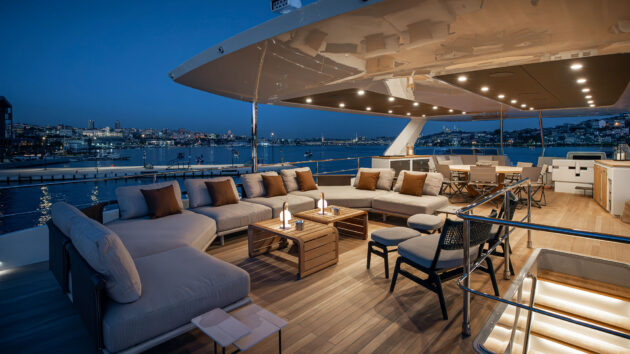
With its huge aft deck, central dining station with split/wet bar, twin helm with companion seating and big forward sunbed, the flybridge is an astonishing recreational asset
External decks
The aft end is certainly very user-friendly. As we step forward along the port passerelle, we’re greeted with a big high-low platform with central access to a pair of crew cabins – an ensuite twin to starboard and a symmetrical cabin to port.
These both get direct access to the engine room and to the washer dryers in the central passageway – and they quite naturally generate a raised sunbed up above, that juts out over the aft platform with symmetrical steps to the cockpit on either side. It’s a short sunbed but it’s impressively wide – and when you ascend to the cockpit, the side decks are equally practical…
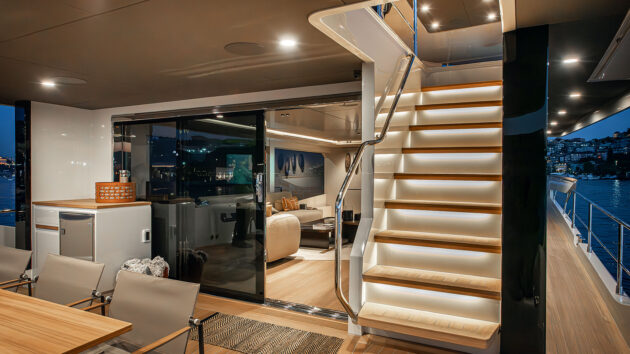
The steps to the fly are shalllow, bright and safely contained
They are usefully wide and, remarkably, they run all the way to the bow without a single step to obstruct your passage. They’re covered too, thanks to big trawler-style overhangs from the flybridge, and the raised guardrails are built into cutaway bulwarks to lighten the profile and improve the views. That in itself feels like a very practical explorer yacht asset, and the use of a largely open cockpit does too.
There’s an aft bench built into the leading edge of the raised sun pad with a pair of tables ahead of that, but the rest, apart from a port wet bar, is wide open and available for whatever kind of furniture you fancy.
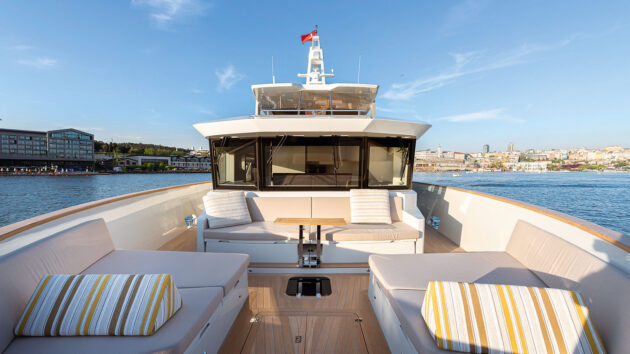
The unusual bow design is much more keyed in to lounging than to dining
The bow space is also quite unusual. The lateral bench beneath the reverse screen faces forward to a pair of broad peripheral sunpad-style seating units. It’s quite a short bow with limited flexibility as regards socialising, but it’s remarkably deep and safe with plenty of storage beneath the various units and very easy movement both from side-to-side and fore-and-aft.
There’s also plenty more of that lovely pale, honey-coloured natural teak, both in the deck and on the elegant forward rail cappings.
As for the flybridge, that’s an amazing piece of work. It occupies almost the full beam and is extraordinarily long, so it’s much larger than you would expect on a boat of this scale.
That’s handy because with only one dedicated sun bed on the main deck (and even that, largely sheltered by the flybridge structure) it has a big job to do. Access is outstanding, thanks to broad, teak-lined flybridge steps, bookended by mouldings, underlit with LEDs, lined with a port handrail and set at an easy, shallow angle.
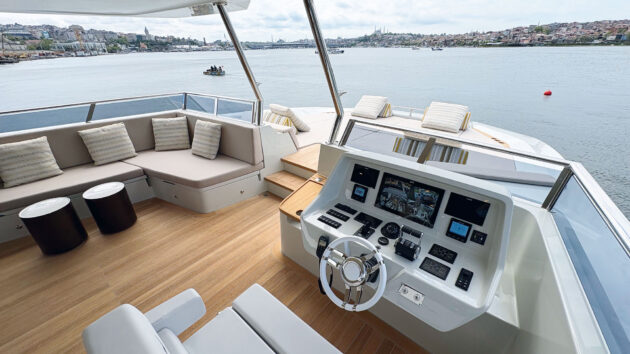
The flybridge is so big you can’t actually see the rest of the boat from the helm
And once you’re up there, what we get on the test boat is a massive aft deck with lots of space for a huge wraparound suite of freestanding furniture. There’s easily room for the entire ship’s company back here but you also get an eight-man dining station further forward, plus a beautifully conceived split wet bar with cooking facilities to starboard and refrigeration (oceans of it) to port.
Ahead of this is a starboard two-man helm opposite a bank of companion seating – and we’re still not finished, because ahead of this section, through a permanent gap in the wind deflector, is a rooftop sunbathing platform that extends almost to the foredeck.
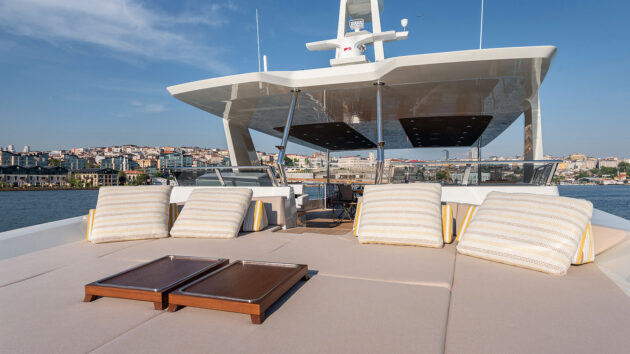
The Silent Pack adds solar panels and lithium batteries for generator-free anchoring
It’s big enough to swallow plenty of people and, thanks to slightly raised mouldings and low-profile rails, it’s also remarkably secure. It is, in short, a spectacular flybridge and the only downside of that, apart from elevated weight and stylistic chunkiness, is a helm with no real view of any of the boat’s parameters.
The third wetbar-mounted helm station, on the port side of the cockpit, is also a bit tucked away but happily, the main deck helm does plenty to make up for that.
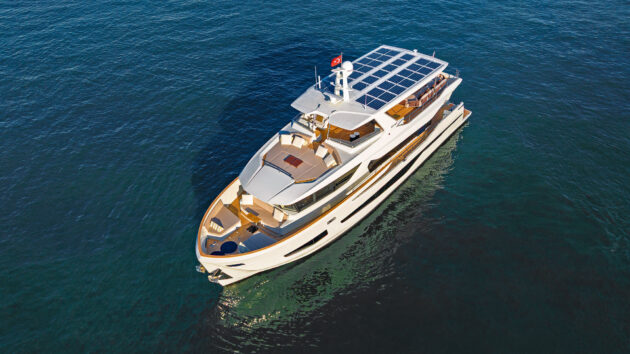
The upper deck is much larger than you would expect, even from a boat of this scale
Sheltered day spaces
When you step into the saloon, again via a single-level threshold to a single-level deck, the intimacy of the space is immediately striking. There’s no view of the galley or helm from here.
Both are tucked away forward, so the crew can operate discreetly, behind a transverse bulkhead that houses a flatscreen TV. There’s also a transverse staircase running alongside this bulkhead that takes you down to the lower deck – and that orientation, changed over the 26XP, opens up quite a lot more space for the various guest cabins than the old boat was able to provide.
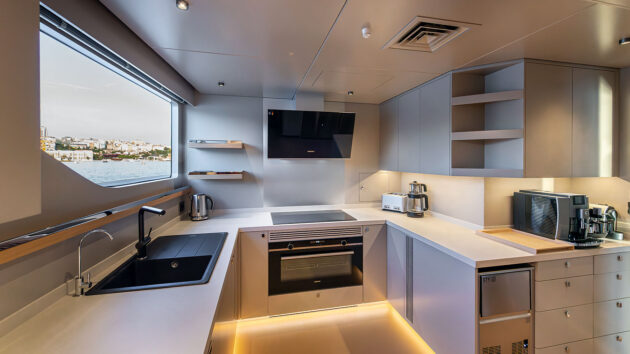
This is a serious professional galley with direct crew access from the port side deck
But as for the saloon itself, it adds to the brightness of the big windows and the cutaway bulwarks with two-part sliding doors to starboard. These sit next to a freestanding dining table, but if you want to feel less formal, there’s also a casual lounge on the port side a little further aft, with low-slung settees and a bespoke coffee table.
The flow of traffic is again excellent and, when you head further forward, the crew facilities are too. The galley, immediately ahead of that bulkhead, is massive, with all kinds of space for refrigeration, worktops and equipment, plus big views and direct access to the port side deck.
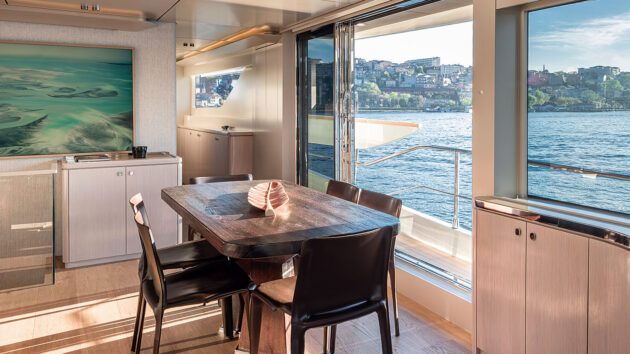
The openness of the starboard dining station is very attractive
Ahead of this sits a compact but serviceable day heads to keep the guests from having to head down below and finally, ahead of that, up a single step for increased volume down below and uprated visibility, is the pilothouse.
It uses a central skipper’s chair with excellent visibility both through that reverse screen and the side screens, plus a handy door to the starboard side deck and a port window for ventilation and communication.
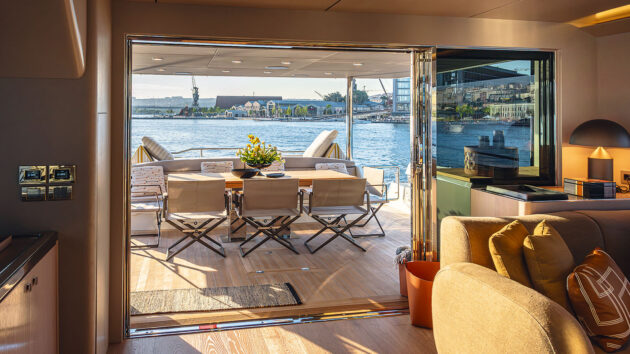
The interplay between cockpit and saloon is moderate but adequate
There’s also a bank of companion seating to port, big enough for four or five people plus lots of storage spaces. The skipper’s chair could do with some adjustability just to shift you closer to the touch points but that aside, it’s a beautiful helm, both for crew and for self-drive owners.
That said, you can swap the driving position and a bit of that enormous galley for a main deck cabin instead. In that case, it would get access via that starboard door to a private bow lounge instead.
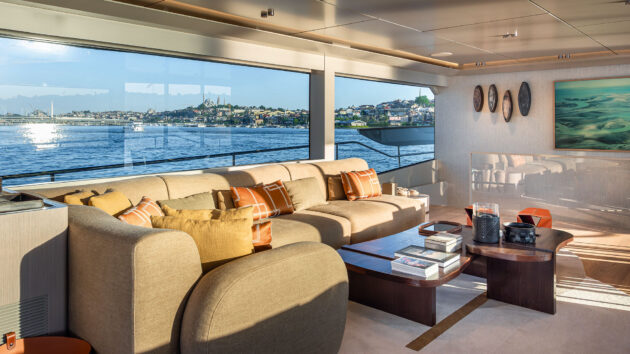
Highly developed crew routes mean the saloon can remain as private as you like
Sounds good doesn’t it but what’s particularly interesting is that, while this premium option would normally be reserved for the owner, such is the scale and privacy of the full-beam midships cabin on the lower deck that the main deck cabin – the chief party trick of so many large high-end motoryachts – would remain a VIP space. So just how good is the owner’s cabin?
Four-cabin lower deck
When you reach the bottom of the staircase, you turn right to discover a full-beam owner’s cabin of immense scale and quality. There are huge hull windows on both sides – so huge they seem to encompass the entire side wall.
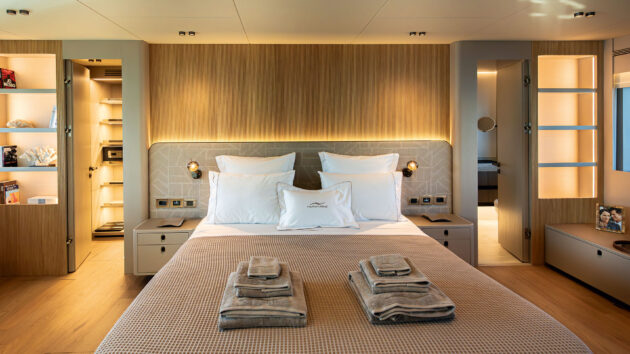
The calibre of the lighting is so striking that the vast hull windows are almost incidental
These give way to a freestanding chest of drawers to starboard and a low-slung settee to port. There are open back-lit cabinets built into the bulkhead aft of these and an oversized bed in the centre, but there’s still lots of free deck space and it’s made to feel bigger by a flat, entirely dip-free deckhead that is so lofty a six-footer can barely reach it.
As for the facilities, there are two doors in the aft bulkhead on either side of the bed. The port one leads to a big transverse bathroom with a really generous rain shower, a long tapered vanity unit and another large hull window above the loo. The starboard one provides access to a massive (and very practical) walk-in wardrobe, with drawers, shelves and hanging storage lining all three sides.
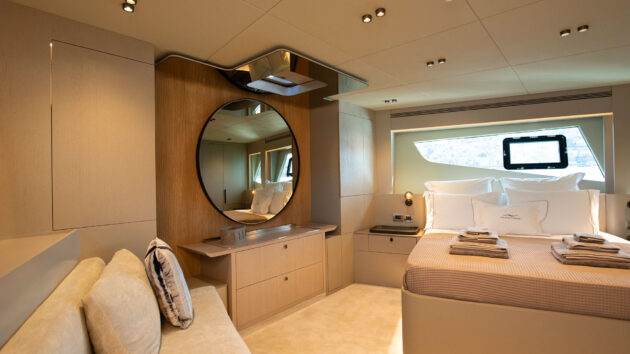
The bow cabin uses a diagonal starboard bed to open up lots of floor space
As you make your way further forward from here, beneath a beautiful, slightly undulating burnished copper deckhead that casts a lovely light on the central passageway, the space is broadly divided into three.
There’s a VIP double on the port side with another huge window, more outstanding headroom and plenty of storage neatly hidden in attractively upholstered bulkheads. The ensuite is also a really good size, and on the starboard side, the guest twin follows suit with the customary combination of light, headroom and quality finish. Playful angles in the bulkheads add extra personality to these spaces but the bow’s VIP cabin does, of course, provide just a little extra.
Slightly flared hull sides enable the 27XP to add a bit more volume forward – even more than you would tend to expect from the relatively bulbous bow of a displacement Category A explorer yacht. And when you step into the forward cabin, that volume is beautifully used with a starboard bed on the diagonal, opening up plenty of extra deck space.
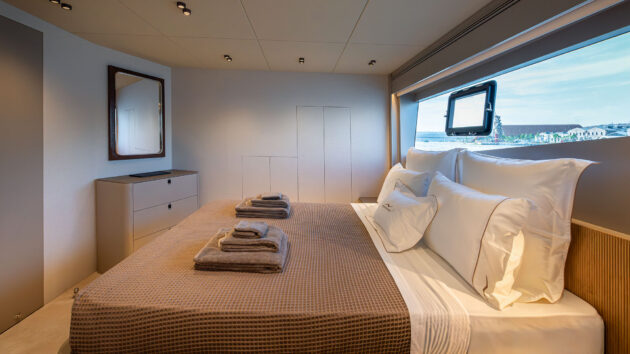
But even the guest double gets room for a transverse bed beneath the hull window
There’s also room for a casual settee beneath the window to port and that feels like a very sage design choice, given how much storage there is elsewhere.
Clean and quiet
The 27XP enables you to pick an engine rig anywhere from twin 560hp MAN diesels right up to 1,800hp units, in which case, you get a substantially modified hull to help get the best out of that.
The test boat, however, comes with much more modest twin 850s, in pursuit of refined but moderate long-distance cruising performance – and as elsewhere on this boat (from deck layouts, to furniture selections, equipment choices and finishes) – that’s part of the flexibility that makes the 27XP so custom-friendly.
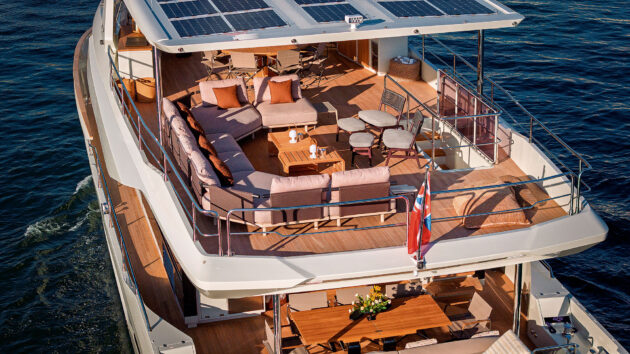
There are all kinds of ways to customise the big open decks
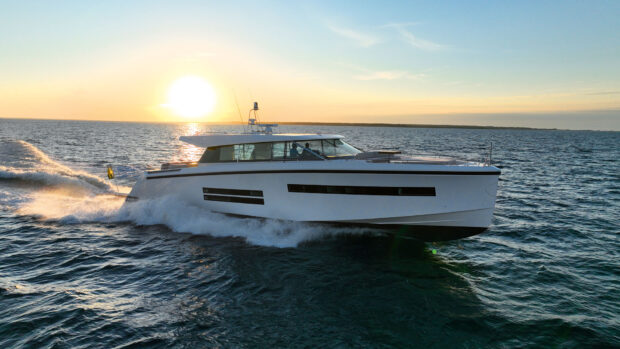
At sea, this Category A displacement cruiser appears to deliver very much what’s promised. While it tops out at a shade over 15 knots, it’s extremely refined and quiet at an 8- to 12-knot cruise. We’re seeing decibel readings pinned right down in the low 50s from the main deck helm, and even up on the flybridge, the sheer scale of the deck seems to block out a great deal of the engine noise.
The range looks pretty strong too. Just 3L per mile at 7 knots delivers around 3,000 miles and that range stays well in excess of 2,000 miles as you push on to 8 knots. In the context of the true explorer yacht, you couldn’t quite call that ocean-crossing capability, but it’s certainly not far off.
As for the handling, there appears to be no great price to pay in terms of stability for the weight of the big flybridge, nor any in terms of ride softness for the expanded sections toward the top of the hull at the bow.
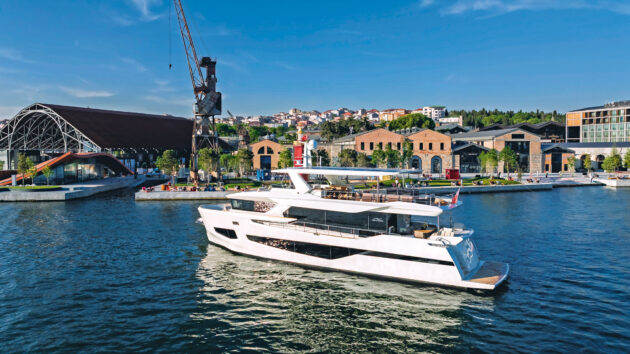
But in fairness, our test day is flat to the point of benign, so assessing its true sea manners will have to wait for much more volatile conditions than this.
Numarine 27 XP specifications
LOA: 88ft 6in (26.97m)
BEAM: 22ft 8in (6.90m)
DRAFT: 7ft 0in (2.92m)
DISPLACEMENT: 92,000kg (full load)
FUEL CAPACITY: 11,000L
WATER CAPACITY: 2,000L
CABINS: 4 or 5 plus 2 crew
BERTHS: 8 or ten plus 4 crew
ENGINES: 2 x 560-1,800hp MAN diesels
MAX RANGE: 3,296 Nm @ 6 knots
PRICE: From £6.2M ex VAT
Verdict
What a thoroughly thought-provoking boat this is. As you would expect of a yacht at this level, it’s very refined and quiet underway, and it feels distinctly premium throughout every one of its living spaces. In terms of its design intelligence, it also gets some of the best value out of its 88ft you’re ever likely to see. While the fore and aft decks are relatively short, the internal space is very generous and the flybridge is mind-bogglingly huge. This is also one of the strongest boats in its sector, both for guest privacy and for crew comfort; and with all kinds of deck layout possibilities, alongside some valuable options for the engines and the main deck cabin, it’s also a brilliantly easy platform to customise. As for its appearance, you might suggest that it’s a shade top-heavy from some angles, particularly with that big flybridge hardtop, but its attractively disruptive combination of cutaways, angles and glazing panels, still manages to lend this boat a visual appeal subtly better than its internal volumes suggest.