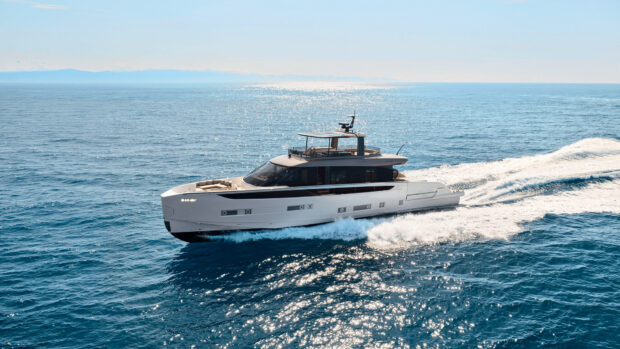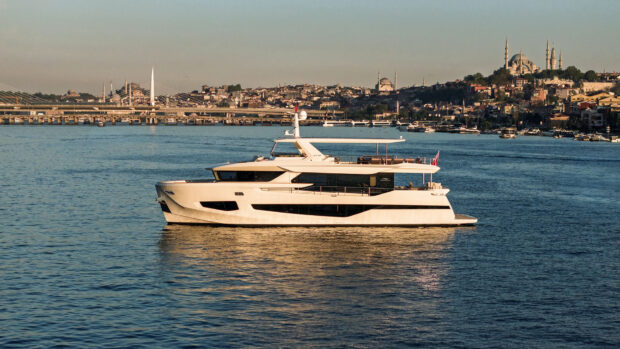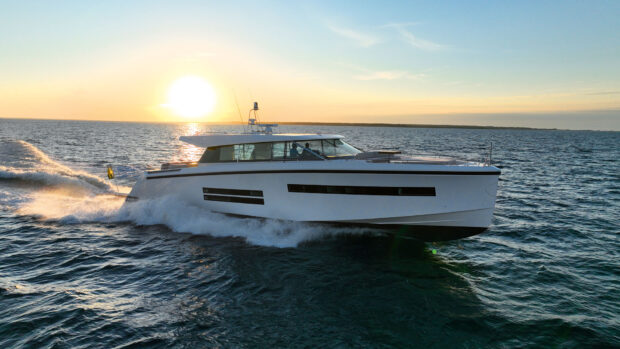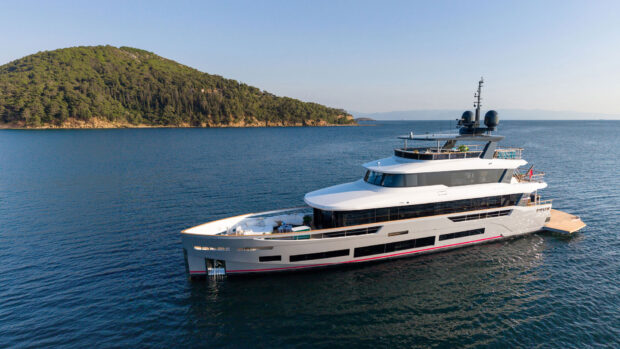


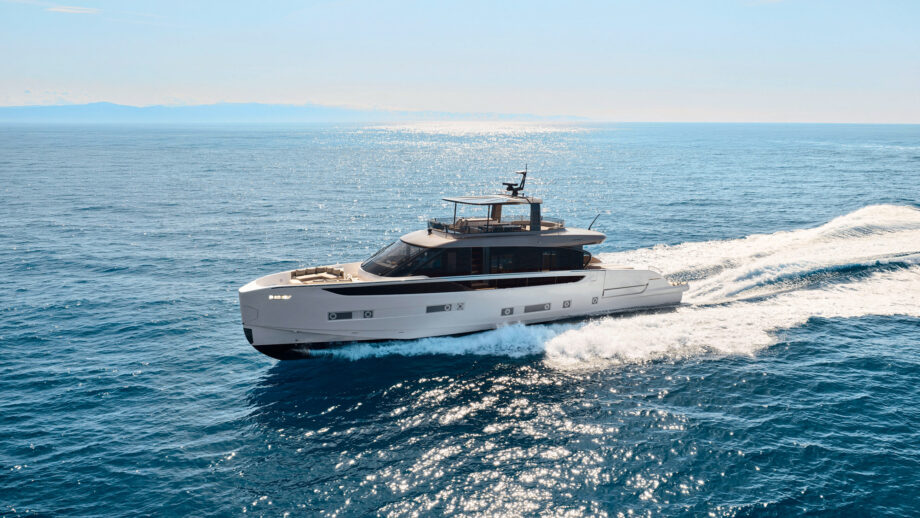
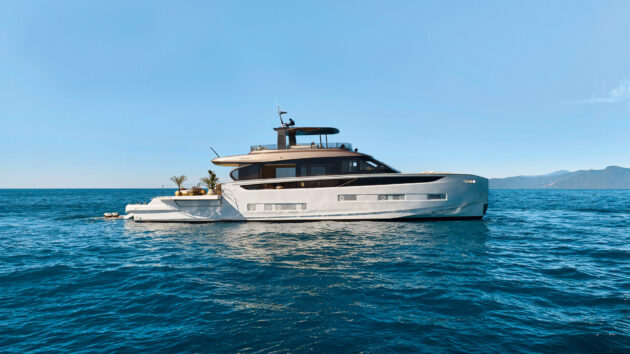
The new flagship of the Seadeck range, the Azimut Seadeck 9, isn’t just a different style of boat, it’s a different way of enjoying your time at sea
Over the past three years Azimut has quietly been replacing the previous generation of S-series sportscruisers and sportflys with a new range of Seadeck models.
Introducing a softer look with a greater emphasis on relaxed cruising and a closer connection with the water, they represent a deliberate step away from the sportier style and performance of the S range towards a gentler, more sustainable way of going boating.
This is no idle boast, Azimut went to some lengths sourcing sustainable materials for everything from the decking (cork instead of teak) to the carpets (recycled fishing nets) but most eye-catching of all was the promise of hybrid diesel-electric power.
Starting with the mild hybrid Seadeck 6 in 2024, which could run for several hours at anchor in zero-emissions mode, and followed last year with a Seadeck 7 fitted with a prototype Volvo Penta helm-to-propeller full hybrid drivetrain, Azimut is now looking to build on that with its most ambitious model yet – this Seadeck 9.

With its multiple folding platforms and features the Fun Island takes beach club design
to new extremes
Powered by triple IPS drives, it too can take advantage of Volvo’s latest D13-based IPS Hybrid package, at least it will do when it becomes more widely available. In the meantime, it’s relying on its more visible attractions to lure buyers in.
Styled by Azimut’s go-to designer Alberto Mancini with ‘eco-conscious’ interior schemes by Matteo Thun and Antonio Rodriguez, it takes the design themes introduced on the smaller models to new extremes.
With an LOA of 84ft, it’s not quite as long as its Seadeck 9 might suggest but what it lacks in length it more than makes up for in deck space because as with all Seadecks, it features a spectacular folding beach club, referred to by Azimut as the ‘Fun Island’.
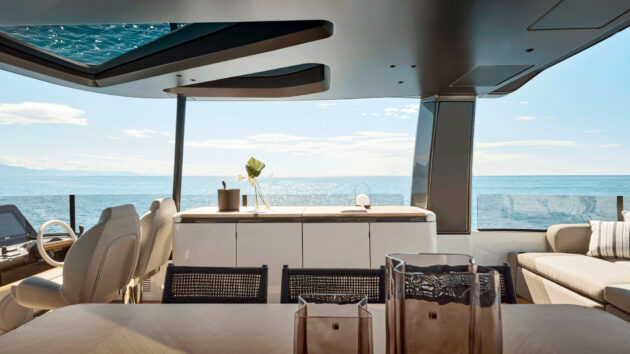
: The top deck is bigger than most sport-flys but not as large as a full blown flybridge
Pleasure island
Consisting of long drop-down platforms on both sides, a fold-out Transformer platform at the stern and a fresh water plunge pool in the middle, all of which are included in the standard specification, the Seadeck 9’s beach club covers an astonishing 60m2 of usable space.
What’s more, all that fold-out real estate only takes a few minutes to set up. Filling the 6 x 7 x 2.5ft deep pool takes rather longer, however. To save time most of the 423-gallon capacity comes from a dedicated fresh water holding tank, while the remainder is topped up from the normal freshwater tank or watermaker.
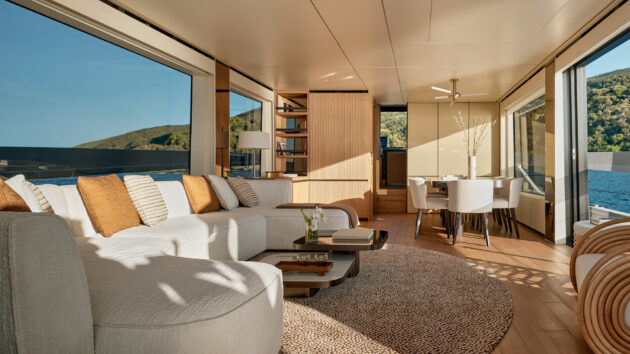
A set of floor-to-ceiling glass doors along the starboard side of the saloon open up to the elements
The only problem with the holding tank idea is that it’s located in the engine bay just above the middle engine, so, if the boat has been cruising for any length of time, the water can be rather warmer than desired.
Ditching that and filling it completely with fresh, cool water, which is what the first boat’s crew has been doing this summer due to the long European heatwave, takes quite a bit more time.
It’s also worth noting that the pool needs to be emptied before making passage and when not in use can be disguised by sliding sun-loungers over the top of it.
Incidentally there are two very large lazarette lockers either side of the pool, the port side one big enough for a PWC and lifting davit. The tender itself, up to a Williams 395, has to be stowed on the Transformer platform.
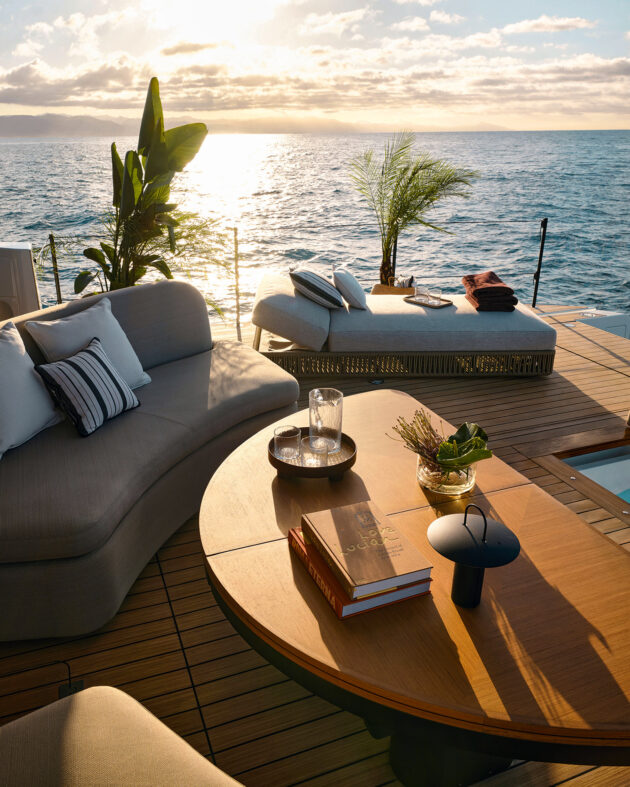
The majority of the seating faces aft to appreciate the views
If the aft beach club is the star of the show, it’s by no means the only outdoor guest space. The foredeck lounge offers another retreat at main deck level with plenty of comfortable seating tucked behind reassuringly deep bulwarks.
But it’s the top deck that takes the role of best supporting actor. While not quite as large as a traditional flybridge, it’s far bigger than the compact sportsbridges found on the previous Azimut S models.
Access to it is via stairs from the port side-deck rather than the usual position in the cockpit, presumably to avoid stealing any space from that fabulous Fun Island.
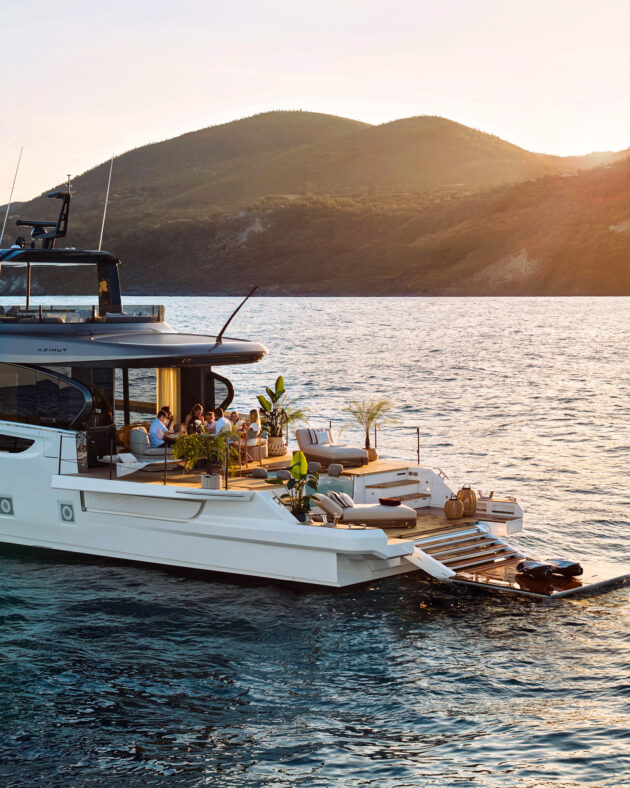
Outdoor living takes top priority on the new Seadeck 9
There’s an upper helm position with two bucket seats to starboard, a large wet-bar with the option of a pop-up TV behind it, and an eight-seater dining table to port – all under the cover of a surprisingly stylish and unobtrusive hard top. The aft end is fitted out with wall-to-wall sunpads.
Soft on the inside
Wellness is the major theme of Seadeck interiors. The vibe is contemporary calm and if we had to pick just the one word to describe it, that word would be informal. Certainly, it’s a less macho look than the rather bling, high-contrast finishes seen on some of the later S-series models, and in our opinion, all the better for it.
The saloon is the biggest beneficiary of this, making the most of the pale colour palette, textured fabrics and gently curving radii to create a more relaxed, informal vibe than would normally be the case on yachts of this size and price.
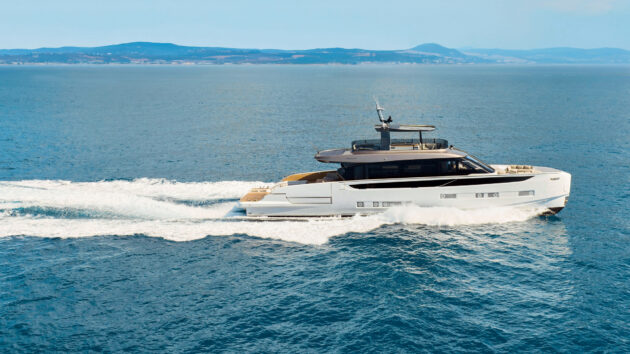
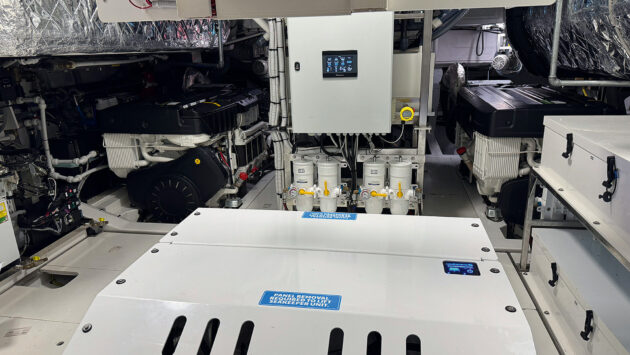
The standard triple Volvo Penta IPS drives can be upgraded to the latest IPS Hybrid diesel-electric drivetrain
But it’s the way it opens up to the elements that feels really special. Not only do the aft-deck doors slide all the way over to port, leaving a wide, step-free opening out to that spectacular beach club, but a second pair of sliding doors/picture windows along the starboard side open up onto the side deck. The result
is a wonderfully airy space that feels more like a beach-side veranda than a formal indoor saloon.
The veneer choices are either oak, as shown in these images, or walnut. Most of the freestanding furniture was either designed by Thun & Rodriguez or selected off-the-shelf by their team. There’s also the option of a 65in TV in the main saloon, which drops out of sight when not in use to avoid disturbing the holistic feel of this decidedly new-age cruiser.
Our only real criticism of the 9’s saloon is the choice of sofa to port. To the designers’ eyes the proportions are probably perfect but the seat cushions feel a little too firm and the back rest a little too low for a truly relaxed posture.
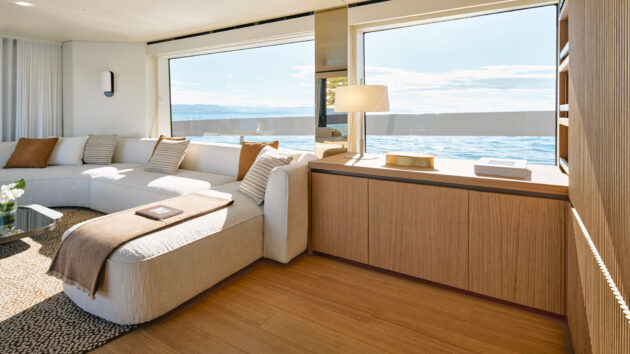
This area opposite the dining table adds to the feeling of space but also packs in lots of handy storage
The latter ensures it doesn’t block too much of the light and views from the dramatic full-height picture windows immediately behind but a sofa’s primary function is to be sat or sprawled on, not seen.
With its own side-deck door to port, the Seadeck 9’s bridge and adjacent galley can be partitioned off with a sliding door as and when required. This makes good sense on a crewed yacht when both guests and crew prefer not to be disturbed but the location of the galley might feel a little remote for owner operators when all the fun’s happening further aft.
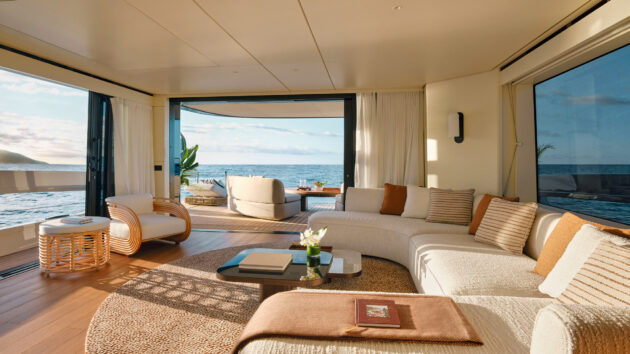
The big windows, sliding doors and low-level furniture make for a wonderfully airy vibe, although the sofa isn’t particularly comfortable to sit on
Inner sanctum
A dog-leg staircase in the forward port corner of the main saloon connects to the lower deck and a longitudinal guest corridor that’s slightly offset to port to give more space to the third cabin than the fourth.
There’s a convenient day-head at the base of the stairs and then four ensuite staterooms. The owner’s is located amidships aft and occupies the full beam. Two thirds of the space is bedroom with a forward-facing king, bench sofa beneath a nice hull window and a very useful study or vanity desk in its forward corner.
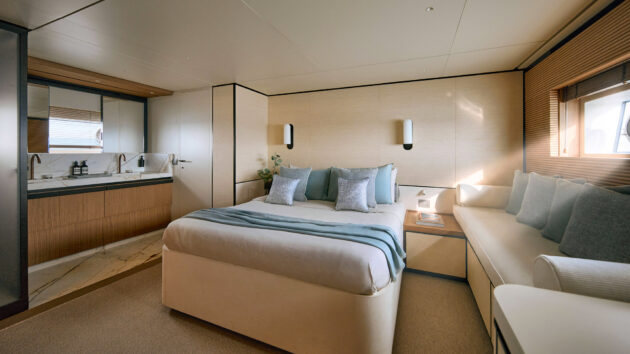
The owner’s cabin shares the beam with its ensuite that can either be left open or screened off
The starboard third is ensuite shower-room, which can be left open plan or concealed behind sliding doors. Either way the head and shower compartments have their own doors.
Then there’s a VIP double in the bows that has its double bed set at roughly 20° off the transverse and facing to port. Its ensuite is to starboard. Between those two prime cabins is a good-size double to starboard and a smaller twin to port.
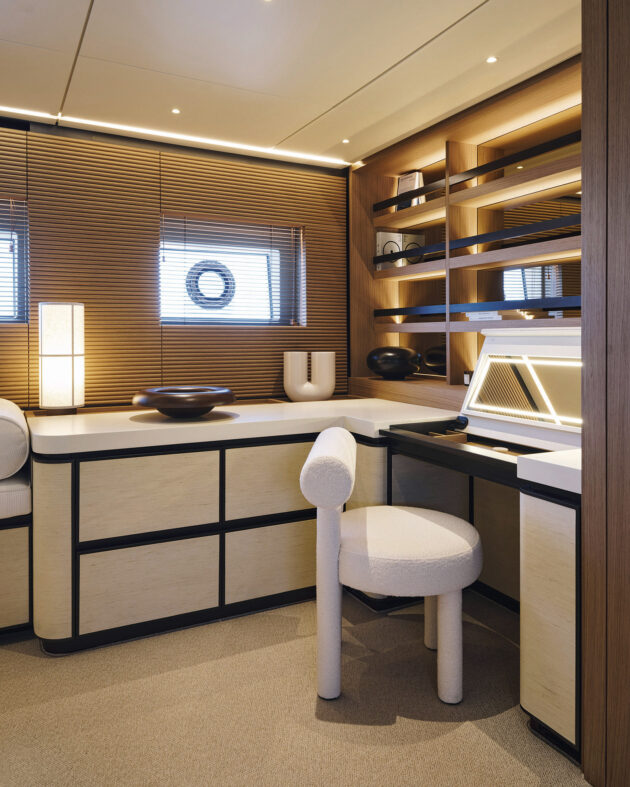
The stylish corner desk/vanity unit is a great addition
All five guest bathrooms aboard have attractive Paonazzo marble wash-tops. There are two crew cabins for up to three tucked between the owner’s cabin and the engines – a single for the captain and a twin bunk.
These are accessed from a door on the port side-deck down a narrow and near-vertical set of steps. The communal space there is all the better for a tiny square portlight with porthole, as indeed is the captain’s cabin on the opposite side. The access to the engineroom is down here too.
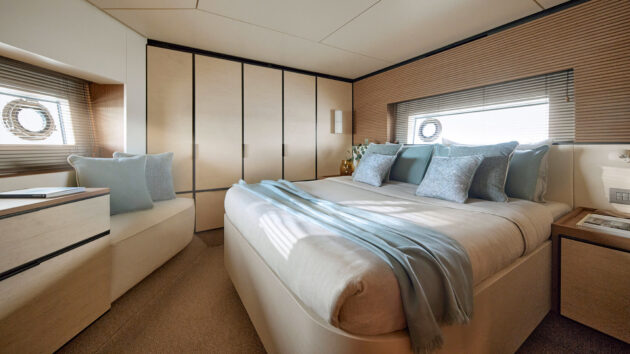
The bed in the forward VIP faces across the beam at a 20° angle
Soft power
Beyond the promise of a triple hybrid IPS option soon, plus 150 or 200KWh battery packs and solar cells on the hardtop, there are two conventional propulsion choices – either triple 900hp Volvo Penta IPS1200s or 1000hp IPS1350s. Our test boat had the more powerful option, as do all the others currently on order.
With those biggest D13s, and depending on load, the top speed is in the high 20s. Our best run was a whisker shy of 30 knots, which translates to 2,390rpm, but we were running quite light, probably at around a third load.
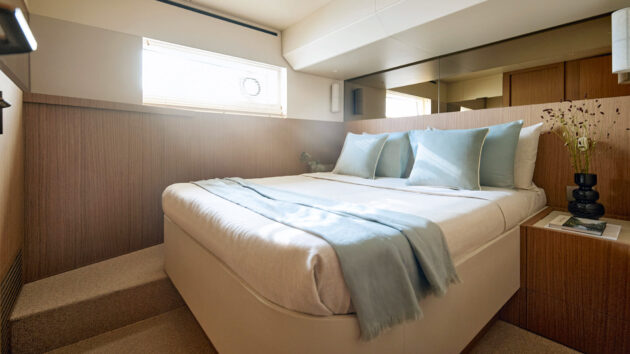
The second guest double is smaller but has a more conventional forward-facing bed
Fast 23-26-knot cruising translates to around 2,000-2,200rpm, at which a working range, allowing for a 20% reserve, would be around 250-290nm. Cut the revs to 1,000rpm and watch-the world-slide-by at 10 knots and that range should push out to more like 830nm.
Handling appears assured, although the calm conditions we experienced during our test off Varazze on a still morning were far from punishing. Visibility is fine from the lower helm.
Sustainably built
The Seadecks are built at Azimut’s headquarters in Avigliana at the foot of the Alps and at least 100-miles from the final fit-out and launch site in Savona, where their IPS pods and sport-fly modules are added once they get to the coast.
Carbon fibre and foam-cored panels keep the weight down for better handling and fuel efficiency
Like all Azimuts these days, this one has a significant amount of carbon fibre in the superstructure and foam-cored panels are used throughout, all of which helps reduce the overall weight and keeps the centre of gravity low.
In keeping with its focus on sustainability, recycling has been taken seriously. Almost a third of Seadeck interiors make use of RPET – aka recycled polyethylene terephthalate. Optional Econyl carpets made from recycled plastics are also available. And cork is the standard decking, although this one has a sustainable-teak upgrade. A lot of effort has also gone into getting the LED lighting solutions aboard just right.
A big Seakeeper 26 gyro stabiliser helps eliminate roll under way and at anchor
The 9 is certainly a quiet boat too. Cruising at 20 knots, which equates to around 82% load on those diesels, and with doors closed, we recorded just 60dB(A) at the bridge, 57dB(A) in the owner’s cabin, which has a full-beam twin-cabin crew space between it and engine-room, and 73 dB(A) in the VIP, most of which was water induced.
Seadeck 9 prices start at €6.4 million, excluding delivery and taxes. However, expect a typical non-hybrid specification to add perhaps another 30%. Major options include bigger engines and generators, a Seakeeper 26, the hardtop, a spa conversion for the pool, and potentially an Exilator system to eliminate exhaust pollution.
Oh and although the standard colour is a light cream gelcoat, we are told any colour is possible.
Azimut Seadeck 9 specification
LOA: 84ft 0in (25.60m)
BEAM: 20ft 8in (6.30m)
DRAFT: (FULL-LOAD) 6ft 2in (1.88m)
FUEL: 1,532 US gals (5,800L)
FRESHWATER: 396 US gals (1,500L)
DISPLACEMENT: (Full-load) 162,677lbs (76.79 Tonnes)
RCD CATEGORY: A
Azimut Seadeck 9 costs and options
Base price: (3xD13-900/IPS1200s) €6,400,000
Test boat includes: Engine upgrade (3xD13-1000/IPS1350) | Seakeeper 26
Verdict
Despite all the talk of hybrid power when the Seadeck series was launched, no production versions have yet been delivered with a full hybrid drivetrain, largely because Volvo Penta has only recently made its IPS Hybrid drives available. Not that this has prevented Azimut from selling plenty of regular diesel-powered Seadecks – around 30 Seadeck 6s and 20 Seadeck 7s have been delivered to date. We’re told that the order book for the Seadeck 9 looks just as healthy. That’s because there’s far more to this boat than just clever tech. Its Fun Island beach club is in a different league to anything else in the class and while not everyone will buy into its softer looks and sustainable messaging, there’s no doubting the appeal of that single-level main deck with its wide-opening doors, floor-to-ceiling windows and relaxed indoor/outdoor vibe. Whether customers will pay a premium for the hybrid version on top of what is already quite an expensive 84-footer remains to be seen but, with or without it, the new Seadeck 9 is already a very enticing package.