

Motor Boat & Yachting's resident skills expert, Jon Mendez, walks us through proper use of a liferaft
Liferafts often provoke plenty of discussion among boat owners. In an ideal world we’d all have one stowed on board just in case, but the reality is that the size, weight and cost of a liferaft can prove off-putting for owners of smaller boats.
The decision of whether to carry one or not is usually influenced by the size of the vessel, your boating location and the type of trips you like to make.
If most of your boating is local, where help is never far away, but you like the idea of occasional longer trips further afield, one option could be to hire one as and when you need it.
There are two basic types of inflatable liferafts – canister or valise (a type of soft carry bag). Canisters are designed to be permanently mounted on the exterior of the boat so they need somewhere strong enough to carry the weight of the raft, the frame and the mounting hardware.
Valise ones are usually lighter but take up valuable locker space and are more easily damaged by other items stowed on or alongside them.
Most rafts are designed to be mounted or stowed a certain way up, so if placing it in a cradle, check with the manufacturer which way this should be as the weight of the gas bottle used to inflate it can damage the contents if left in the wrong orientation.
Article continues below…
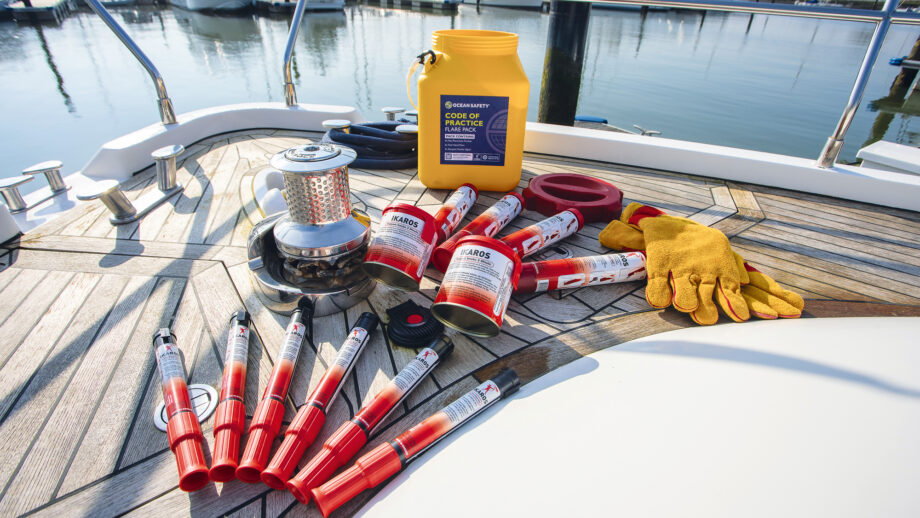
How to use (and store) flares on your motor yacht
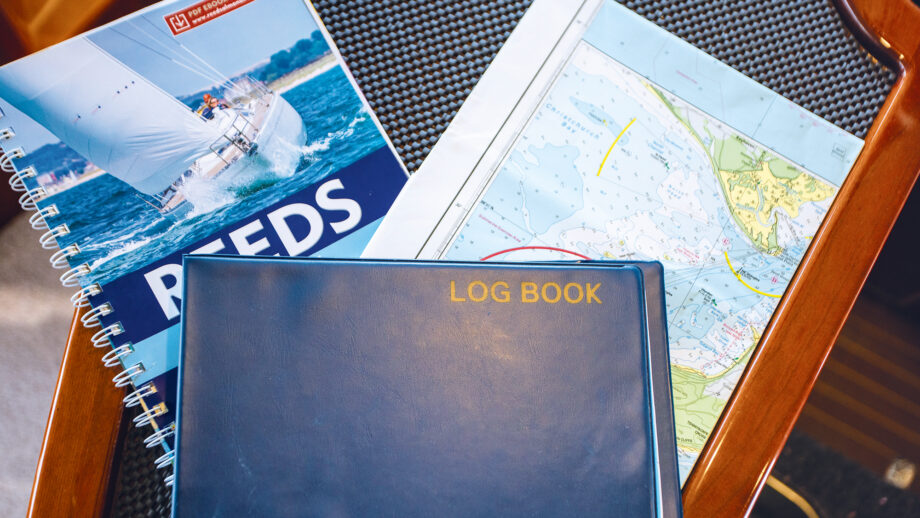
How to stay safe and legal on the water (and why logbooks still matter)
If stowing a valise liferaft in a locker, choose the location carefully. It needs to be as accessible as possible but also away from any risks. The aft cockpit is an obvious choice but that could place it over the engines and make it vulnerable to an engine fire.
If placed in a deep locker, would you or your crew be capable of lifting it out in an emergency? Extra lifting straps could make it easier.
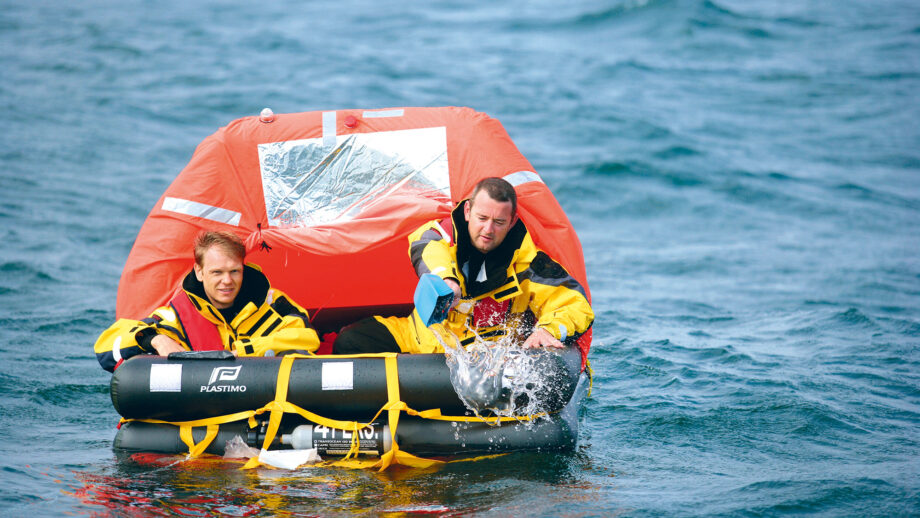
Liferafts are a last resort item; it’s much easier to spot a large boat than a small raft, so only board one if your boat is about to sink or is on fire. That said, it’s worth considering where you would launch your raft from and how you would get in it before you need to use it in anger.
The launch position can never be set in stone, as in the event of a sinking you should try to ensure it’s on the downwind side of the boat, so the wind is holding your vessel against the raft.
However, in the event of a fire then you want the upwind side for obvious reasons. As is so often the case, my best tip is to attend a Sea Survival training course, where you’ll get the chance to launch and board a liferaft in a safe, controlled environment.
All professional boaters have to complete a refresher course every five years. Attending one of these courses just once could literally save your life.
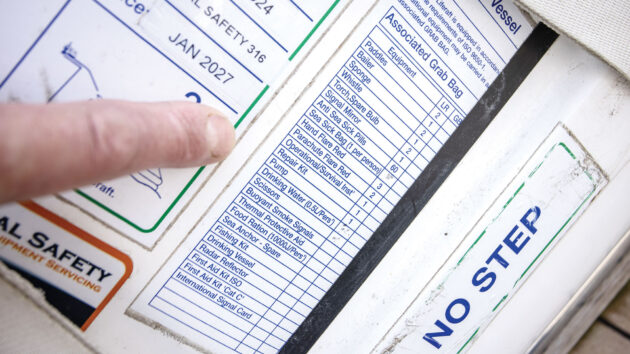
Raft spec
Check the raft’s contents and painter line length are right for your needs. This is an eight-person, SOLAS B pack that lasts for up to 24 hours, with an 11m painter and a service date of Jan 2027. The pack’s contents are shown on the outside.
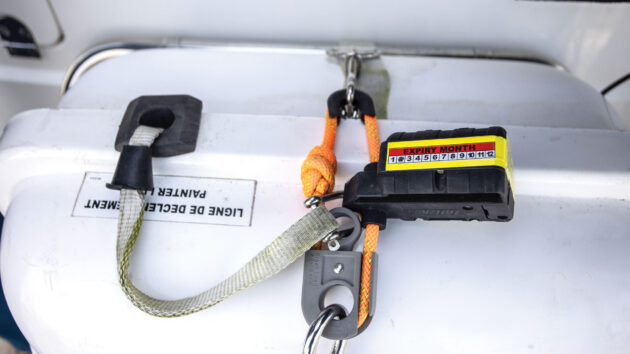
Auto release
If you’re using a deck-mounted canister, it’s sensible to attach it with a hydrostatic release that lets the liferaft float free on contact with the water. The liferaft painter MUST be attached to the weak link on the hydrostatic unit.
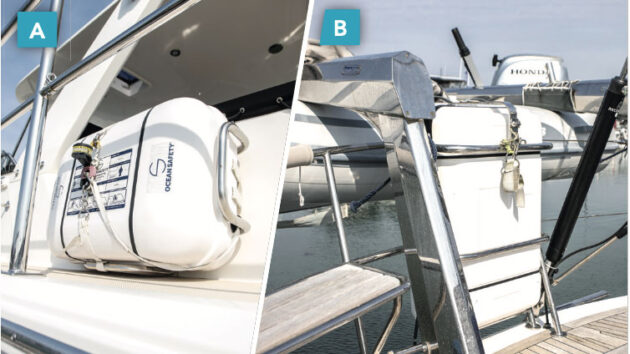
Good locations
Example A is an excellent location as it’s mounted on the flybridge of a motorboat, complete with a hydrostatic release. Example B looks like a good location but it’s manual release only and would be hard to lift out.
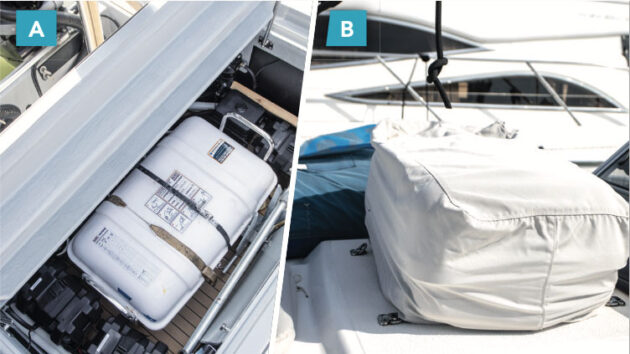
Less good
Example A – top marks for carrying a liferaft, but stowing a heavy 10-man raft deep in a locker will make retrieval tricky in an emergency. Example B – it could take valuable time to remove the cover from this liferaft.
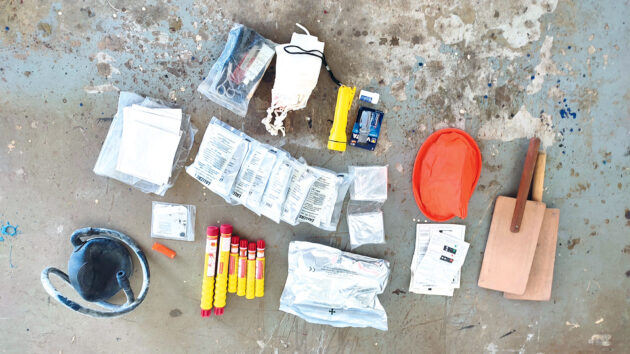
Liferaft contents
The contents of a raft: flares, drogue, paddles, instructions, repair kit, pump, first aid kit, plastic bags – for water or other liquids – sponge. Some come with water and food. Leisure ones are very basic.
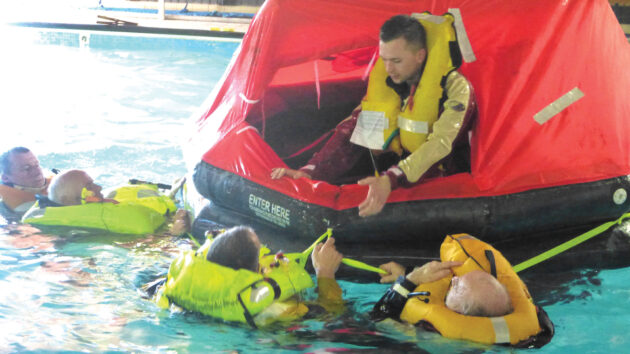
Sea survival course
If you are going to carry a liferaft then I highly recommend attending one of the RYA’s one-day Sea Survival courses. You will learn a huge amount of useful information and get the chance to put it into practice – vital for the safety of you and your crew.
 If you enjoyed this….
 If you enjoyed this….
Motor Boat & Yachting is the world’s leading magazine for Motoryacht enthusiasts. Every month we have inspirational adventures and practical features to help you realise your sailing dreams, as well as tests and news of all the latest motorboats.
Plus you’ll get our quarterly Custom Yachting supplement where we share the last on offer in the superyacht world and at the luxury end of the market.
Build your knowledge with a subscription delivered to your door. See our latest offers and save at least 30% off the cover price.
Note: We may earn a commission when you buy through links on our site, at no extra cost to you. This doesn’t affect our editorial independence.