

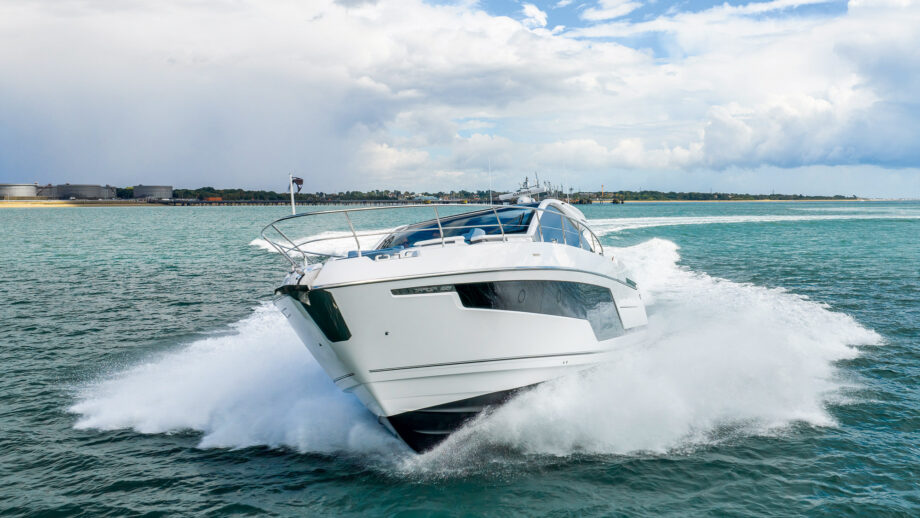
Can the new flagship Targa really combine the best of open and closed boating on a single platform?
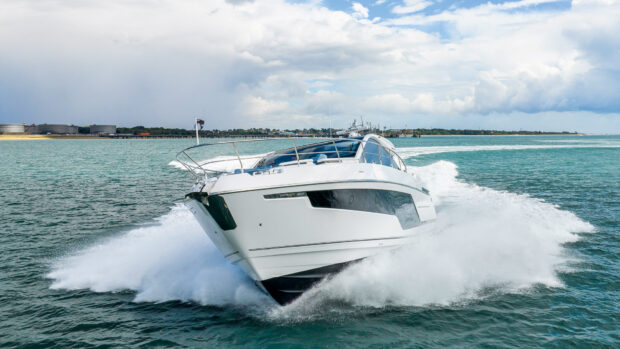
This new Targa 58 GTO was always likely to look even prettier than the Squadron 58. Just removing the flybridge is a surefire way of achieving that. But as we stroll down the pontoon at Shamrock Quay in Southampton, it’s tough not to be taken with the styling of this thing.
The raised hull sides drop the relative height of that low-slung coupé superstructure, providing a hunkered profile that becomes all the more predatory thanks to a set of unusual (and entirely new) ‘haunches’ at the aft end of the sheerline. It’s a great-looking boat and, as we arrive at the transom, it’s clear that it means business in terms of boating versatility too…
We’re told that this boat has a dual personality and to really understand what that’s about, it’s useful to take a look at the smaller Targa 47. That comes either as a traditional Open sportscruiser or as an enclosed GT model.
Here, however, we don’t have (or apparently need) that choice because on the 58, it’s all achieved by the one boat. With the Targa 58’s superstructure terminating 100mm further forward than the Squadron model and the engines being positioned about 90mm further aft, Fairline has created space in the engine room for the aft door (and the two side windows) to simply drop down, beneath the deck, entirely out of sight.
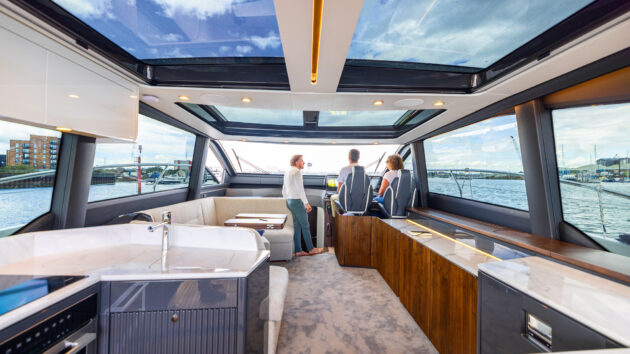
The deck arrangement lavishes a tremendous amount of space on the aft cockpit
That enables you to turn this boat from a comfortable cruise-friendly four-season coupé into an open sportscruiser at the push of a button – well, at the push of three buttons if we’re being pedantic.
Fairline has been diligent in nailing the potential benefits of that too. In addition to the fact that the angled aft threshold naturally blurs the boundary between inside and out, the L-shaped galley straddles those zones to such excellent effect that the external element feels like an integrated part of the whole rather than a separate wet bar.
Part of that, of course, is down to the disappearing windows and doors, but it’s also down to the single-level deck, which remains teak-lined on the inside until the step up to the main part of the saloon. It’s also down to the physical and stylistic continuity of that galley.
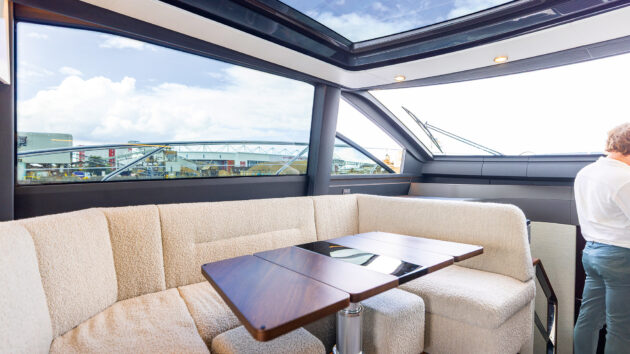
The hi-lo twin-leaf table and roving seat pods are a very useful upgrade at the saloon dinette.
From worktop height and material choice to cupboard design and the fluted finish of the doors, it’s all conceived to eradicate any sense of boundary and it really does work.
Big boat beach club
This deck arrangement also lavishes a tremendous amount of space on the aft cockpit. It encompasses 207sqft and, with the optional side terraces dropped down, that increases by 42% to 290sqft. Not only is that much bigger than the Squadron 58, but it’s also bigger than the Phantom 65 – and when you look more closely, it’s clear that Fairline has done everything it can to make all that space feel like the open-decked beach club of a much larger luxury motoryacht.
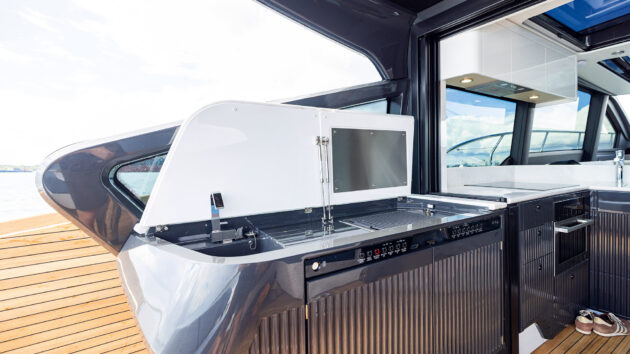
The indoor galley links up seamlessly with the wet bar once the doors and windows have dropped out of sight
For a start, there’s an open “waterfall transom” that sees the teak-lined full-beam steps tumble down from cockpit to bathing platform in extremely elegant fashion. There’s also a central sunbed, that projects out over the large high-low platform, with a reversible backrest so you can lounge looking out over the sea.
In spite of a rather formal and beautifully lacquered fold-out table with some very classy marquetry at its hub, the cockpit seating section is pleasantly casual and low-slung, with an aft bench that faces forward towards a very well conceived L-shaped seat that nestles in the lee of the superstructure’s elegant glazed side extensions.
Even the crew cabin and tender garage collaborate in the Beach Club fun. The single crew cabin/day heads, for instance, is accessed beneath the steps on the starboard side of the sunbed. But in a move of remarkable design clarity, the lowest step stays put when you hinge up the door, creating a natural lip that prevents water ingress so you can leave it open at anchor for easy access during the day.
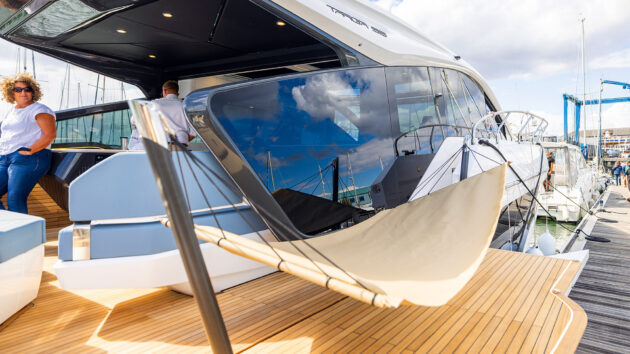
You can opt for up to three hammocks and upgrade the tender garage/beach club with a fridge, shower, speakers and stereo remote
There’s a single bed running fore and aft in here with a clever recess above it that increases headroom by an extra couple of inches. There’s also easy access to the main electrics panel, which means you don’t have to mess about in a hot and humid engine bay.
As standard it is supplied as a basic storage lazarette but you can upgrade it with just the heads and sink or opt for full crew cabin fit-out; a worthwhile choice that should boost resale values.
There’s no room for a shower in the day heads but that’s where another trick makes itself known. Hinge up the sunbed and the big garage is much more than it seems.
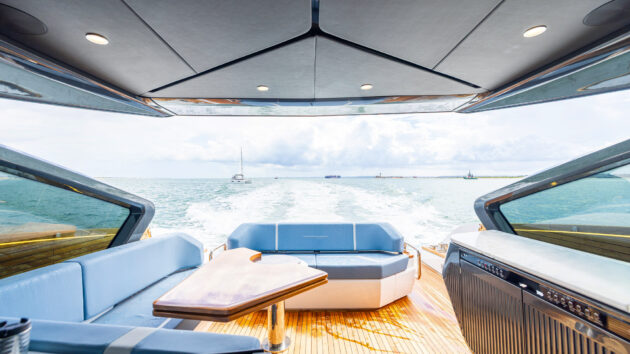
A tapered roofline and glass side panels provide shade and shelter without blocking the view
Yes, it’s a storage space for a tender and a Seabob if you choose to use it that way, but it’s also a sheltered beach club lounge, perfect for freestanding furniture to face aft over the swim platform – and the fit-out really nails that look too. In addition to a seamless continuation of the flat teak decking, you get a plush deckhead lining up above with inset LEDs, plus the option of a 30L fridge, a stereo remote and a set of integrated speakers.
There’s also a big panhead rainshower built into the underside of the garage door, which is as useful for occupants of the crew cabin as it is for swimmers. You can even spec up to three hammocks for the ultimate laid back vibe – one on each side deck and another on the aft platform. That’s most likely ‘inspired’ by Saxdor’s devilishly clever new 460 GTC but it’s no less fun for that.
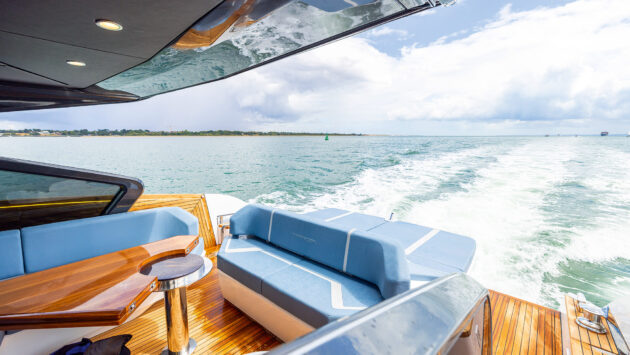
The folding table is shaped to ensure there’s plenty of space for guests to move around freely whether open or closed
Now, as intimated, you could certainly fill this space with a Williams 325 jet tender (or even a 345 with deflated tubes) but there’s undoubtedly a case for keeping it on the hydraulic platform instead and launching it into the water as soon as you drop anchor, so you can avoid cluttering up the beach club with the straps and rails necessary for tender deployment.
However you choose to use this aft end, you still get a very worthwhile bow lounge for eight, comprising a wraparound aft bench and a forward island sunbed, plus the same integrated fold-away table as we’ve seen in the past from Fairline.
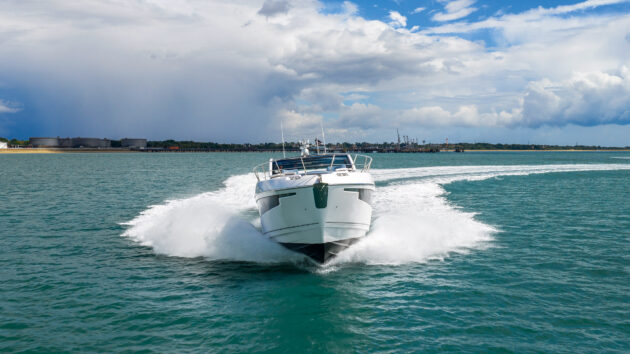
The trim tabs are handy for pinning the bow down but they’re largely redundant in terms of windage correction
Inside story
Step inside (or should we say less outside) and the upper section of the saloon trades the teak deck for carpet and a deep, indulgent port dinette. It comes as standard with either a dining table or a coffee table but the optional high-low two-leaf unit fitted to the test boat covers all the bases.
The roaming seat pods are also very useful. They simply pull out into the walkway, upping the seating capacity to eight without obstructing the flow of traffic at all.
Across on the starboard side, a long cabinet fills the space between the galley and the twin helm seats. You can replace the forward part of that with an inward-facing two-man settee but the test boat cabinet is very well used.
There’s a dedicated space for your crockery; an under-counter wine cooler; an optional fridge forward and a lovely lit cabinet for all your glasses. There are also two TVs over here – a large pop-up one in the back of the cabinet, in easy line of sight from the dinette; and another that lifts from the aft worktop and swivels through 180 degrees, so you can view it either from inside or outside.
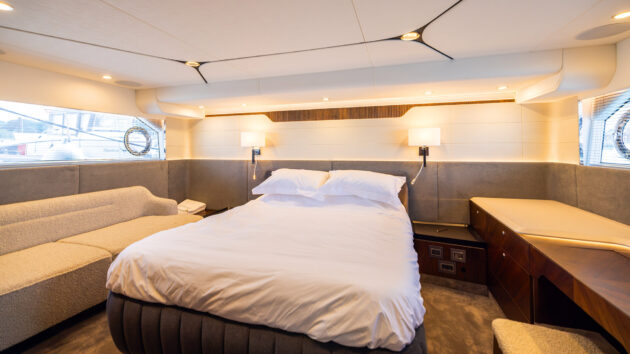
In spite of the fact that the owner’s cabin butts up against the engine room, it’s the quietest place on the lower deck
As for the cabin arrangement, that’s much the same as on the Squadron 58. It involves a full-beam owner’s mid cabin that butts directly up against the heavily soundproofed engine room bulkhead.
The owner also gets a very decent port ensuite but the other two cabins (the forward VIP and the starboard guest twin) share the second bathroom. As on the Squadron, the VIP comes with the option of scissor berths and the fact that you get a mixture of curved and subtly angled bulkheads and a staggered central corridor adds much more interest to the arrangement than the three-cabin two-bathroom layout suggests.
Whether the relatively understated mixture of wooden and upholstered bulkheads with steel accents feels as diverting as you might see from the finest Italian brands is open to debate. But again, there are plenty of thoughtful design touches down here, not least in elements like a recess in the bulkhead that swallows up the door handle, so you can open the owner’s door that little bit wider.
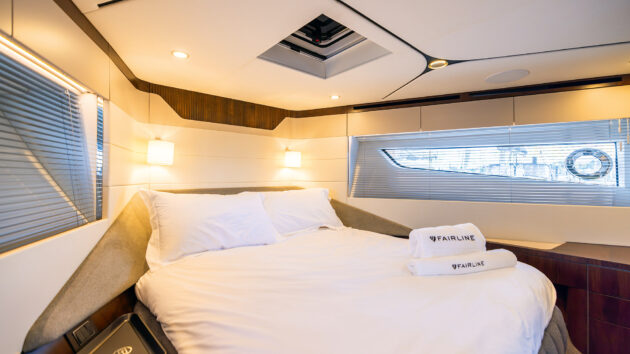
: You can spec the VIP cabin with scissor berths instead of a fixed island double
Small boat agility
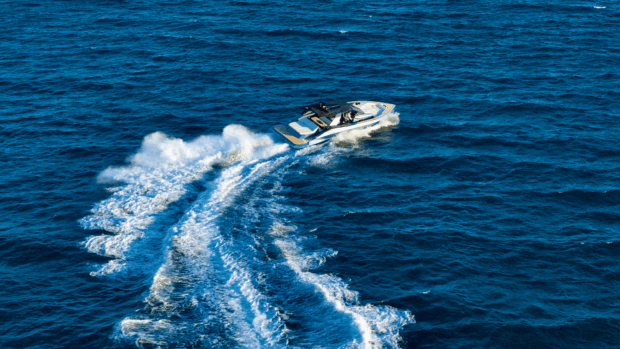
You can have one of two engine rigs – either twin Volvo Penta D13-900s or the test boat’s D13-1000s. They’re positioned a decent way forward on straight shafts and, while Fairline quotes a 32-knot top end, we’re seeing closer to 33 knots on the day – and that’s with 3ft seas, a lively wind, relatively full tanks and eight people on board.
Given the reduction in overall weight, as well as the reduced windage and the lowering of the centre of gravity, you would expect this flybridge-free model to add a degree of handling vigour that the Squadron lacks and it does that too.
The tracking is true, the turning circle is tight and what use we find for the tabs is more to do with pinning the nose under power than adjusting the lean to compensate for the wind.
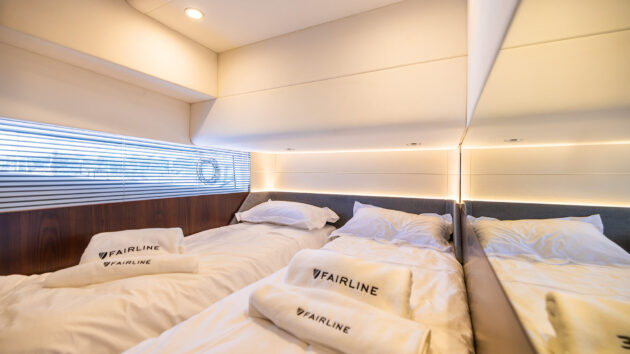
While the guest twin is pretty small, headroom, light and views are all strong
When we execute a faster turn, the heel is equally pleasing. And if the turn-in feels like that of a smaller boat, so does the recovery from the heel when you straighten up the wheel.
As we charge at 30 knots through 3ft seas with torrential rain hammering down, there is some wetness splashing in from what appears to be a little drainage gulley beneath the skipper’s side window – and that will of course be remedied.
But as for the two-man helm station, that’s a lovely piece of work, particularly given the ergonomic awkwardness of the helm unit we saw on the original Targa 47 Open.
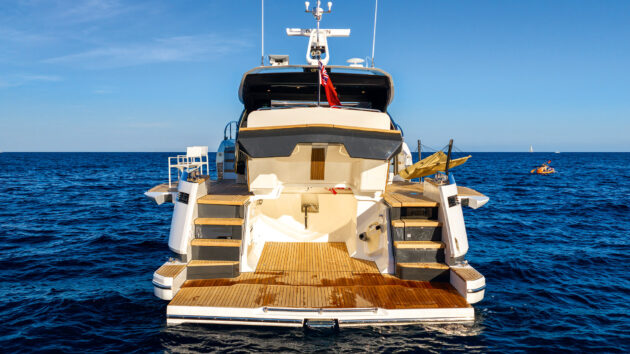
With its ‘waterfall’ transom, beach club tender garage and drop-down terraces, it feels like the aft end of a significantly larger boat
Here, the seats adjust up and down and fore and aft. The wheel is also adjustable and there’s a foot brace available to you whether you’re sitting or standing. Better still, there’s a ledge between the seats that puts a joystick and MFD remote directly in your right hand, so you can sit back and relax on a long passage or shift yourself forward and get right up close to the dash-mounted controls.
The triple MFDs have also been mounted at a much steeper angle, reducing glare and reflections from the big overhead sunroof. And while the windows on both sides are usefully deep for uprated visibility, they also drop down so you can communicate with crew. In short, what felt like a conspicuous weakness on the Targa 47 has become a very conspicuous strength on the 58.
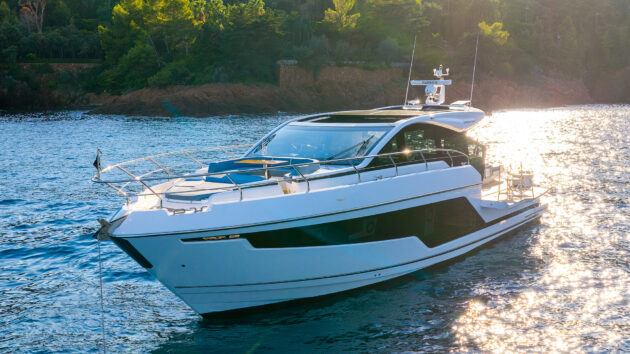
Good though it is to drive, this is a boat that’s designed to excel at anchor
Fairline Targa 58 GTO specifications
LOA: 58ft 11in (17.98m)
BEAM: 16ft 4in (4.99m)
DRAFT: 5ft 0in (1.52m)
DISPLACEMENT: 26,500kg (light)
FUEL CAPACITY: 2,800L
WATER CAPACITY: 700L
ENGINES: 2 x Volvo IPS-1350 900hp / 1,000hp diesels
Fairline Targa 58 GTO costs and options
Price: from £1.68M ex VAT. Test boat includes the following options:
2,000hp engine upgrade
Drop-down terraces
Aft deck leisure upgrades
Adjustable saloon table
Hammock
Crew cabin
Verdict
This is a fun, sexy boat with fine looks and plenty of practicality, both for year-round cruising and sunny-weather day trips. It’s highly thoughtful in terms of the design too – so thoughtful, in fact, that we haven’t had time to list all the stuff we enjoy. We haven’t mentioned the new step that gives you easier access to the helm position; or the coloured stitching on the inside of the dash, so it doesn’t discolour when people steady themselves on the way down the stairs; or the pneumatic sunroof seal that prevents leaks and secures in whatever position you fancy; or the dedicated slot for the sink lid; or the pop-up storage box in the corner of the galley; or the trough in the anchor locker that keeps your lines and fenders separate from your chain. We could go on but we’re sure you get the picture. It’s a class act and with base prices going from a shade over £1.68 million ex tax (and our high-spec test boat adding another £800,000 to that), it’s priced accordingly. That base price is, in fact, broadly comparable to Sunseeker’s latest Predator 55, so if you want both the comfort of a GT and the openness of a sportsboat, alongside a Beach Club arrangement that could easily grace a much larger yacht, do yourself a favour and give the Targa flagship some serious consideration.