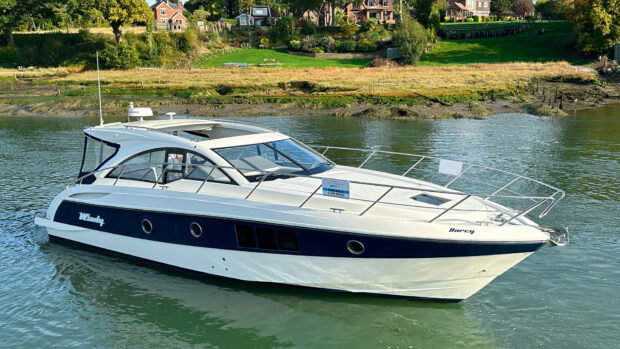

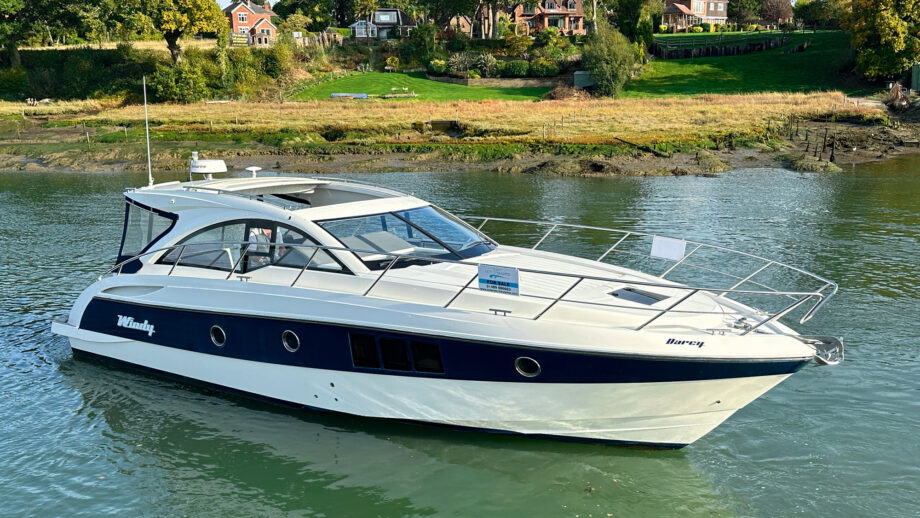
Fast, ultra-capable, and hitting 43 knots, the rare Windy 40 Maestro remains the definitive driver’s sports cruiser on the used market
Very few brands excite the keen driver to the same degree as Windy. This Norwegian yard has always excelled in building fast, sharp-handling boats that can cope with seas way beyond their size. Born from necessity, Scandinavian boats tend to be strong sea boats, but Windy has always had a zero-compromise flavour of its own.
The 40 Maestro replaced the formidable 37 Mistral, a boat with a pedigree stretching back to 1998 that sold more than 200 worldwide. Though the 40 kept the same rakish 23-degree deadrise, it was not just a hull stretch job.
The Maestro gained seven inches in the beam, 2ft 6in of length and 1.8 tonnes in displacement, while keeping that signature deep vee hull and sharp forefoot.
As early proponents of resin infusion, Windy built a new plant in Sweden for this boat’s construction and, by using this layup, it claimed a 30% reduction in weight with no loss of strength. Considering how few comparable 40ft sportscruisers can match her 7-tonne displacement, that doesn’t sound unreasonable.
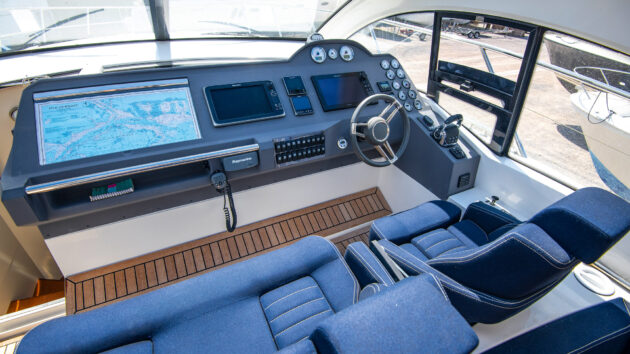
Helm design is close to perfect with adjustable seats, ideal ergonomics and a clear dash layout
According to Berthon, who were Windy importers during its 11-year production, only six were sold in the UK. However, these low sales figures are more a reflection of economic forces rather than the boat itself. Following the 2008 financial crisis, the jump in price from £306,000 for the 37 Mistral to £374,000 for the 40 Maestro was too much for many.
The owner’s view
David Watson, whose boat is featured in this article and is for sale with Solent Motor Yachts, bought the boat for weekend cruising with his wife. From a skipper’s perspective, he finds the seakeeping reassuring.
“Whether you are running into a head sea or running with the weather on the stern, she cuts through with ease. Getting caught was never a problem, as you know you’re always going to get home safely,” he told us.
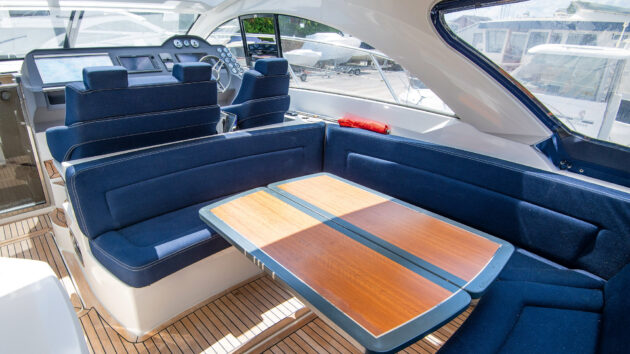
Simple cockpit layout works well with lots of forward-facing seating and a sociable dinette
His previous boats, a Fairline Targa 43 and an Absolute 39, didn’t stack up against the Windy in terms of their sea manners. While he does feel that the stern thruster is overkill, one aspect he particularly loves is the easy engine access.
As he puts it, you simply “press a button and you’re straight in.” He also had an extra triple battery bank fitted in order to supply a 240V inverter, increasing his autonomy and reducing the need for shore power. They did quite a bit of on-board socialising where the big cockpit proved its worth, as did the Eberspacher diesel heating. However at 84, David now feels it’s time to pass the torch on to a younger skipper.
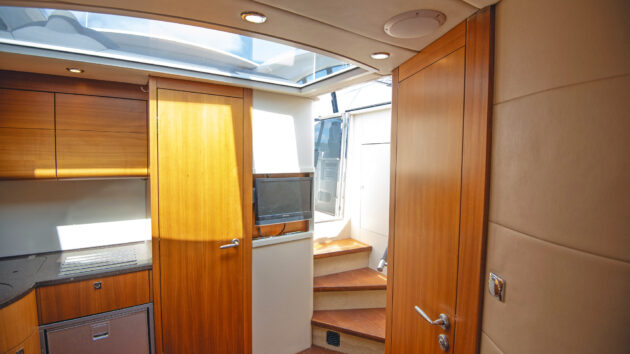
Large skylight and multiple hull windows ensures the lower deck is filled with natural light
Engines & performance
Engine options were all twin Volvo DPH sterndrives; either 300hp D4s, 370hp D6s, or 400hp D6s . According to Berthon, of the six boats sold in this country, five had 370hp D6s, and one was specified with 400hp D6s. The 400hp D6 was available late 2011, so you might expect this engine to have eclipsed the 370hp D6. However, the super-efficient hull produced 43 knots with just 740hp, so few forked out extra for the 45-knot top speed of the 400hp D6s.
The D4s were a non-starter, as at £20,000 less than D6s in 2010, no UK customers were willing to cut corners on a boat of this dynamic ability for such little reward.
When MBY tested the Maestro in 2010 we recorded a 43-knot top end and a cruising speed of 30 knots, when the boat was just starting to get into its stride. Impressively, the Maestro hit 20 knots in just over five seconds and 30 knots in just under ten.
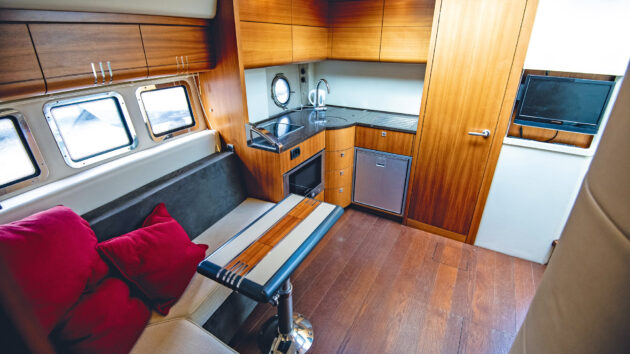
Compact galley is fine for brunch duties but may struggle on longer cruises
Economy is another Windy strong point and the Maestro didn’t disappoint, returning 1.8nm per gallon at 30 knots, 1.6 at 37 knots and 1.25 at 43 knots. This is very close to the consumption claims recorded by Windy itself.
Handling and sea keeping are equally important for most Windy owners and once again the Maestro lives up to expectations.
It runs with excellent natural fore-and-aft trim, only requiring a little extra angle on the sterndrives for those last few knots.
Bar the exception of a beam sea, very little input is needed on the trim tabs too. Running into tight turns does not require a change in leg trim, as the hull hangs on perfectly while tracking round, and composure in large and confused seas is equally confidence-inspiring.
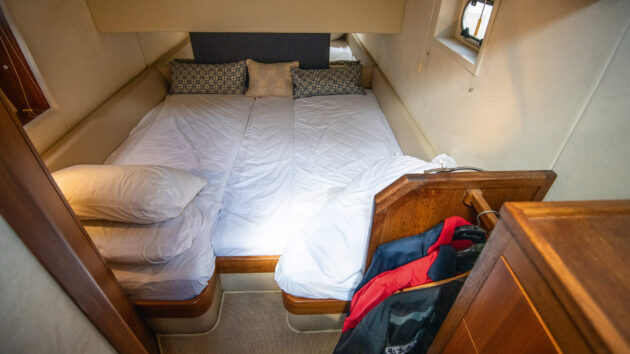
An infill turns the mid-cabin’s two singles into a wide double bed but headroom is limited
The helm station also reflects the emphasis Windy places on the driving experience. It encourages you to sit rather than stand and even then, the view from the four-way adjustable seat is perfect.
If you want to stand, you can do so but you need to pop your head out of the sunroof due to the limited headroom when closed. The primary gauges are paired together on the starboard side of the wheel for easy checks. On the port side, a wide non-reflective dash is ideal for modern arrangements with multiple MFDs.
Points to consider
Bearing in mind what this boat is capable of in terms of sea keeping and performance, the results of spirited driving need to be considered. Though strongly constructed, evidence of stress cracking is something to look for, especially with well over a decade of use, as well as operation and condition of the canvas sunroof.
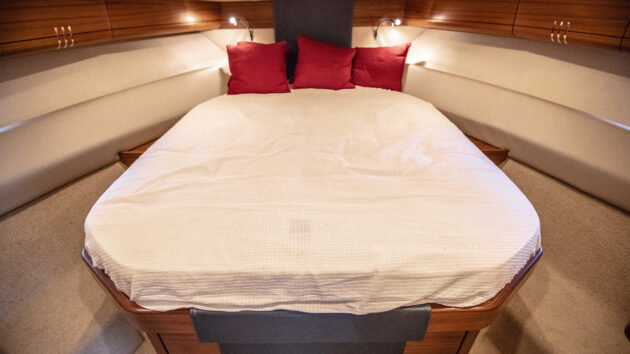
The forward cabin has better headroom and storage as befits its master cabin status
Depending on conditions, the Maestro can also suffer from spray entering the rearmost part of the cockpit at speed, so scrutiny of the aft bench upholstery would not go amiss.
The engines and stern gear are obviously a point of interest. Extensive service history is important, and running the engines to full operating temperature on sea trial is needed to make sure there are no overheating problems.
Internally rusted or partially blocked heat exchangers that are ten to 15 years old, will quickly make themselves felt. DPH sterndrives and Volvo’s nickel-bronze-aluminium props can suffer electrolysis without regular anode changes. Depending on location and time in the water, this could be twice a year.
Internal wear and tear on the drives themselves, notably bevel gears, and externally the steering linkages, is also worth thinking about. The D6 is renowned for its low-down torque, which takes its toll on any sterndrive, especially when powering out of tight turns, so plenty of boats are fitted with steering tie bars.
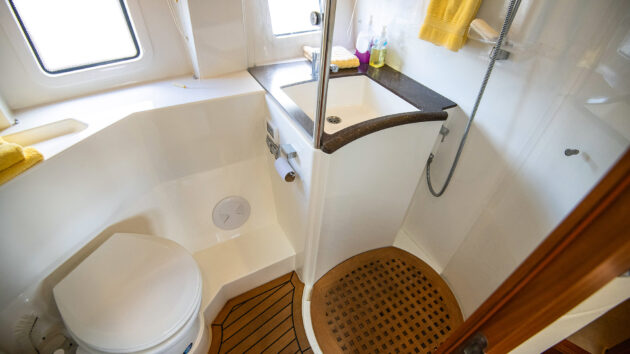
The shower and sink can be shut off with a sliding circular screen
The key option for a UK boat is cockpit heating, as limited saloon space below means you will likely spend some of your evening up top. Joinery options are maple wood or matt cherry wood. Decking can be teak, though Windy offered molasses-baked maple as part of its ethical build policy.
In terms of hull colour, the normal UK/Scandinavian options were white or white with a blue band. For boats heading to the Med, there was a range of more daring custom-sprayed colours as an alternative.
Options, extras
The deck design is based on a simple but large cockpit which provides a big dinette area, converting to a sunbed with an infill. A wet bar sits on the port quarter with sink and fridge, and storage lies under the seating, companionway and port cockpit bulkhead.
Windy has not crammed a tender garage onto this boat so the cockpit, bathing platform and engine access points are all pretty strong. It does make you wonder about the credibility of garages in boats of this size, especially as you can put a small tender on the bathing platform.
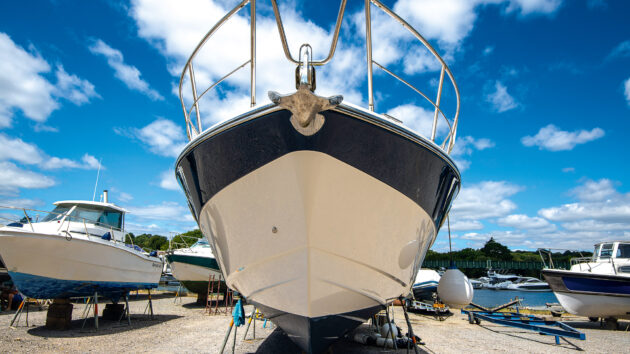
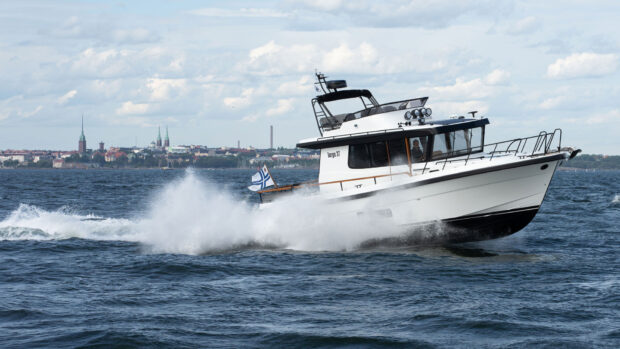
Sharp forefoot and deep-vee hull gives excellent sea-keeping
As for that engine access, a push of a switch quickly brings up the cockpit hatch, with the table and aft bench swinging back. Steps lead you down into a generous engine bay with everything easily to hand, including the batteries, which run conveniently down the port side of the bay.
Below decks, there is a large heads compartment to port. The mid cabin is generous with a big double bed, though it lacks standing headroom. Storage can also be limited, so the owner of the boat featured put extra storage at the foot of the bed.
The forward cabin is not bad all things considered, but this is a rakish Windy so width is a bit limited. Headroom is good though, and storage will meet most people’s needs.
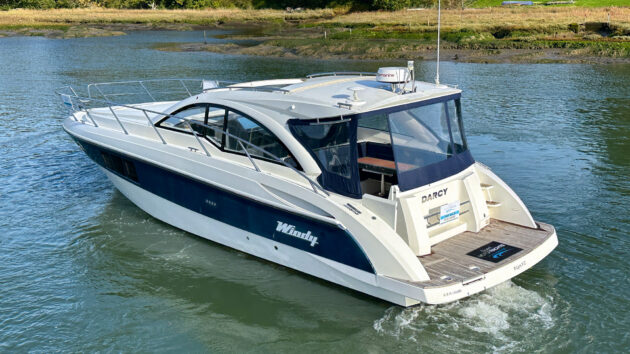
The most popular engine choice (D6-370s) are good for 43 knots
The saloon is limited in seating but the mid-sized L-shaped galley is pretty reasonable, given the space constraints. Natural light is also very good down below, thanks to the huge roof light in the saloon and three large square portholes.
Windy 40 Maestro specifications
LOA: 39ft 01in (11.91m)
BEAM: 12ft 01in (3.68m)
DRAFT: 3ft 02in (0.96m)
DISPLACEMENT: 7,600kg (light)
FUEL CAPACITY: 800L (175 gal)
WATER CAPACITY: 215L (47 gal)
TOP SPEED: 43.0 knots (test engines 370hp D6s on DPH sterndrives)
FUEL CONSUMPTION: 2.6L/nm @ 30 knots /1.8 nmpg
RANGE: 250nm at 30 knots with a 20% reserve
Verdict
This is certainly one of Windy’s best boats. In 2010, a realistically specced version with 370hp D6s was £413,000 inc VAT, which in the cash-strapped UK at the time, made it a pipe dream for many. Today, the Maestro remains a formidable offshore powerboat that will show a clean stern to most of the competition but it can be yours for around half the price. It is powered by reliable engines and in spite of the fact that those engines are modestly powered by the latest standards, the Windy’s highly efficient, sea friendly hull makes it a genuine driver’s delight.