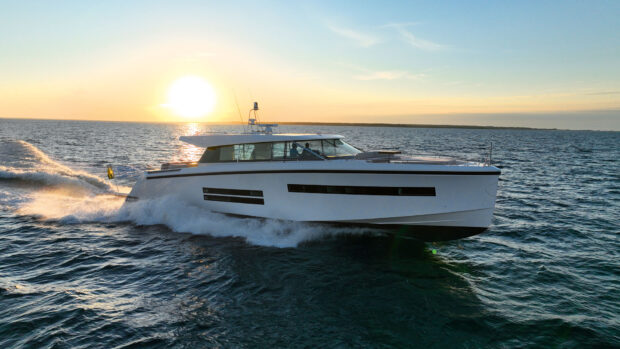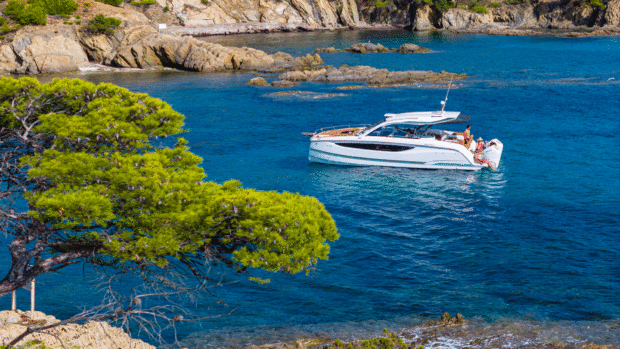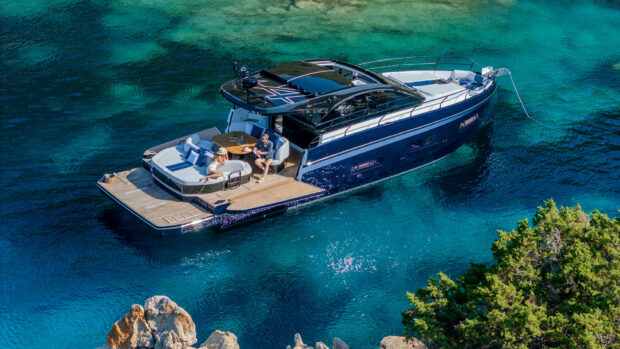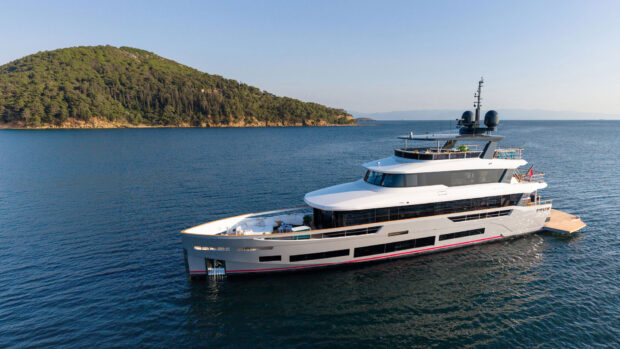


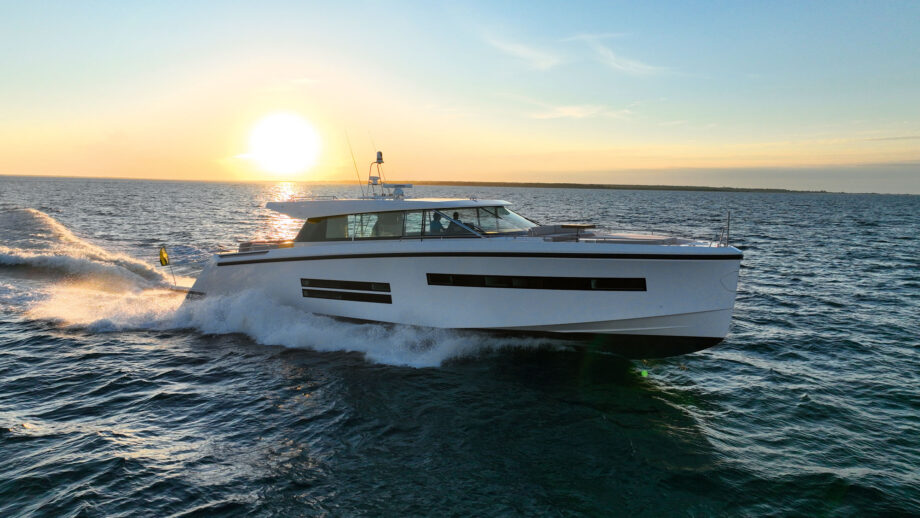
Alex Smith heads out to sea on the largest model yet from an iconic Swedish brand to see if it lives up to his first impressions
When Swedish builder Delta Powerboats unveiled its range-topping 72 at the 2025 Cannes Yachting Festival, it was hard not to be impressed.
Built entirely from vacuum-infused carbon fibre and weighing in at just 30 tonnes (about 50% less than you might reasonably expect of a 72ft cruiser), here was a boat that combined the hull technology of the world-famous Mannerfelt design studio with a very particular brand of high-end luxury that erred more on the side of Nordic restraint than superyacht ostentation.
With its pared-back lines and trim rectangular hull windows, it was a delight to look at but it still came with four good cabins, a proper crew space and the promise of the kind of performance and fuel efficiency that has seen many people fall in love with the smaller Delta 48 Coupé.
Naturally then, when we received an invitation to sea trial this boat among the waters of northwestern Estonia where it’s built, it was not one we were likely to pass up.
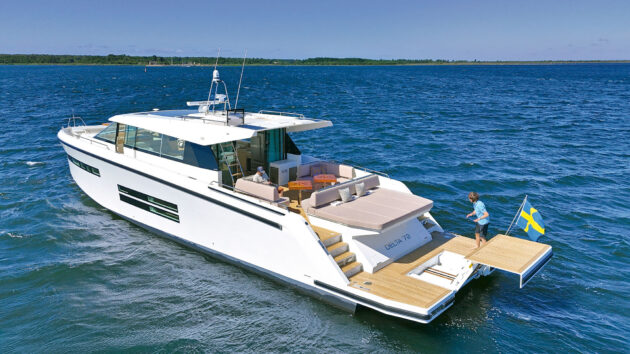
Delta has lavished a major slice of the LOA on the aft deck and it pays big dividends for party-lovers
A big back end
The scale and arrangement of the cockpit is very satisfying. Symmetrical L-shaped seating units look aft toward a big transverse bench, enabling you to seat up to 12 people in a really convivial way. A pair of elegant teak tables sits at the heart of this space, each with four triangular folding leaves so you can accommodate everyone for dinner.
They’re mounted on high-low struts but there’s no need to convert this region into a sunbathing zone because the aft bench backs onto a sunbed that juts out above the swim platform with plenty of room for six people – and that’s to say nothing of the sunbathing spaces available elsewhere on this boat.
The practicality is strong too. There’s excellent storage under the seats with easy one-handed access thanks in no small part to the fact that the seating units, like the hull, the superstructure and the bulkheads, are built from stiff, lightweight carbon fibre.
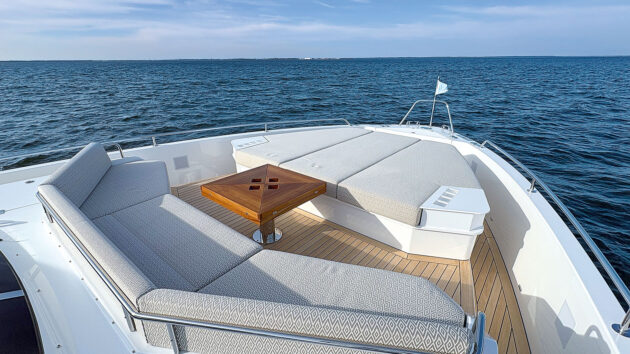
Subtle angles and really supportive backrests transform the usability of the bow lounge
There’s also a pair of joysticks back here, one on either side of the cockpit, plus a starboard wet bar with a sink, fridge and ice maker. And there’s space for a 3.5m Pirelli jet tender beneath the sunbed, with an excellent storage tray above it.
That does mean that the trough for the tender goes pretty deep, invading the engine space to such an extent that the two engines feel as though they’re physically divided. But on the plus side, the tender garage does come with hook ups for your pressure washer and shore power, both tucked neatly away with dedicated hatches for easy access from the swim platform.
Notwithstanding the ingress of that tender tray, the engine room is also really well arranged. There are two broad hatches so you can access each engine from the cockpit deck and there’s also direct access from the transverse crew cabin.
Once inside, there’s a false bulkhead ahead of the engines, which themselves are shunted forward a touch on jackshafts to better distribute their weight. This bulkhead is a great way to minimise reverberation and there’s a transverse treadplate ahead of it, so you can shuffle on all fours from one side to the other.
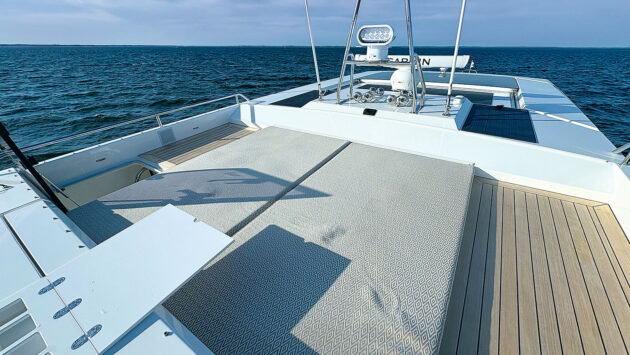
The intimate rooftop terrace can be equipped with a sunshade
It’s still a bit tight to get around but this is a very high-spec boat so that’s only to be expected. It comes with air conditioning, a pair of generators, a Seakeeper 14, the Seakeeper Ride system, a watermaker and a very substantial lithium battery bank for handling big loads at anchor, so it’s very tough to fault the way it’s been laid out.
As for the crew cabin, that runs across the boat, directly ahead of the engine bay, providing a natural buffer between the machinery room and the lower deck living spaces. It uses a couple of lengthy bunk beds and a fold-down table so the skipper can do a bit of work.
There’s also a C-Zone unit and a Garmin MFD in here so you can control the various ship’s systems and get a duplicate display of whatever’s going on at the helm. And while the storage looks uncommonly well catered for, the starboard ensuite also gets full standing headroom and a separate shower.
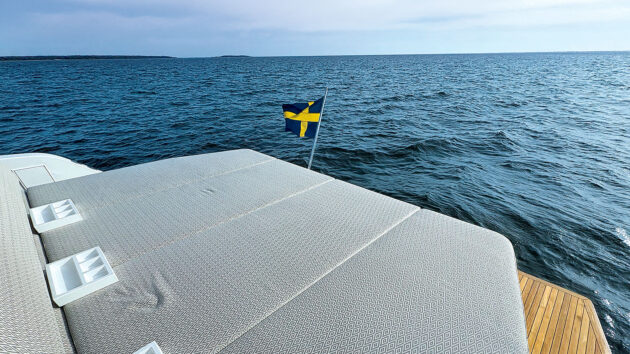
The massive aft sunbed comes with integrated snack trays
Extra outdoor spaces
Believe it or not, there are two more outdoor day spaces to help supplement that big aft cockpit. The first of those is in the bow.
A big central bench with a neat inward-facing angle on either side looks forward toward a raised island sunbed that also operates very naturally as an aft facing seat.
That creates a lounge for ten without in any way obstructing the walkaround decks. There’s masses of easy-access storage inside this unit, plus another pressurised water outlet; and as elsewhere on this boat, the steelwork is lovely, not least in the form of sunken cleats and flush-fitted winches that lift out of the deck.
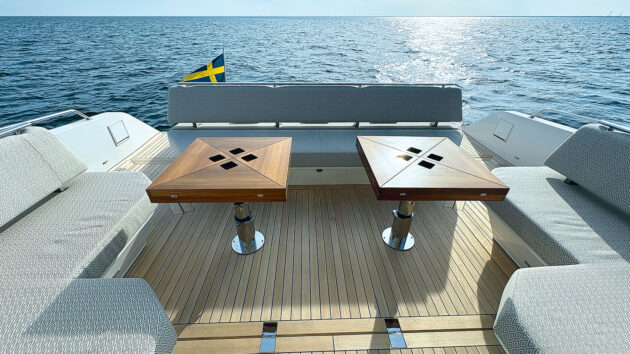
The sociable cockpit dining station oozes quality
Head up the ladder on the port side of the cockpit and you find yourself on another unusual space – this time, a cushion-lined roof terrace designed for two but big enough for four.
It’s a very shallow, low-profile space; so low-profile in fact that you wouldn’t know it’s there from the look of the boat. But while there’s still plenty of room up here for the practical gear – a sunroof, a set of solar panels and a magnificently oversized search light – you also get a rather charming little fold-out table that emerges from the mouldings at the back end of the roof structure so you can perch up here with some snacks and a drink and wonderfully unrestricted all-round views.
If you really like that concept, you can even add a sunshade on carbon-fibre poles up here. And while it’s obviously still quite rudimentary as a socialising zone, it’s a very effective way to get extra value out of the roof structure.
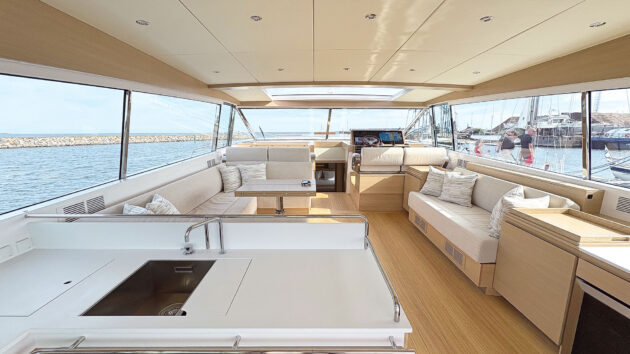
Though not vast, the internal saloon is wonderfully bright, thanks to big windows, narrow mullions and a pale oak fit-out
Big bright views
The saloon is by no means vast by the standards of a 72-footer and, given the scale of the fore and aft lounges, you wouldn’t expect it to be. But it does feel very bright and open, thanks to really generous headroom and large unobstructed windows with mullions so narrow, they look virtually non-existent.
The windows also feature recessed blinds that simply drop down from their hiding place. You secure them in position with integrated magnets and while that naturally lends itself to the idea of a convertible saloon dinette for overnighting, the fact that we have four cabins on the lower deck, plus the crew bunks aft makes that unnecessary.
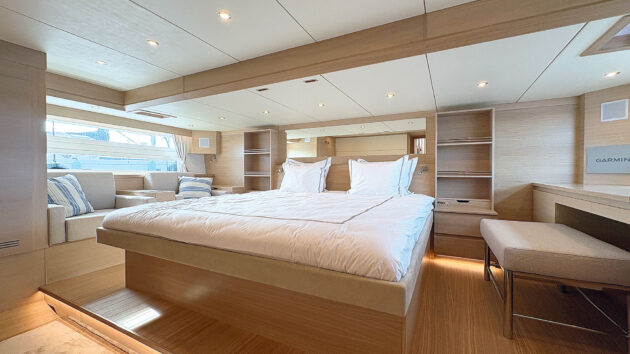
Our one and only issue with the owner’s cabin is the obstructed view through the two-part hull windows
What we get instead is a transverse aft galley that opens out into the cockpit by means of four-part sliding doors. Ahead of that, a port dinette looks across to an inward-facing starboard settee and beyond that are no fewer than four helm seats – two at the starboard wheel and another couple at the port co-pilot position.
This guest spot is particularly well appointed. There’s a big space beneath the dashtop for your charts. There are also extra storage spaces and cupholders, plus a table that folds out so you can perch with a meal. The Alcantara dashtop feels distinctly luxurious and does a great job of muting any glare; and in addition to 10cm of seat travel for a variety of body shapes, there are twin side doors, which is great for fresh air, as well as side deck access.
The details elsewhere are equally pleasing. There are dedicated glass and crockery cabinets hidden away with automatic ambient lighting. There are various charging lockers concealed beneath hatches to help tidy up the aesthetic. And there’s even a pair of inset trays bookending the starboard settee, so you and a partner can load up on treats and recline in comfort, even without direct access to the table at that port dinette.
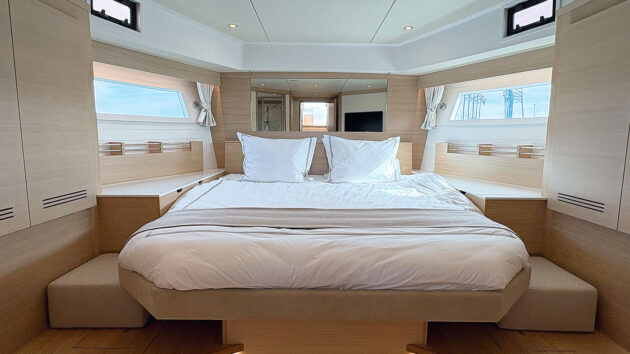
The VIP has breadth, height and an airy feel
Four-cabin layout
There are four cabins on the lower deck – a VIP bow cabin, a starboard double, a port single, which would also function very well as an office or an overspill storage room; and finally, a full-beam owner’s cabin amidships. This most glamorous of the four is beautifully arranged.
To the port side of the big central 2m bed is a large desk with a bench so generous that two people could easily get a bit of work done or dress for the day side-by-side. To starboard is an even more delightful lovers’ lounge.
It uses a pair of seats facing inboard with a central hand-holding zone, beneath which is a storage bin for your wine. There’s another cabinet for glasses too, so it’s a really indulgent place to relax with a tipple before you go to bed or to delay the day with a cup of tea before you join the rest of your guests.
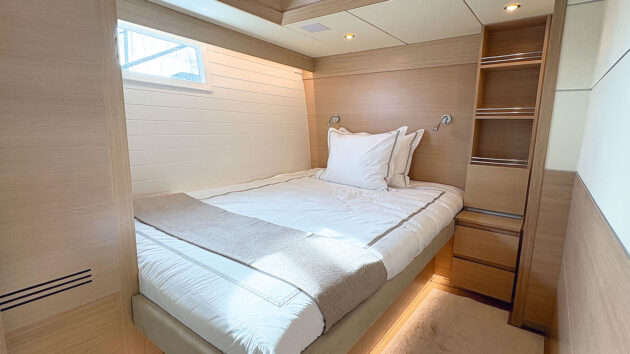
The starboard double is also ensuite
As on the main deck, the inherent quality of this space is again elevated by the detailing. Think neatly tucked away charging troughs and beautifully conceived storage lockers, all finished in pretty honey-coloured oak veneer on lightweight carbon-fibre bulkheads with pale fabric deckhead linings.
You can also spec a slightly darker teak finish, rather than oak, but either way, our only proviso in here relates to the hull windows. Though the depth of the aperture is very decent, each window is split by a horizontal spear that sits directly at eye level, obscuring your view of the horizon.
It no doubt adds a little strength and, in terms of the external aesthetic, it certainly looks all the more sporting because of it. But if it were at all possible, we would take an uncluttered view over any of that.
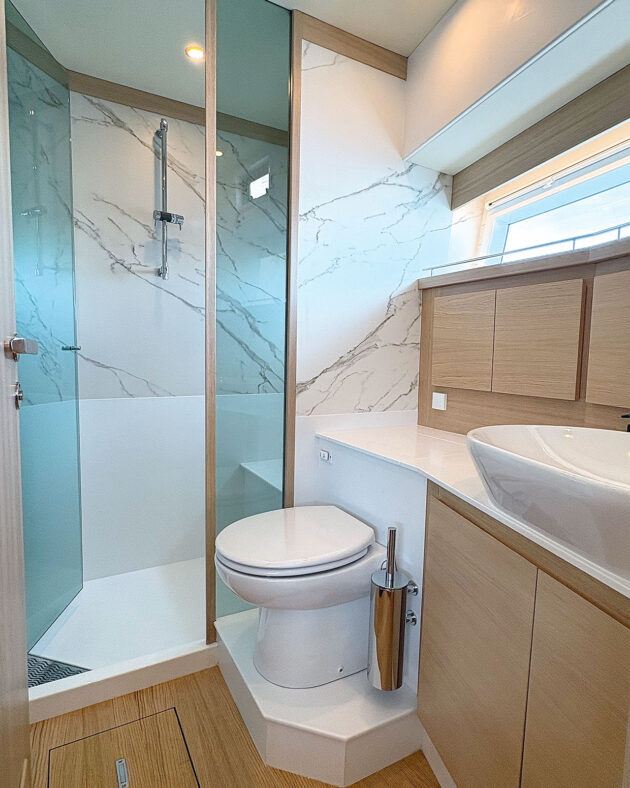
There’s no real marble on a boat this light
Small-boat helming
This is by far the largest boat we’ve tried with the Seakeeper Ride system and it does precisely as you would want, keeping the boat flat and level without effort or fuss. Trouble is it also restricts the heel in the turn and on a lightweight, carefully balanced Mannerfelt hull, that’s not quite what we want.
Turn the system off and immediately, the heel goes from moderate to gregarious – so gregarious in fact, that the Volvo engine management system overrules our fun with an alarm, compelling us to stop, reset and go again – this time with a slightly more circumspect approach to the helming.
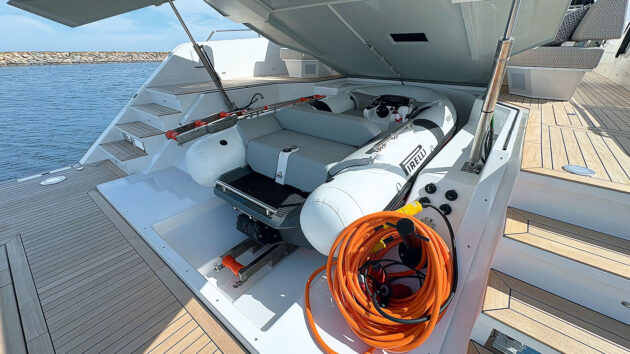
There are also outlets for a pressure washer and the shore power in here
We do exactly that and, while it’s not quite the same order of experience as the Delta 48 Coupé, this is still very much a driver’s boat. That’s what you get from the combination of the Mannerfelt hull, lightweight carbon fibre construction and fastidious attention to weight distribution.
Our twin Volvo Penta IPS-1350s (around 1,000hp apiece) push us to a top end of 40 knots and the efficiency is even more remarkable. At 30 tonnes, we’re about five tonnes lighter than a Pardo GT65 and that sees us burning just 6L per Nm at 20-22 knots for a range comfortably in excess of 400 miles.
To put that in perspective, that’s broadly similar to the fuel flow rate we recorded on Jeanneau’s new 38ft powercat with a pair of 350hp outboards so, for an eight-berth 72ft luxury monohull, that’s a superb return.
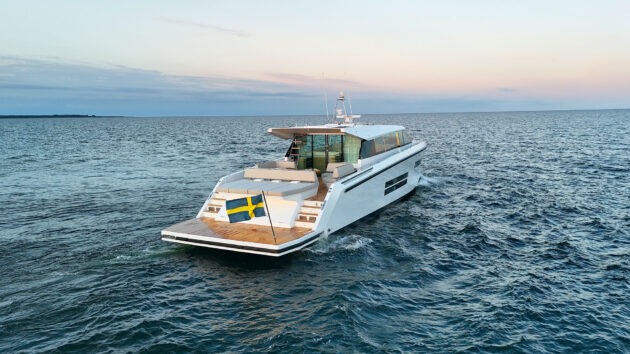
This is boatbuilding of a more purist and traditional nature
As you might imagine, there has been a fair bit of talk about an outboard option of this boat with quadruple Mercury Verado V12 600s for a top end in the region of 50 knots. Trouble is you would have to double the fuel capacity to around 6,000L to make it viable.
That would directly contradict the lightfooted approach behind this Delta flagship and it would also do nothing positive either for the looks or the weight distribution, so if that provisional idea has now been shelved, we’re very pleased to hear it.
Delta 72 Coupé specifications
LOA: 71ft 4in (21.75m)
BEAM: 18ft 4in (5.60m)
DRAFT: 5ft 3in (1.60m)
DISPLACEMENT: 30,000kg (light)
FUEL CAPACITY: 3,100L
WATER CAPACITY: 1,000L
ENGINE: Twin Volvo Penta IPS-1350s
Delta 72 Coupé costs and options
Price: From €3.9M ex VAT test boat includes the following options:
Seakeeper RIDE system
Seakeeper 14 gyro stabiliser
Lithium battery bank
Watermaker
Twin generators
Verdict
The Delta 72 Coupé is really quite a unique boat. If you scour the market, the Pardo GT75 is probably the closest you’ll find, but this is altogether more classical than that. Forget drop-down bulwarks, reversible furniture and inside-outside pilothouses. Notwithstanding its carbon-fibre construction and its palette of cutting-edge equipment options, this is boatbuilding of a far more purist and traditional nature, packaged with all the stylistic modesty you might expect of a high-end sailboat. And yet it still comes with a big sociable aft lounge for 12 and an equally sociable forward station for ten, plus lots of cruising practicality, masses of storage and a really diverting drive. In addition to its Med-ready day spaces and Monaco-ready styling, it also provides a set of cabins that express all the muted luxury you hope to see from an established Nordic builder, without ever spilling over into fuss or excess. So if you’re in the market for a premium 70-footer, don’t just default to the mainstream players. Do yourself a favour and give the extraordinary Delta 72 a go.