
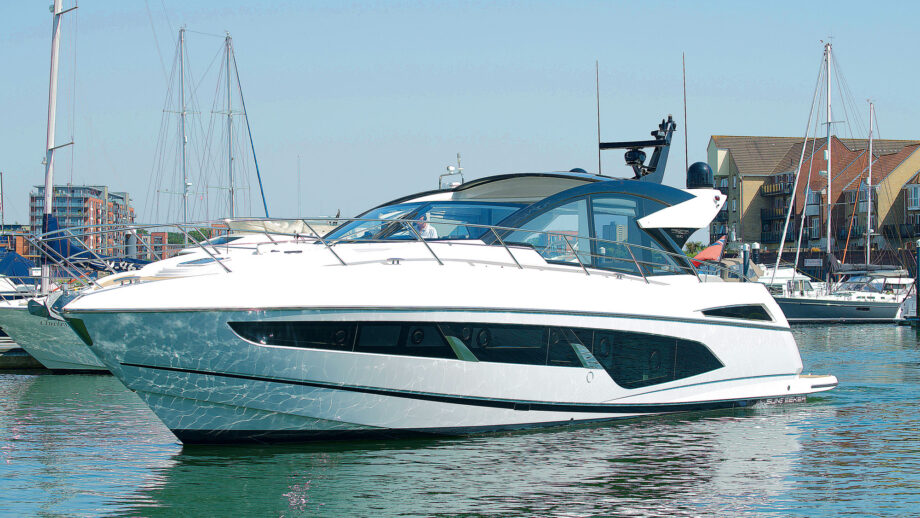
Andrea Frabetti brought Italian luxury and clever carbon weight-saving to Sunseeker’s famous hull. Here's what to look for secondhand
Sunseeker made its name building sportscruisers. Titles like Superhawk and Apache made the opposition look tame in comparison. In 1999, with the stakes getting ever higher, Sunseeker launched the original open Predator 60.
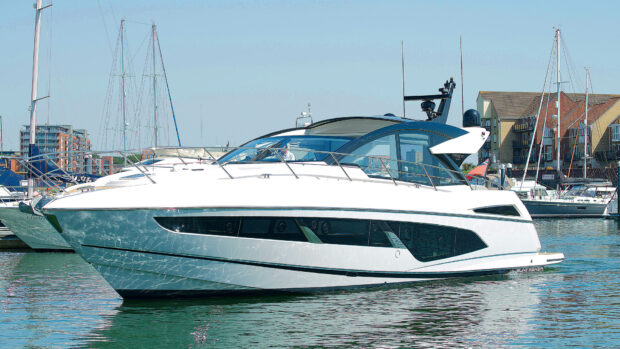
In 2009, this was resurrected as the Predator 60, Gen 2 but this time as a hard top model. Both boats shared the same hull and, powered by twin 1200hp 16.2L MAN diesels, made 36 knots. Striking to look at and impressive to drive, this was the gold standard in big sportscruisers of the time.
In 2015, Sunseeker replaced the 60 Gen 2 with the Predator 57, which was replaced four years later by the Predator 60 EVO. Though a similar boat with the same hull, layout and dimensions as the 57, it featured a fresh interior influenced by Sunseeker’s then new boss Andrea Frabetti. Having spent years at Ferretti, he joined Sunseeker in 2019, giving the new Predator a more contemporary Italian feel with impressive attention to detail.
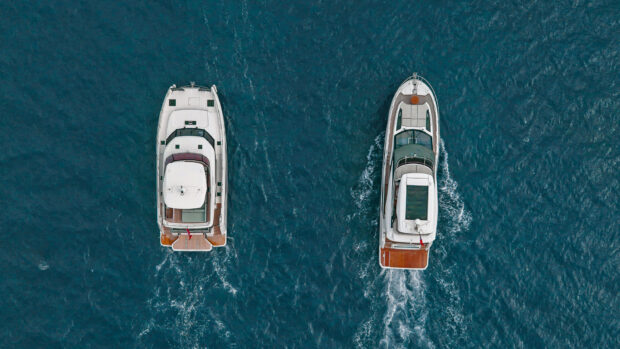
Its performance also received a boost as the new EVO was 400kg lighter thanks to the extensive use of carbon fibre in the sunroof and the transom/crew cabin area. Over its four-year production span, 33 Predator 60 EVOs were built.
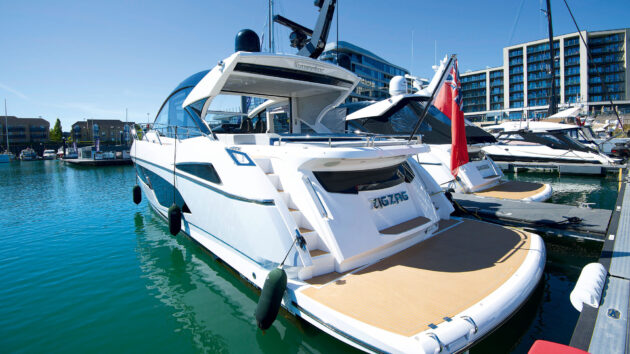
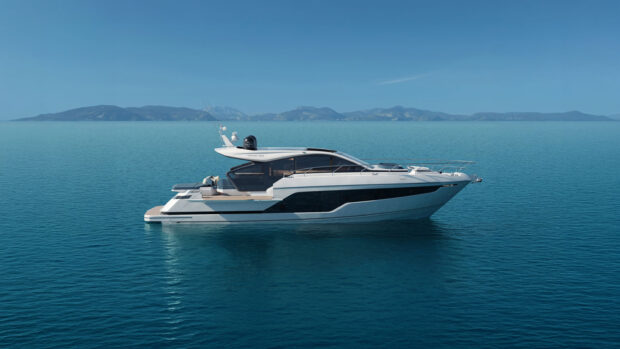
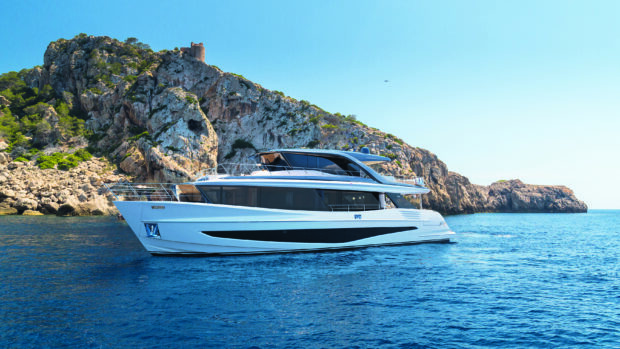
Sleek lines and carbon fibre hard top justify the Predator name tag
The owner’s view
Speaking to Flynn, whose boat is featured in this article and advertised for sale in the classified pages, we got a personal perspective of the Predator. He considers the step-up in accommodation from his previous Portofino 53 considerable.
“She’s a Frabetti boat, so the styling and luxury always impresses. Staying on board for any period of time is no hardship – you never crave shoreside comforts.”
He finds that helming the boat in all weathers poses no problems either. Being a 60ft Sunseeker, she just cuts through it. Handling is also spot on, steering quickly for a big boat. With bow and stern thrusters coupled to shafts, Flynn finds her easy to berth and has no problems cruising single-handed if need be.
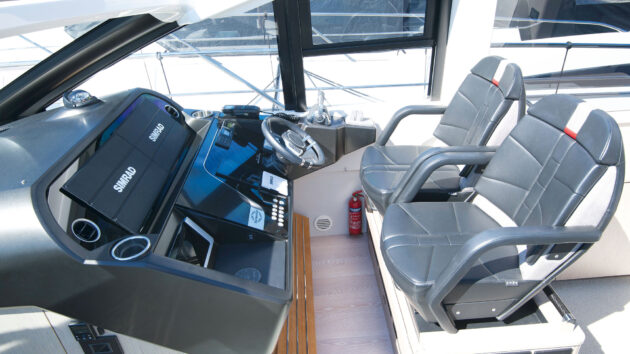
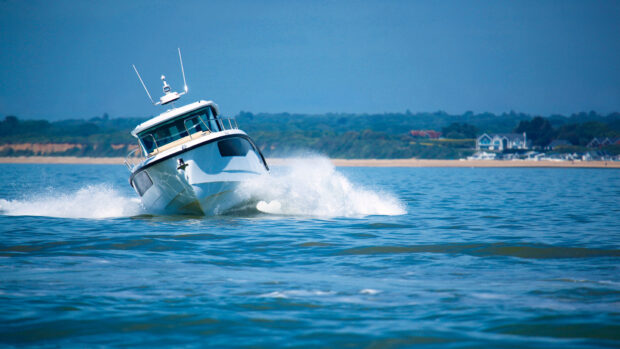
The EVO is a true driver’s boat with the performance and handling to back up its looks
One aspect he was particularly keen to highlight though is the huge sunroof and the full-beam glass doors that drop down into a void between the cockpit and saloon. It means this boat can either be an open sportscruiser or an enclosed coupe. As he puts it “going out all year round is definitely on the cards, as you have the best of both worlds”.
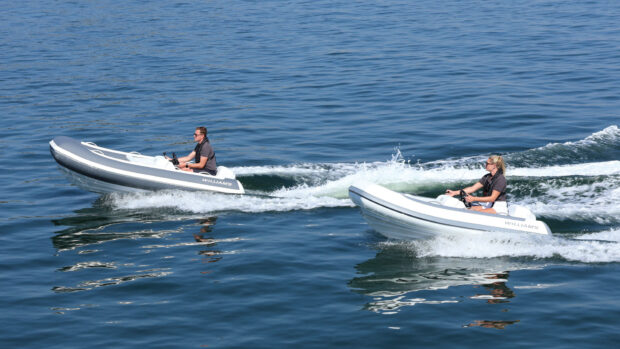
In terms of fitting and specifying, Flynn opted for a 3.25m Williams tender, as it fits in the garage without the tubes deflated.
He went for fridges in the cockpit as well as the galley. Another touch was getting a steam cooker, which is great for fish and vegetables. Being an offshore social platform, he has done a lot of scenic anchoring, which is where the Quick Gyro X19 stabiliser comes into its own.
Fitted in the crew cabin, it keeps you on an even keel when needed. For Flynn it has been the perfect boat, which he is now selling as he “inevitably goes through a four/five year cycle of chopping and changing”.
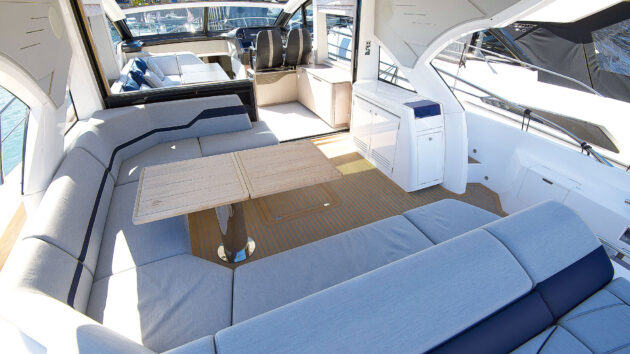
Drop-down doors between the cockpit and saloon make this a genuine year-round cruiser
Performance & handling
The 60 EVO engine options are twin 725hp Volvo IPS-950s, twin 900hp Volvo D13s on shafts and twin 1000hp D13s on shafts.
In 2020, we recorded 33.5 knots from a test boat with 900hp D13s, so you should comfortably expect 34/35 knots from a 1,000hp D13 boat, and a touch less with IPS. Shafts or IPS is a matter of personal preference. IPS is an easy docking solution, but shafts and thrusters also give good manoeuvrability – especially with a joystick system – and they’re cheaper to service.
When new in 2019, IPS cost an extra £80,000 in while upgrading from the standard D13 900s to D13 1000s also involved a £50k premium, so you may find bigger price tags on secondhand boats with these engines.
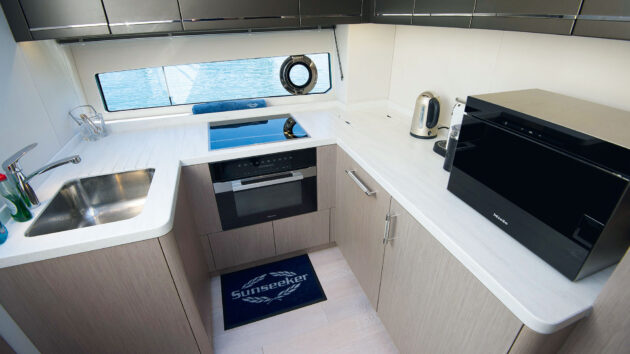
The standard galley is big enough for most but there was an extended galley option too
In terms of driving, it handles in a way that belies its size. One thing that struck us during feisty sea trials in 2020 was just how responsive and balanced the electronic steering is for a 28-tonne boat.
There is no delay in its responses and the curves it cuts are impressively tight. As mentioned earlier, the EVO weighs around 4-5 tonnes less than the older Predator 60 Gen 2 so should give similar performance to its predecessor even with the smaller engines.
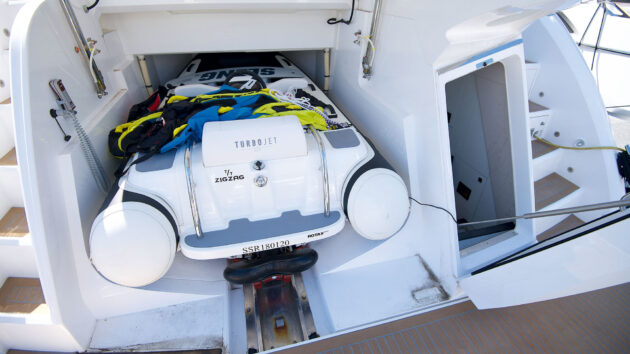
There’s also a sizeable tender garage and compact crew cabin/lazarette at the stern
Points to consider
Bathing platform hydraulics is one area to scrutinise. Flynn had a persistent issue with hydraulic fluid leaking from the internal hoses connected to the platform rams, making it very slow to raise.
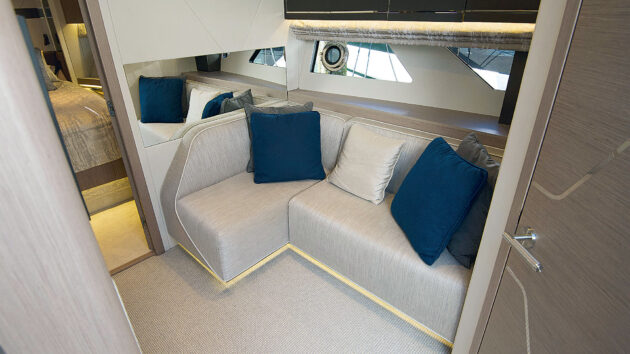
The extended galley comes at the expense of this cosy lower saloon seating area
To fix it once and for all his engineers recommended making a completely new component to obtain a leak-free fit, which has resulted in trouble-free service ever since. Flynn also cleans and lubricates the sunroof guide rails with marine-grade lubricant, as they can get contaminated over time – especially from shell fragments dropped by seagulls.
Another thing to look out for are bow/stern thruster batteries, as Flynn’s once gave up the ghost at an inopportune moment – something to bear in mind with a big shaft-driven boat that relies heavily on its thrusters.
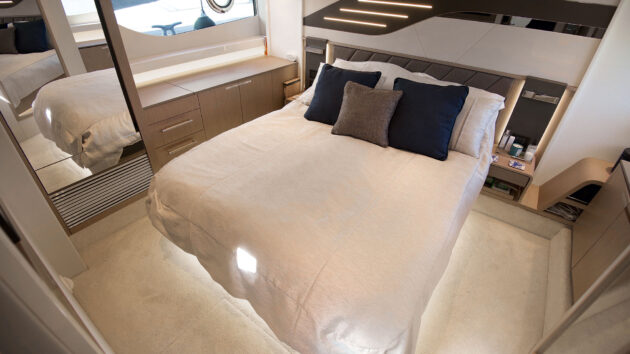
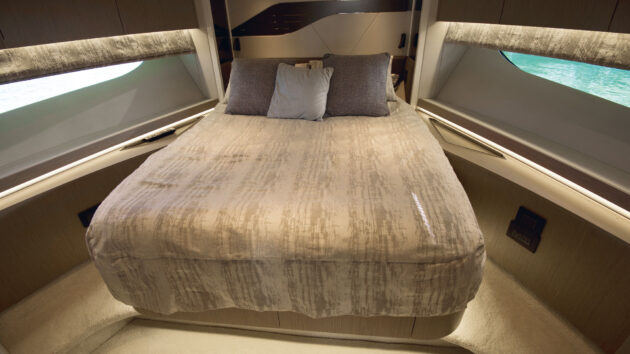
The full beam owner’s cabin enjoys good light and views thanks to big hull windows
Options and extras
One area to consider is the small crew cabin on the starboard quarter. Though it offers a single bed and heads, few buyers chose it fitted like that. Instead, it provides a storage compartment or, in the case of Flynn’s boat, a perfect location for a gyro stabiliser.
But the most significant layout option is the extended galley. Though the normal port galley is more than adequate for most, some chose the extended version.
This involves losing the starboard L-shaped seating area in favour of a second full-size fridge, washing machine, and wine cooler plus some extra worktop. It does provide a bigger galley but, when you consider the fridge and barbecue options that can be fitted on the main deck, only those keen to stretch their cruising legs will really need it.
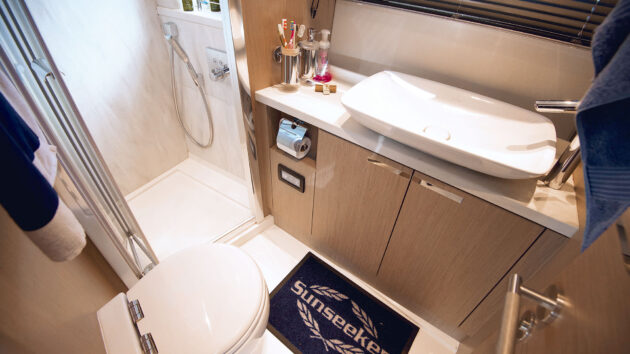
The owner’s ensuite is one of two heads on board the Predator 60 EVO
Something you may find fitted is the Hydro Performance pack. It comprises Humphree auto trim interceptors, Seastar steering with independent cylinders, Ankerman steering and flow-aligned rudders. Six years ago, it cost £10k – and while the standard Predator handles well, this would be a great bit of kit to have if someone else has borne the brunt of the cost.
Something else you should look out for is the multi-function steering wheel. This finger-tip feature enables you to control the two 16in Simrad MFDs; and with a myriad of features and touch screen devices out of reach when sitting at the helm seat, you’re likely to derive a lot of benefit from this.
The forward VIP has ensuite access to the second heads but shares it with the third cabin
Some shaft-driven boats may also have Dockmate Twist – a wireless three-axis proportional joystick control, which controls thrusters and engines and can be used anywhere onboard.
Back in the cockpit, options include a sink and barbecue, as well another fridge and an ice maker – not surprisingly, popular choices. Examples found in hot climates will likely be fitted with the comprehensive £115,000 Med pack, including air con, a gen set and a passerelle. And there were six joinery options too: Black American Walnut, Cherry, Wenge, Eucalyptus and Silver Oak – the last two being lighter (and arguably, more in demand) woods.
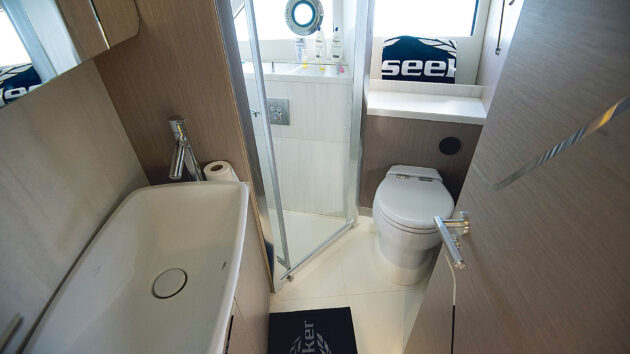
Jack and Jill doors ensure it can be used by day guests as well
In terms of overall layout, this is purely a three-cabin boat. It has a full-beam master cabin amidships with a large ensuite. There’s over 6ft 1in of headroom, a big island bed, long windows, acres of space and reasonable storage. Guest/family accommodation comprises a bunked cabin on the starboard side, which opens toward the L-shaped seating area.
The bunks are reasonably sized, but it’s really aimed at youngsters. The forward VIP cabin offers plenty of room and overhead locker storage, with ensuite access to a port day heads and the option to replace the standard island bed with a scissor berth. This was the only variation in terms of sleeping accommodation and few chose it – though from a family perspective, it can certainly make sense.
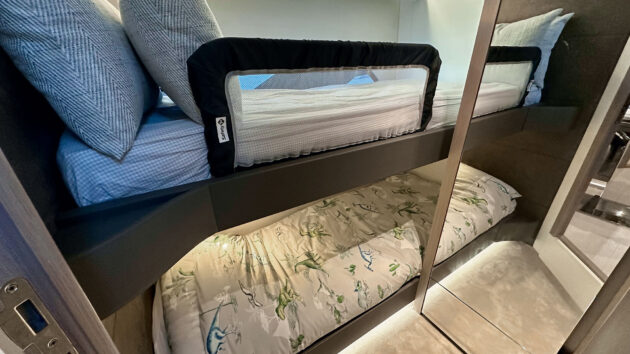
The third cabin has a pair of slender bunk beds that are best suited to youngsters
Sunseeker Predator 60 EVO specifications
HULL TYPE: Planing
RCD: B for 12
LOA: 59ft 10in (18.24m)
BEAM: 15ft 5in (4.70m)
DRAFT: 4ft 3in (1.30m)
DISPLACEMENT: 27,900kg (dry)
FUEL CAPACITY: 2,200L
WATER CAPACITY: 600L
TOP SPEED: 33.5 knots (MBY test April 2020 – engines 900hp D13s)
FUEL CONSUMPTION: 8.75L/nm @ 26.3 knots
RANGE: 200 nm at 26.3 knots with a 20% reserve
Running costs
FUEL: Annual fuel burn 6,800 litres (based on 25 hours at 26 knots and 25 hours at 9 knots)
BERTHING: £14,573 (based on £799/m for Hamble River downstream of Bursledon bridge)
Verdict
As a big Med-focused sportscruiser, this boat has been very popular in UK waters. As well as fitting into most UK marinas, it can go from an open-boat experience to a warm enclosed passagemaker at the press of a switch. Hard top sunroofs are now commonplace but the EVO’s huge sloping carbon roof and clever drop-down doors are particularly impressive. The accommodation is strong, too, but what really sells it is the Predator’s power and presence. It drives beautifully and looks superb – and the years have done nothing to alter that.