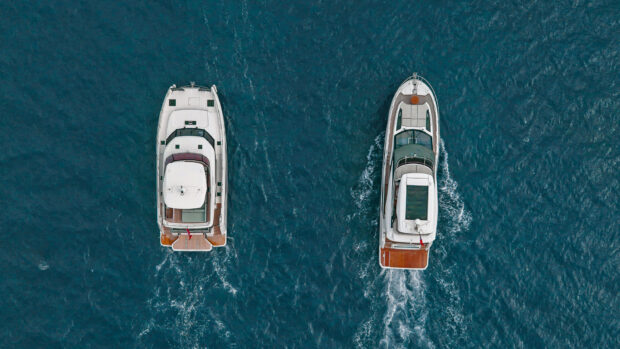


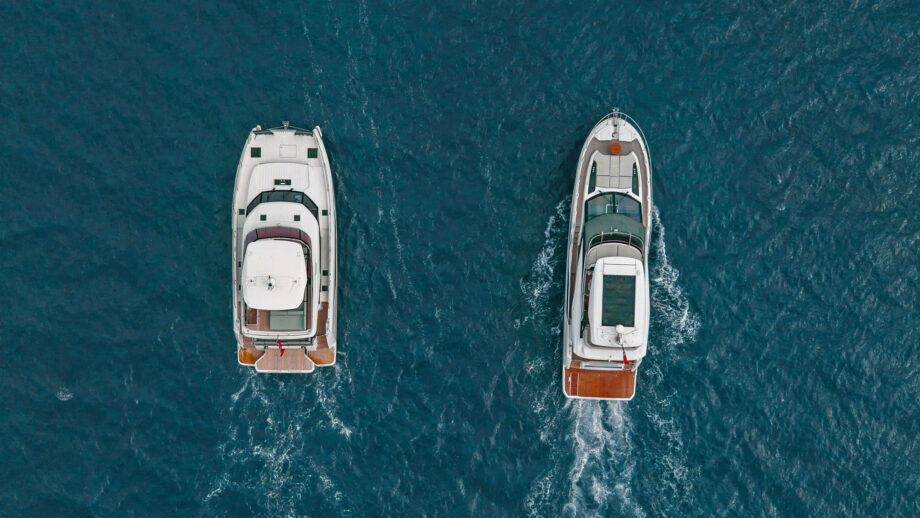
Is Prestige’s 48ft M-Class powercat really a match for a 57ft F-Class monohull flybridge? Alex Smith put them head-to-head
When the Prestige M48 was introduced as the first of Prestige’s new M-line of powercats, it arrived just as the trend toward power-driven multihulls was really kicking in.
There was a growing appetite for the space, stability, softness and efficiency that a well-sorted powercat could provide – and here was a 48ft boat that, according to Prestige, delivered all of those things.
In addition to the space and volume of a 60ft monohull, it came with a price tag comparable to a Prestige 520 and the running efficiency of a 40-footer.
Even the most ardent monohull fan would find it tough to resist qualities like that but just how much veracity was there in these parallels?
We had long been keen to test the theory by pitting the M48 against exactly the kind of monohull it claimed to match, so when UK Prestige dealer Ancasta offered us the chance in the form of the F5.7 (a next-generation 57ft flybridge cruiser from Prestige’s own F Class) it was not one we were likely to pass up. Let the games begin…
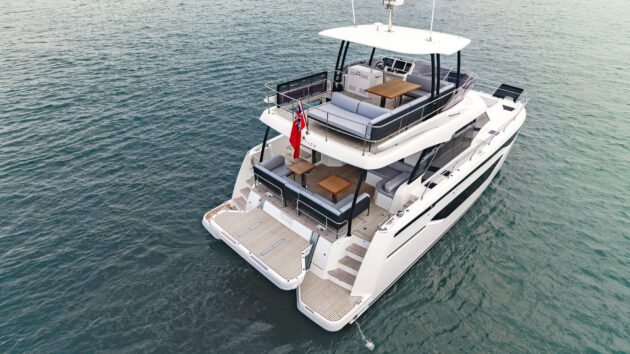
The helm seats are opposite a two-man bench that allows the skipper to feel connected under passage
Exterior
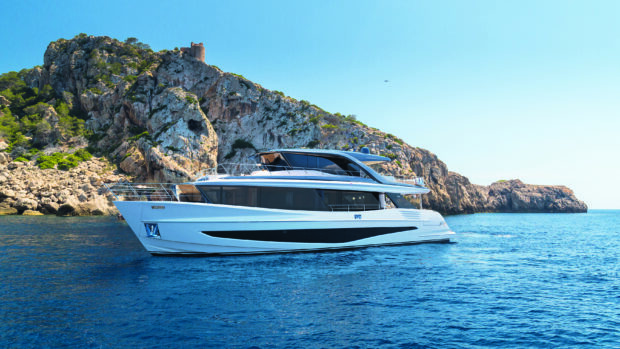
The M48 uses its 19ft 7in beam for an excellent three-part aft platform with a central section that can be raised to extend the big cockpit deck. It’s made all the more practical thanks to a gate in the balustrade and a removable seat pod in the aft bench.
The aft platform also enables you to deploy a 3.2m tender or to elevate it during a passage; and there’s a huge central lazarette with handy canvas dividers and easy access from the cockpit. The use of freestanding furniture increases flexibility in terms of deck layout, and while it limits the variety of storage solutions, the M48 hardly lacks in that regard.
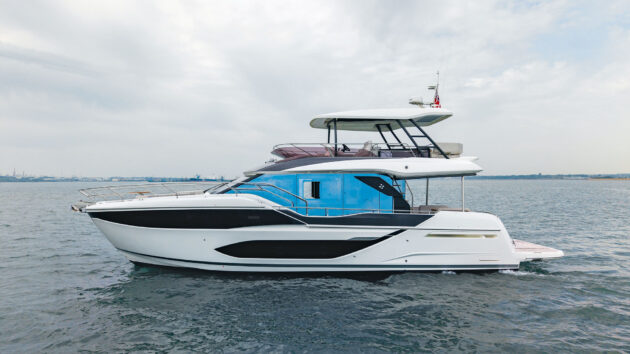
The F5.7 does a better job than the M48 of breaking down the division between indoor and outdoor spaces
Up on the foredeck, a slightly simplistic island sunbed looks forward to a big open deck space, where you can rig another freestanding lounge.
That does feel more like an off-the-shelf solution than a properly integrated set-up but the M48 certainly takes full advantage of its plunging bridge deck with a deep anchor locker and a pair of cavities in each forepeak that can be used as storage lockers or split as a single crew cabin and a wet room-style bathroom. The big flybridge is strong too.
The centrepiece is a ten-man dining station, which backs onto an aft-facing sun lounger large enough for four. There’s also a two-man helm, opposite a second two-man bench that enables the skipper to remain slightly better connected on passage.
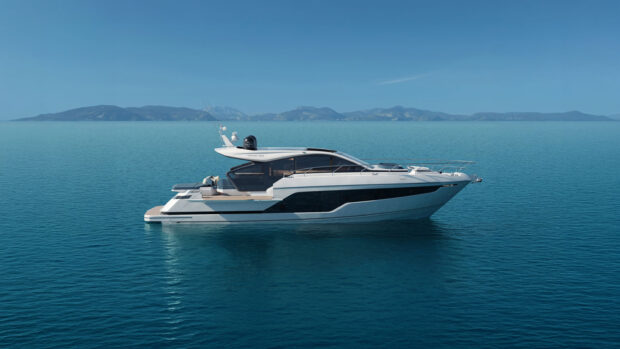
The F5.7 does a better job than the M48 of breaking down the division between indoor and outdoor spaces. The “Ocean View” galley, for instance, straddles the aft threshold with a very attractive bar.
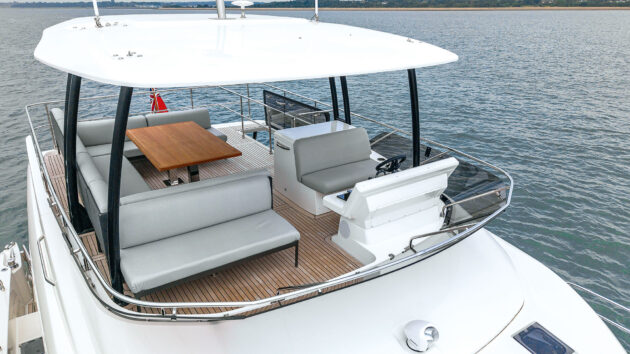
For sheer scale, the M48’s flybridge is tough to beat
There’s also a pair of facing cockpit settees back here with space for extra freestanding furniture, plus a pair of lateral units: one with a sink, the other with a third helm and both with space for a fridge or ice-maker.
A robust 350kg high-low platform is enough for a Highfield 360 tender, and the fact that the shore power, passerelle and transom shower are all loaded into the starboard steps helps free up the port side for access to the transverse crew cabin. You get a single bed, a sink and a toilet in here; and in addition to serving as an overspill cruising cabin, it also provides a handy aft toilet for cockpit day guests.
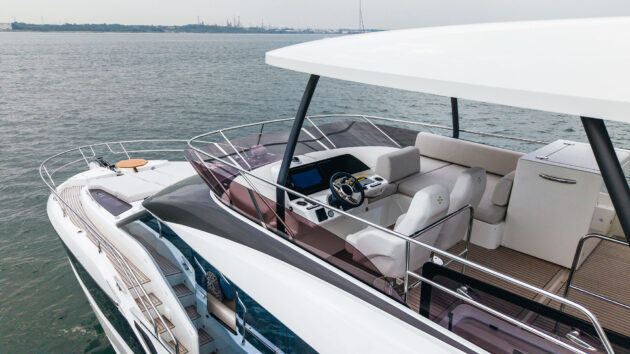
The F5.7’s helm is more sociable than the M48’s
The flybridge, meanwhile, is split in two – a forward zone with a twin helm orbited by companion seating; and an aft dinette big enough for eight. A starboard wet bar splits these zones with a barbecue, sink, fridge and storage space.
There’s also some handy quick-grab storage beneath the bench seats, plus an optional hardtop with a generous sunroof. However, it’s the bow space that really impresses, thanks to a dedicated forepeak lounge that enables up to six people to enjoy a proper sense of separation from the rest of the boat.
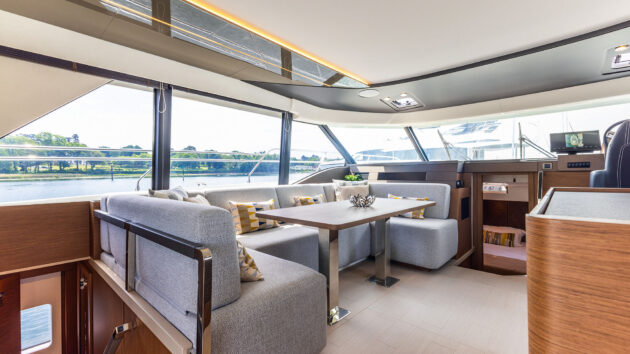
Three staircases break up the space but the forward dinette is strong on the Prestige f5.7
Interior
The small scale of the M48’s optional main deck helm makes a big difference to the flexibility of the saloon. A big starboard galley comes with wraparound work surfaces, a full-height fridge and a pop-up TV.
There’s also a ten-man dining area to port, plus a neat little door to access the starboard side deck. Three private staircases (one to port, one to starboard and one to the bow) do fragment the space but they also enable three couples to cruise without ever feeling in the slightest bit overlooked or cramped.
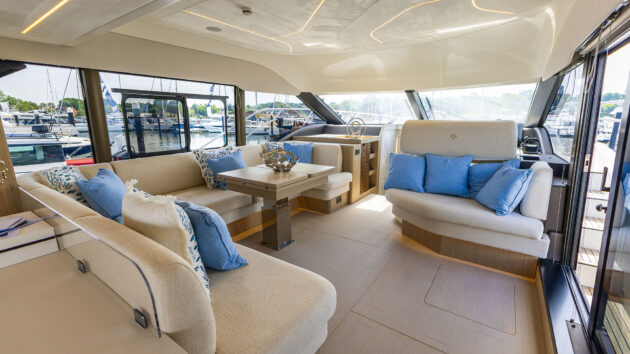
The m48’s narrow side decks help mitigate any volume penalty in the saloon
The layout of the cabins also works well. The two guest cabins use transverse double beds mounted on runners, so you can divide them into singles; and the relatively beamy hulls mean they face outward, through low-level hull windows for excellent views.
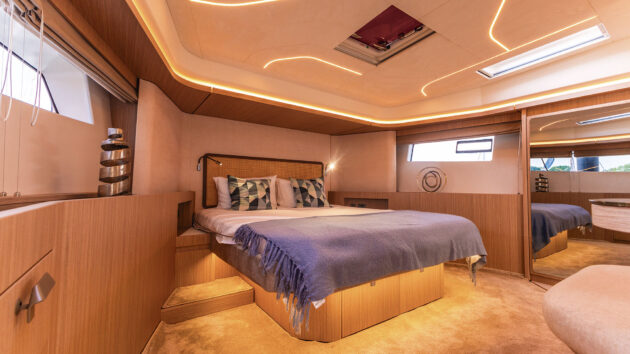
The F5.7 minimises the impact of the hull taper with an elevated bow
Better still, while the starboard cabin comes with its own forward ensuite, the port cabin uses an ensuite compartment aft of the stairwell, making it very practical as a day heads.
As for that all-important full-beam owner’s cabin, it makes great use of the deep bridge deck and forward hull sections with a shower cubicle and toilet compartment that are split to port and starboard, down a couple of steps.
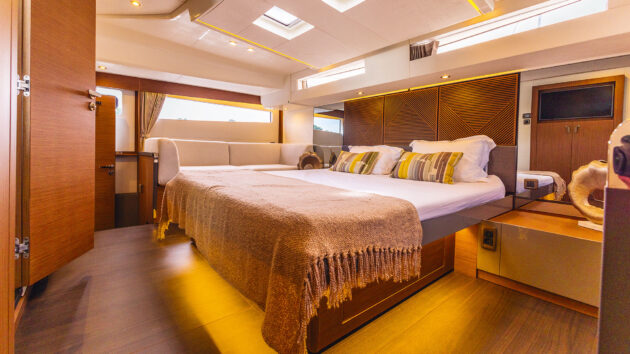
There’s no real contest here: the M48 owner’s cabin wins hands down
That helps ramp up the privacy without impoverishing the light, which floods unrestricted across the owner’s bed from both sides.
The f5.7
On the F5.7, the transverse Ocean View Galley sits right at the heart of the action with easy views aft and very natural interaction with the guests, both in the cockpit and the raised saloon.
Thanks to the slender side decks and extra length, that saloon doesn’t feel like a poor relation to the M48’s either. It features a huge port dinette that looks across to a neatly arranged starboard side.
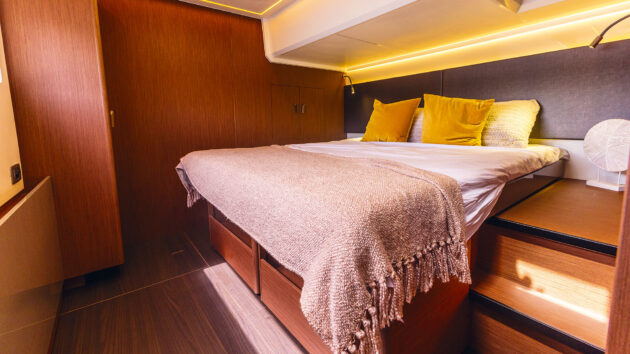
Broad hulls enable the two guest cabins to use transverse beds
Ahead of the midships side door, the two-man helm seat backs onto an integrated aft-facing bench that also functions as an inward-facing chaise longue. When you drop the helm-seat down and swing the backrest over, the entire unit converts into a lovely low-level settee so you can recline and face across to the main dinette without obstructing the walkway.
Down below, the F5.7’s raised bow creates space for a forward owner’s cabin on its own intermediate deck, halfway down the steps between the main and lower levels.
That helps remove it from the most acute sections of the hull, creating excellent volume, as well as natural separation from the two guest cabins further aft. It features a dressing table, a settee and a bright, lofty bathroom – and when you head down, past the starboard day heads, the guest accommodation is decent too.
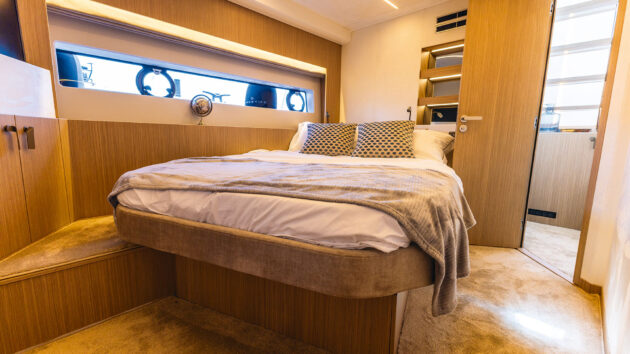
While this VIP cabin is superior to the M48’s two guest cabins, the third cabin is distinctly poky
While the starboard twin is distinctly compact, the port VIP comes with extra room at the back end for a walk-in wardrobe and a transverse bathroom that encompass the entire beam behind both cabins. That provides cruising guests with extra comfort and privacy, as well as additional separation from the noise and vibration of the engine room.
Performance
In taking the established Prestige principle of creating boats that feel like homes on the water, and developing it with the extra beam, height and volume that a purpose-built powercat provides, the M48 is probably more about the destination than the journey.
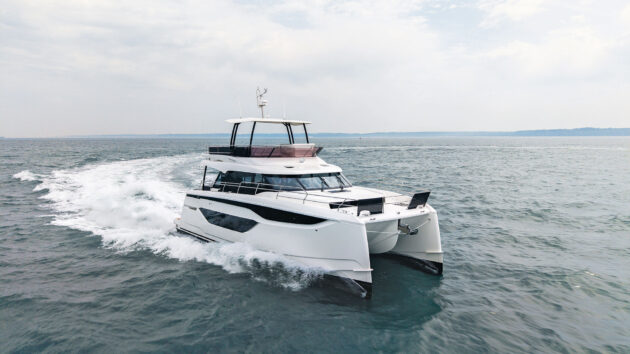
Prestige m48 It’s about ease and serenity in calm conditions
In spite of being three tonnes heavier than the F5.7 and able to carry four people more, it uses a pair of relatively modest Volvo Penta D4-320s hooked up to V-Drives. It also uses quite a deep bridge deck to create maximum internal volume for that show-stopping bow cabin, so this is not one for keen drivers.
Whenever it meets swells or wakes in excess of around 2ft, that central hull section behaves precisely as you would expect, making contact with the water, registering a muted booming impact, arresting your pace by a knot or two and flinging a little spray up and over the foredeck. But in flatter conditions, the drive could hardly be more serene.
There’s no hump to climb, nor any associated peaks and troughs in fuel efficiency. Instead, this mighty chunk of floating real estate simply moves forward through the water with a linear increase in fuel usage from zero right up to the maximum of around 19 knots.
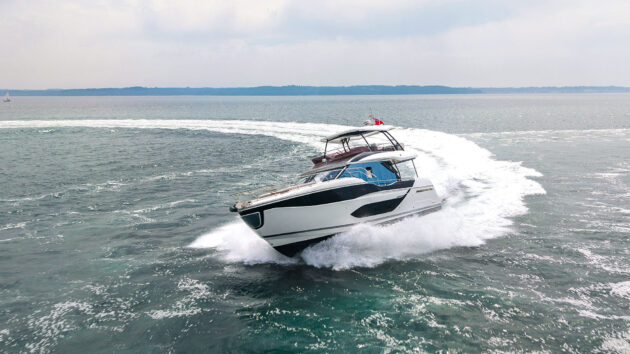
Prestige f5.7 For fun and agility, the F5.7 is an easy winner
If you choose to cruise at 7-8 knots, you can expect to sip fuel at less than 2 litres per nautical mile, with a range from those twin 600-litre tanks of between 500 and 600 miles.
If you increase that to 10 knots, you’re looking at closer to 5 litres per nautical mile and a cruising range of just over 200 miles – and at the top end, that pushes on to 6.5 litres and just under 150 miles. But critically, this boat feels much the same whether you’re doing 9 knots or 19.
There’s no discernible change in attitude, engine noise or ride quality so if you’re happy to take things easy, it makes a great deal of sense.
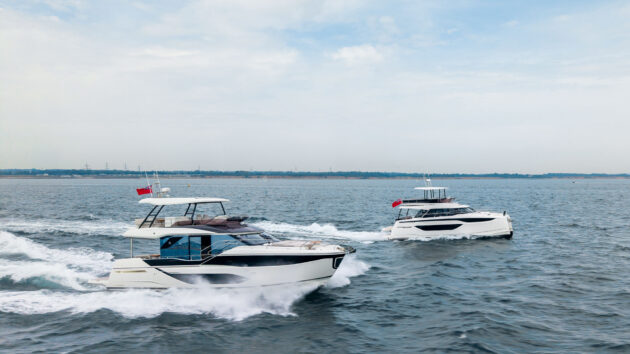
The M48 is flat, slow, stable and efficient. The F5.7 is more rapid, agile and engaging with significantly better helm stations
More from the monohull
With a pair of IPS-800s (D8-600s) on long jack shafts to help optimise the weight distribution, the F5.7 has almost twice the power of the M48. But rather thoughtfully, it uses an extra bulkhead inside the engine bay to help minimise reverberation and pin the decibel readings down around the upper 70s at everything above 12 knots.
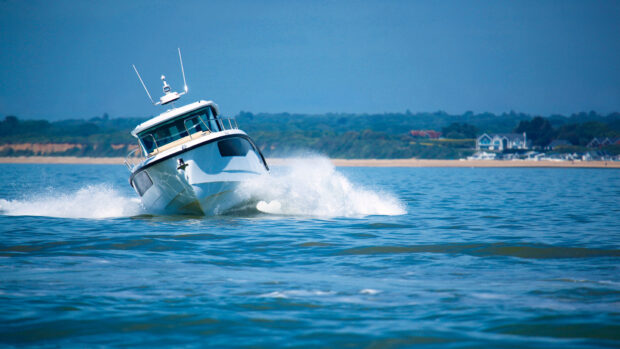
Running into a 3ft head sea at 21 knots, the F5.7’s Michael Peters hull also works a treat, lifting the most voluminous forward sections above the point of impact and providing both decent ride quality and very acceptable splash deflection.
Visibility from the lower helm is pretty good by the standards of a flybridge cruiser too but if you want to change your view, you have two more helms (a flybridge helm and an optional cockpit helm) to play with.
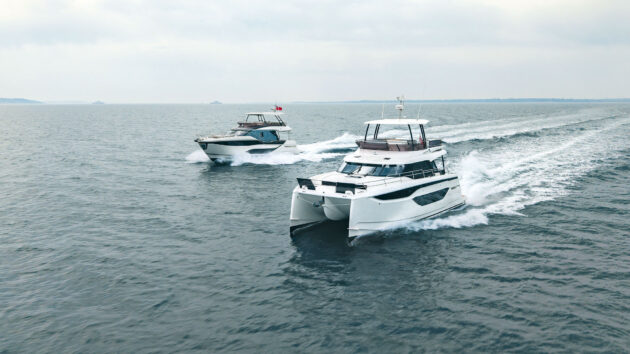
While the F5.7 is a third more costly to run, it’s actually longer-legged because it has almost double the fuel capacity
While getting to the flybridge is more of a mission than on the M48 because of the relatively steep steps, the upper helm itself is a treat. It sits on the port side, surrounded by relaxed sunbed-style companion seating with roving backrests.
You get excellent views of the bow, even from the sitting position and while it’s not quite as soft-riding as the M48, the handling feels just as user-friendly. It’s a very easy and comfortable boat to drive, with plenty of heel and a good natural balance.
The running efficiency also looks decent by the standards of the class. From 13 knots right through to the top end, we’re seeing fuel flow of between 8 and 10L/Nm.
At the lower end of that spectrum, that makes it about 35-40% more costly to run than the M48 but thanks to a pair of 1,100L fuel tanks (totalling 1,000L more than the M48), the range is greater at every rev increment – and with a top end of 25.3 knots compared to the M48’s 19 knots, the outright speed, like the handling, is also significantly more engaging.
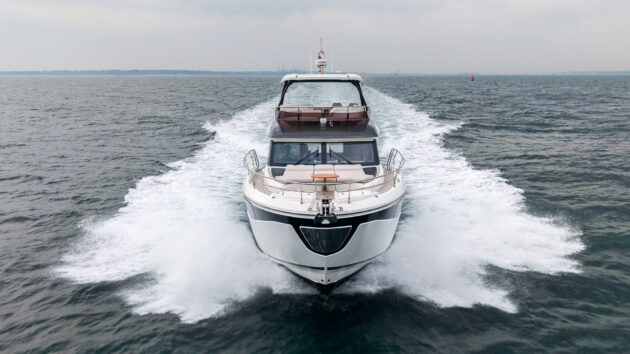
OPrestige f5.7 The monohull is fun en route as well as at anchor
Which boat wins?
The M48 does everything Prestige intended. In addition to its volume, stability and running efficiency, its combination of wide open decks and freestanding furniture is highly flexible. It’s by no means a rough-weather or long-distance boat and it lacks both the style and the driving fun of the monohull.
But if you’re looking for a big, satisfying, novice-friendly platform that makes the most of its length, both as an overnighter and as a party platform, the M48 is a powerful contender.
As for the F5.7, the design intelligence, space management and sociability behind the cockpit, flybridge, saloon and bow space do a great job of mitigating any difference in terms of outright scale. And while its owner’s cabin can’t compete with the M48 to the same degree, either in terms of size or privacy, it again mitigates the deficit on both counts by means of that cleverly elevated bow.
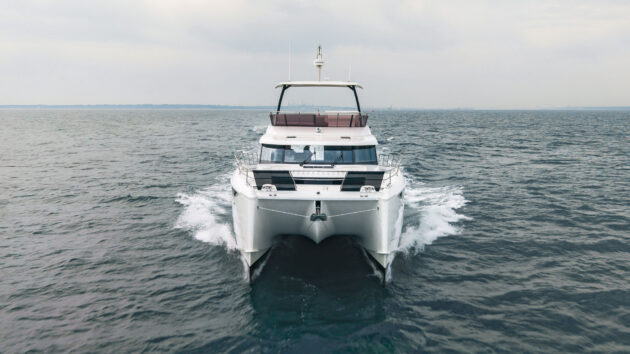
Prestige m48 The cat feels like a floating entertainment hub
The price comparison is equally interesting. The F5.7 is about £75,000 (7%) more expensive to buy than the M48 in base form and £230,000 (or nearly 16%) in high-spec test boat form – and that makes the extra space of the M48 seem all the more impressive. But ultimately, the choice is not actually about one hull or two because, in reality, these are just two cruising boats that address different elements of the same core application.
So if, for you, cruising is about a quiet and comfortable sunny-weather transit between destinations, about large day parties at anchor and about lower purchase and running costs, the M48 is the superior boat. If, however, you value driving fun, dynamic styling, an internal helm position and a palpable sense that you’re on a boat rather than merely a floating entertainment hub, the F5.7 is likely to remain the better bet.
M48 specifications
LOA: 48ft 6in (14.79m)
Beam: 19ft 7in (6.00m)
Draft: 3ft 6in (1.08m)
Displacement: 17,500 kg (light)
Fuel capacity: 2 x 600 litres
Water capacity: 600 litres
Engines: twin Volvo Penta D4-320s
RCD: B12 / C14 / D16
M48 costs and options
From: £1,024,182 ex VAT. Test boat including the following options…
M48 Excellence trim: £104,364
Garmin Surround View: £29,182
Chilled water AC: £35,000
Letterbox passerelle: £22,273
Flybridge hardtop: £18,545
Elec pack and lower helm: £35,409
F5.7 specifications
LOA: 56ft 6in (17.27m)
Beam: 15ft 3in (4.68m)
Draft: 3ft 9in (1.20m)
Displacement: 15,100kg (light)
Fuel capacity: 2 x 1,100 litres
Fuel capacity: 600 litres
Engines: Twin Volvo Penta IPS-800s
RCD: B10/C12
F5.7 costs and options
From: £1,098,091 ex VAT. Test boat including the following options…
Crew cabin: £3,564
Letterbox passerelle: £35,455
Flybridge hardtop: £35,364
Zipwake interceptor tabs: £12,027
Hydraulic platform: £33,364
Seakeeper SK6 gyro: £91,909
Tropical spec AC: £79,000