

Why SEA.AI’s new virtual watchkeeper could be a game-changer for boat owners of all types and sizes. Hugo Andreae reports
What’s your worst fear as a boater? Colliding with another boat? Hitting a semi-submerged log? Failing to spot an open-water swimmer? Getting entangled in a lobster pot? All of them could be catastrophic, yet it’s easy to imagine it happening.
However attentive we are, it only takes a momentary distraction or visibility compromised by low light, glare or rolling seas and before you know it, the unthinkable has happened. The solution, according to SEA.AI is a virtual watchkeeper that never sleeps, can’t be distracted and uses artificial intelligence to recognise and alert you to any potential collision threats.
It works by using a combination of super sensitive low light and thermal vision cameras to spot things in your path which even radar and AIS might miss. It then compares any floating object it detects to its database of over 18 million images of previously identified items and alerts the skipper with visual and audio alerts showing what the danger is and how urgent a threat it poses.
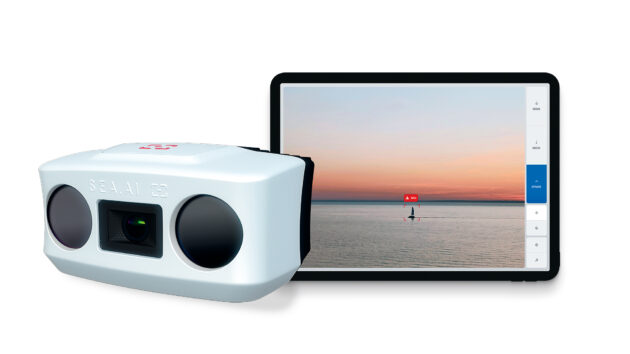
The new SEA.AI Watchkeeper can identify hazards that the human eye might miss
Robot Vision
While this technology has been around for a while (we wrote about its predecessor the OSCAR Sentry in 2021), the cost and size of the hardware involved limited its appeal to superyachts and serious blue-water cruisers.
Now, improvements in packaging and falling tech prices have brought it within reach of many more boaters. Its latest product, the entry-level SEA.AI Watchkeeper, starts at €4,490 ex VAT and can easily be fitted to boats as small as 30ft.
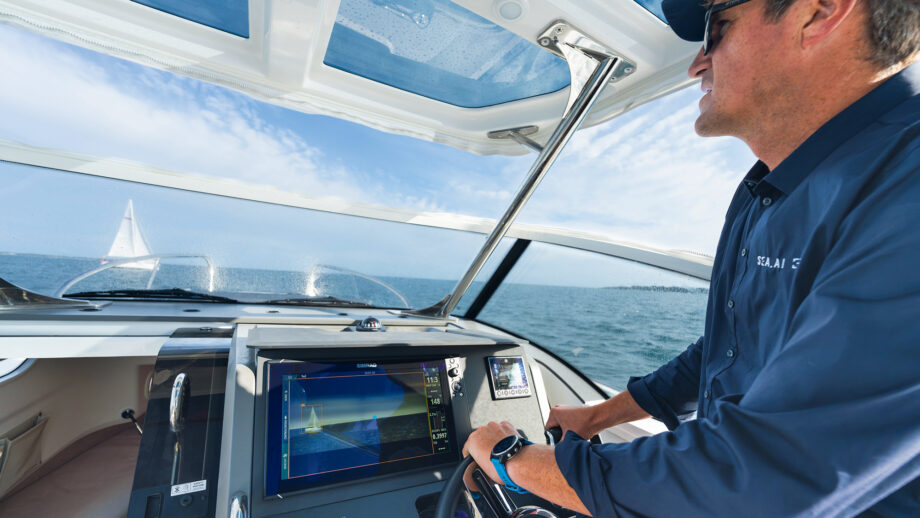
Launched at the Cannes boat show last month, the photos show it mounted on the hard top of a Nimbus T9 sportsboat, looking no more out of place than a GPS receiver or VHF antenna. Weighing just 935g and measuring 110 x 163 x 86mm, it simply bolts onto a radar mast or any other high point with a clear view forward.
Article continues below…

OSCAR first look: The revolutionary system bringing AI to yacht navigation
Even this entry-level model is claimed to see further, in a wider variety of conditions and with much greater accuracy, than the human eye. With a view that extends from immediately in front of the boat all the way to the horizon and a 135-degree field of vision, it can pick up objects as small as a pot marker or human head.
It can even spot the spout of a passing whale or semi-submerged piece of driftwood. That said, the actual precision and low-light ability of the system is dependent on the specification of the Watchkeeper’s built-in cameras.
The basic Watchkeeper Lite model comes with a 3840 x 2160 pixel colour camera that can pick up a large ship on the horizon, a motor or sailing boat at 900m, a jetski or RIB at 350m and a pot marker or human head up to 65m away.
The Watchkeeper 320 adds a basic thermal imaging camera to the package, extending its ability to spot dangers at night but also increasing those last three range figures to 1,300m, 500m and 110m respectively, albeit at the higher price of €8,290 ex VAT. The top of the range Watchkeeper 1280, meanwhile, pushes the range out even further to 2,500m, 960m and 220m respectively.
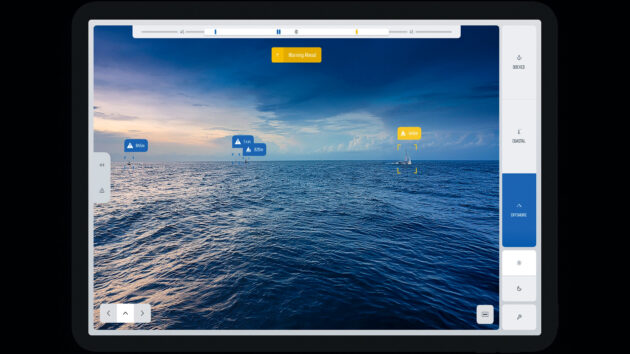
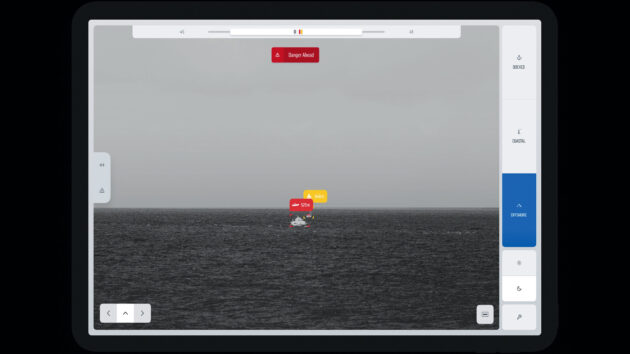
Each hazard is flagged with an identifying icon and a colour code of urgency
Lobster Pots ahead
Whichever cameras it has fitted, the software continuously scans every pixel on the live video stream, using its algorithms to search for anomalies among the waves. As soon as a floating object is detected, it locks onto it, classifies it as one of nine categories (ship, motor boat, yacht, dinghy, buoy, container, whale, person or unidentified hazard) and triggers an audible and visual alert, identifying the object along with its distance and bearing.
This can either be overlaid onto the camera’s video feed with an identifying icon, range and a traffic light system of colours to show how immediate the threat is or, if the MFD screen is being used in chart or radar mode, it will simply announce the threat as ‘danger ahead’ (or to port or starboard) with increasing volume and frequency if no action is taken to avoid it.
The system is compatible with all the main manufacturers of modern MFDs and is designed to work offline, only needing a Wi-Fi connection for software updates and ever more advanced data sets of recognised objects. It can also be streamed to a tablet or smartphone so you can keep an eye on things if you nip below deck to make a cuppa.
An optional thermal camera adds night vision to its regular low light cameras
A black box solution, called SEA.AI Brain, offers all the same features but uses existing third-party thermal imaging cameras that boat owners have already fitted to their craft. It’s important to note, however, that none of these products is being promoted as an alternative to radar or AIS systems but as an adjunct to them.
For instance, it is not designed to identify land or rocks, nor can it pick up sudden rain squalls or weather fronts. And unlike some other anti-collision technologies, such as the WATCHIT system also unveiled at Cannes, it won’t sync with your boat’s depth transducer to warn you of impending underwater dangers.
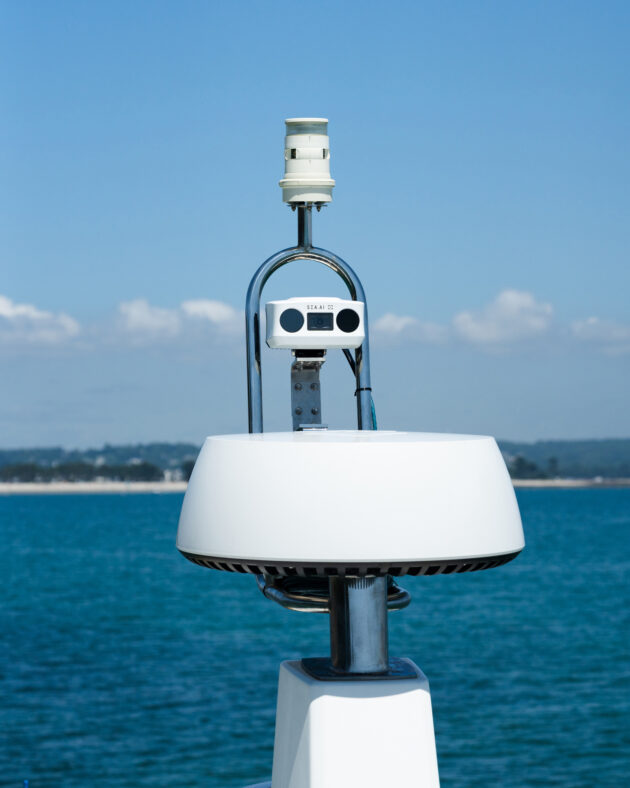
Its compact size and weight make it suitable for smaller boats too
Verdict
While no single piece of technology can replace the eyes, ears and brains of a human boat skipper, SEA.AI’s new Watchkeeper sounds like a formidable extra weapon to have at your disposal.
Its ability to keep an unwavering lookout 24 hours a day regardless of visibility, and its immunity to human frailties such as tiredness, distractions or regular calls of nature, gives it an advantage that no individual can match. Until we have tried and tested the system for ourselves, we can’t fully verify how reliable and accurate it is but the fact that this technology is now available to a much wider section of boaters at a more affordable price can only be a good thing.
It might even help you spot a whale or a passing pod of dolphins.
 If you enjoyed this….
 If you enjoyed this….
Motor Boat & Yachting is the world’s leading magazine for Motoryacht enthusiasts. Every month we have inspirational adventures and practical features to help you realise your sailing dreams, as well as tests and news of all the latest motorboats.
Plus you’ll get our quarterly Custom Yachting supplement where we share the last on offer in the superyacht world and at the luxury end of the market.
Build your knowledge with a subscription delivered to your door. See our latest offers and save at least 30% off the cover price.
Note: We may earn a commission when you buy through links on our site, at no extra cost to you. This doesn’t affect our editorial independence.