

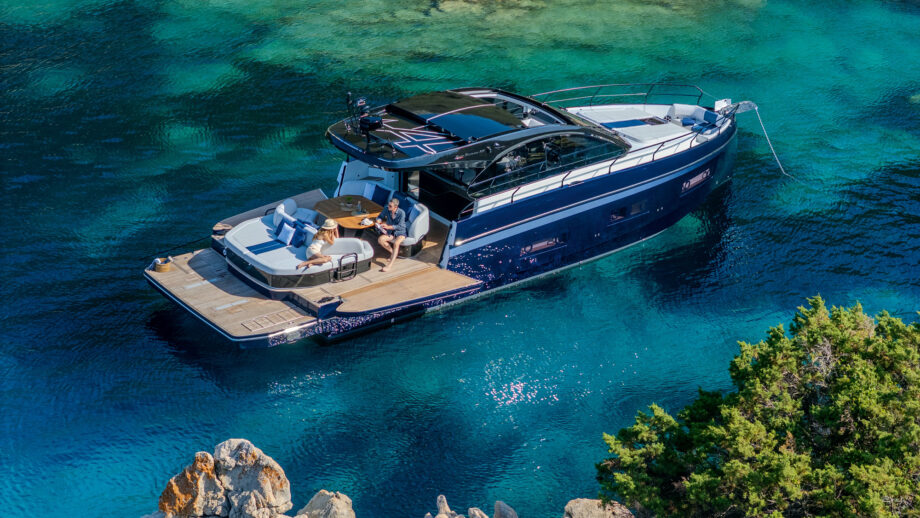
Just how good is the new top dog in Beneteau’s next-generation express cruiser range? Alex Smith gets behind the wheel to find out
There’s certainly no shortage of options in the 50ft Grand Tourer segment. Azimut, Princess, Galeon, Fairline and Sunseeker all have powerful contenders, so Beneteau’s new GT50 really needs to stand out from the crowd and, to a degree, it does.
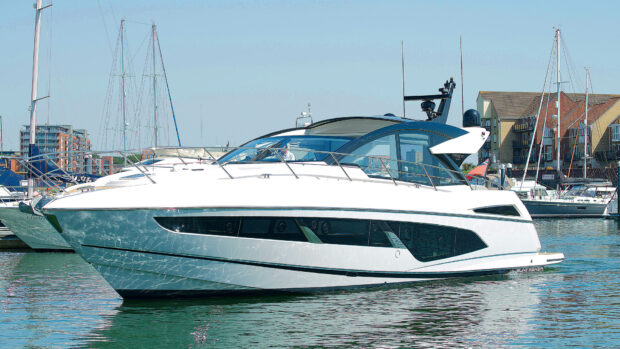
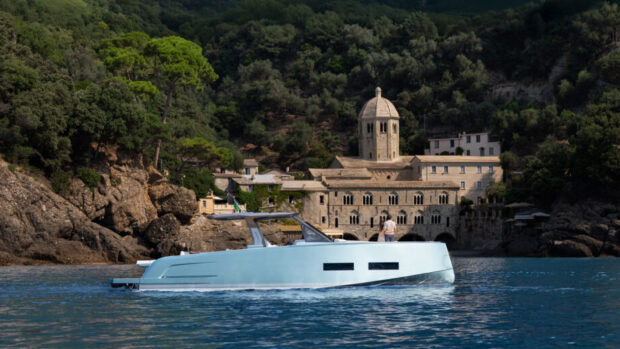
Though its clean lines are apparently inspired by the Japanese principles of Kanso (simplicity) and Yugen (grace), you also get the option of souping them up with the automotive-style special edition vibes of the Alpine pack.
The test boat has exactly that and it makes itself known in the black anodised rails, as well as in the lustrous blue hull colour and the carbon-fibre detailing.
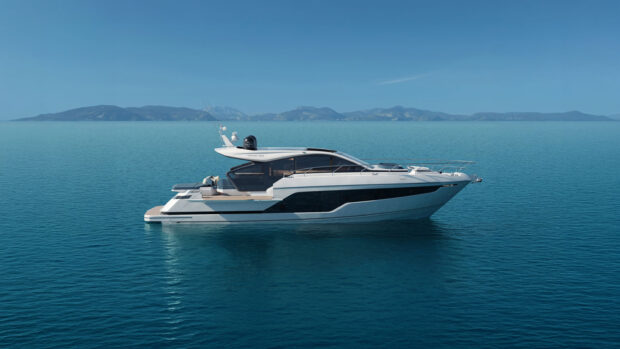
But the purposeful reverse bow would be pretty whatever colour you chose and the low-profile, glass-lined superstructure also hits the mark. So for a brand better known for practical cruisers than glamorous Med boats, it’s a fine attempt at bringing the next-generation Beneteau GT line back into contention with the industry’s frontrunners.
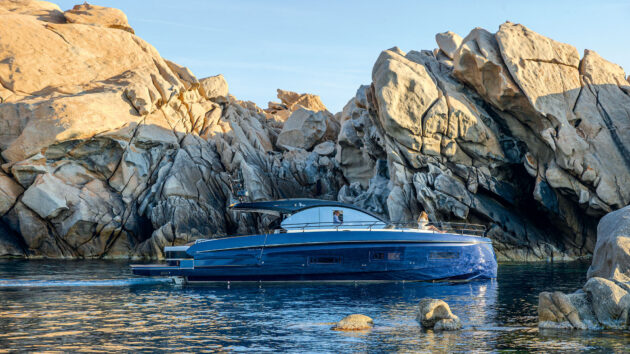
The styling of this glamorous Med-ready platform is a million miles from the practical GT cruisers of the past
The great outdoors
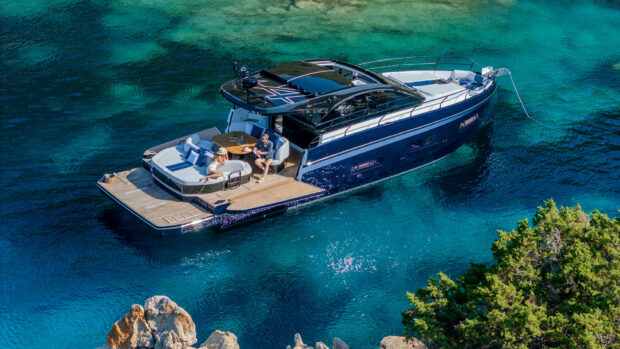
When you take a cursory peek inside, the layout of the external decks appears to tread a slightly more formulaic line than the styling. The bow’s island sunbed, for instance, leads aft along symmetrical side decks to a cockpit with a central sun pad and dining unit, an open transom, a high-low platform and a pair
of drop-down bulwarks.
That’s a pretty well-trodden path among Med boats but, in terms of sheer deck space as well as execution, it does feel exceptionally strong for a 50ft boat – and that makes good sense.
After all, this is a boat designed to excel in terms of outdoor space, so while the old GT50 used a fixed transom with a built-in tender garage, this new version drops the garage in favour of what could reasonably be described as a beach club.
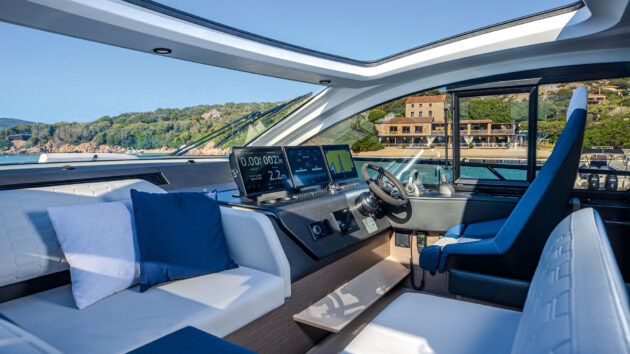
If you grow tired of climate control, you can open up the GT50’s protected helm to the elements
What that means in practice is an open single-level deck with a huge swim platform just a single step below the cockpit. It also means that the two fold-down side terraces come as standard – and if you upgrade to the hydraulic aft platform so you can drop it below the surface, the sheer degree of integration with the elements is very striking.
The seating collaborates in that too. A pair of delightfully sociable (almost intimate) angled settees wrap around one another, with a table in the centre that folds both ways so you can move through the space freely. It also lifts clear so you can get to the engine hatch underneath.
The aft bench backrest, meanwhile, flips forward to elongate the big sun pad, leaving just a pair of corner seats facing forward to the opposing settee. And there’s a slim locker beneath the sun pad to help compensate for the absence of a tender garage with space for lines, fenders and toys.
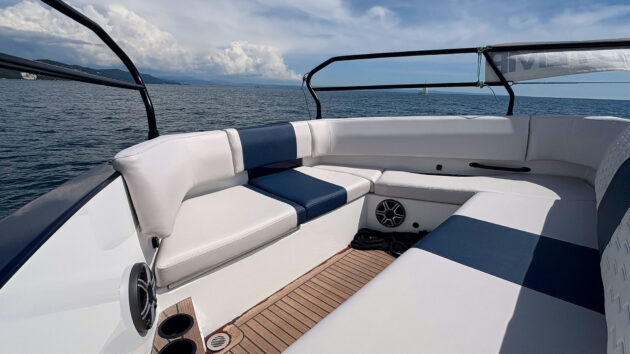
For many, the bow lounge will be the most appealing place to sit
If you do decide you want to carry a tender, though, the hydraulic platform option with the integrated flush-mount cradle enables you to carry anything up to 350kg, which brings a small Williams or a Sea-Doo Spark into the mix.
You can also spec an awning, both from the back of the roof structure and out over each of the two side terraces; and if you really want to shut off the back end up for year-round entertainment, and help compensate for this boat’s very deliberate lack of indoor day spaces, the optional canvas enclosure would be a really worthwhile option.
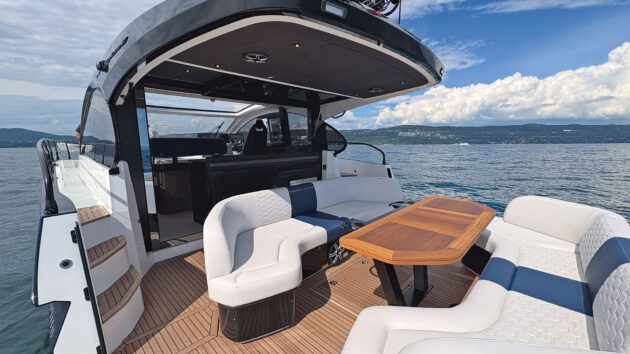
The cockpit’s sociable wraparound dinette provides masses of storage, as well as seating
Interestingly, when you head toward the bow, the fact that you take three steps up to the foredeck suggests that Beneteau has designed this boat with at least half an eye on the cabin spaces. But just as the bow’s raised island sunbed begins to cement that idea in your mind, you witness a delightful bow lounge, sunken deep into the elegant forepeak – and once again, the day spaces take back the initiative.
When you perch yourself in here, the backrest comes right up to your shoulder blades so it feels fantastically sheltered and secure, which is particularly welcome when cruising with a young family. And it’s big too, in fact, it will happily swallow up to six people at a time and that makes it a really valuable alternative to that wide open aft cockpit.
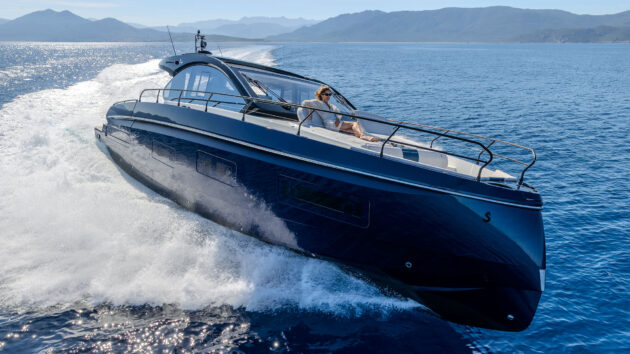
It hits a 32-knot top end
Sheltered helm
Between the bow and the cockpit deck is a relatively short superstructure. Single-piece side windows that extend beyond the aft doors make it look larger than it actually is, while providing some useful shelter from the elements in the big cockpit deck. But all we really have space for in here is a galley and a helm with a bit of companion seating.
The transverse galley itself is well done though. It comes with a hinged window that flips up so you can serve food and drinks to guests in the cockpit. There’s also a narrow bar, a fridge and a slide-out tray on the external side of the bulkhead, with a power point for an electric griddle to help reinforce that interplay between the inside and outside.
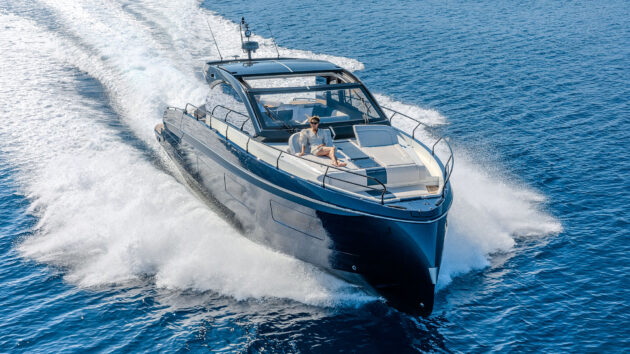
If you want blockbuster speed to match the blockbuster looks, you’ll have to hope for an outboard version
The galley is deep and high too, with excellent storage space. There’s also a two-ring induction hob and a decent bit of work surface, plus a couple of fridges and space for either a wine cooler or an ice maker to starboard.
There’s also a microwave, tucked out of sight beneath the skipper’s chair. There’s no reason why you shouldn’t use a microwave at knee level in a closed compartment beneath a seat but, like the griddle tray, its position seems just a shade odd.
In any case, ahead of the galley is a starboard helm seat and a compact bank of seating that sits directly beside and ahead of that, cutting into the dash moulding and dominating the centre of the boat. It’s big enough for three or four people and it comes with a roving infill module so you can lounge instead of sit.
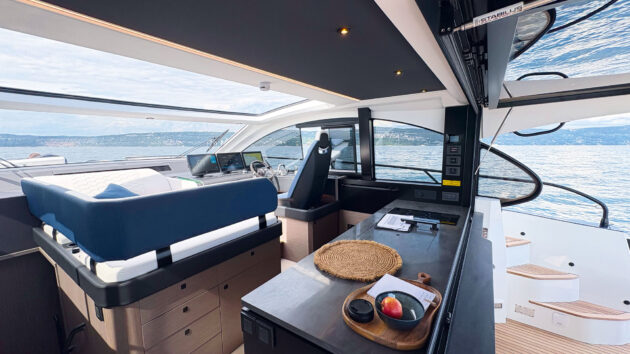
The galley opens directly out into the cockpit
It’s an excellent companion seat for lengthy trips in comfort – and it’s all the more comfortable because you can close off this entire section (galley, helm and seating unit) for year-round use. Again, like the prioritising of open deck space, the inclusion of a closed climate-controlled helm was a key design priority based on Beneteau’s Seanapps data – direct feedback from the Beneteau Group’s vast customer base, which tells them exactly how people actually use their boats.
And for sheltered helming with a small family, you would have to say it works very well indeed. But there’s no option (nor any real space) for a table so if you want to dine, you’re doing it outside.
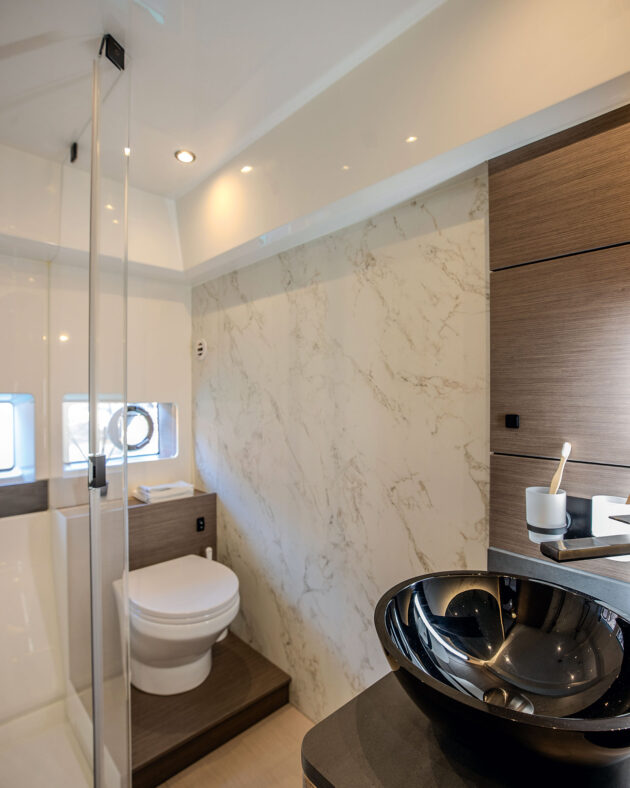
The day heads sits opposite the owner’s ensuite and gets the lion’s share of the space
Cabin conundrums
The stairwell to access the lower deck is left open to the ‘saloon’ to avoid wasting any space on doors or partitions and that makes good sense, given that the entire zone can be shut off from the outside world.
As for the basic layout, that sees the midships section split between a guest triple and a smaller single with restricted but adequate headroom. The owner’s cabin, meanwhile, sits beyond the two bathrooms in the bow.
Now of course, that brilliant sunken forepeak lounge threatens to impact on headroom in the forward cabin but the designers have mitigated that by shifting the space slightly aft into the broader section of the hull.
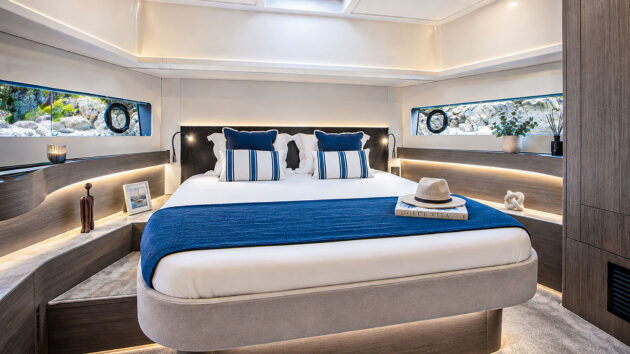
Three steps up to the bow’s island sunbed creates surprising volume in the owner’s cabin
The result is plenty of space on both sides of the bed plus plenty of clearance to sit up and read a book at the head end. And because of all that height, the bed itself is sufficiently raised for a huge ply-lined baggage space, easily accessed with one hand.
It’s also worth mentioning that the ensuite comes with a separate shower with a good size of seat plus sufficient headroom for a proper rain shower.
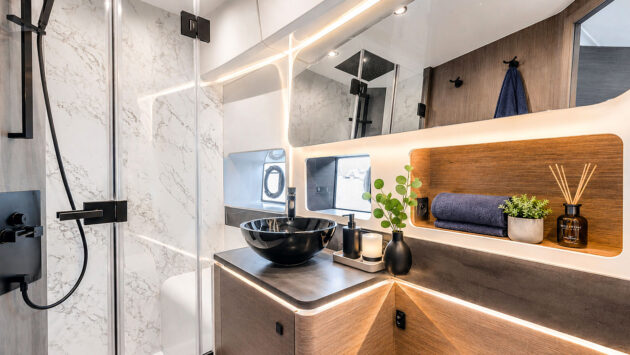
The owner ensuite might be slim but it comes with lots of headroom and a rain shower
Whether you will be able to change things up and spec that midships space as a full-beam owner’s cabin at some point in the future is currently uncertain but, given the spaces you get up top, the test boat’s three-cabin, two-bathroom layout is very acceptable indeed.
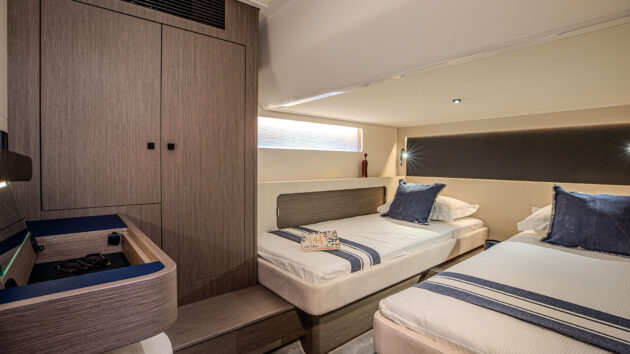
The guest triple does a good job of freeing up the single for storage
Easy underway
The only engine option on this boat is a pair of Volvo Penta D6 IPS 650s, so as a 13-tonne 52-footer, we’re not expecting the performance to be as bold as the styling.
But the way it’s all laid out looks pretty good. A pair of jack shafts helps shift the weight forward and while there’s not a huge amount of room in the engine bay, there’s enough for all the key kit, including a port battery bank, a generator and a pair of fuel tanks totaling 1,300L.
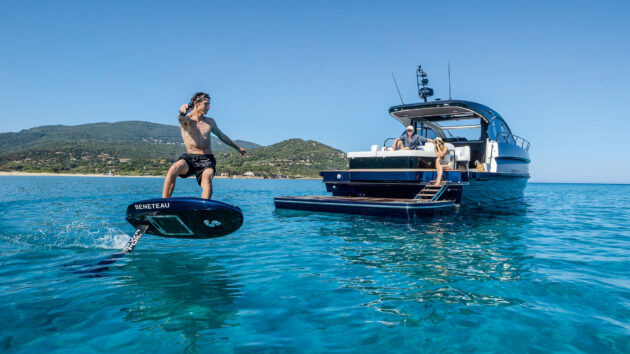
Day spaces are king both fore and aft
As for the driving experience, it’s not just the concept, layout, styling and application that has changed over the old model. The hull has been completely changed too, by British naval architect, Bill Dixon. The aim is to plane quickly, run efficiently and handle predictably and we can certainly confirm all of that.
We also get stable tracking off the plane courtesy of that extended waterline length – and in spite of the fact that we record a fairly modest top end of 32 knots, this boat achieves its peak cruising efficiency at between 28 and 31 knots, so a fast cruise is both comfortable and surprisingly economical, particularly as you can ease off on the tabs a touch and let the hull do its thing.
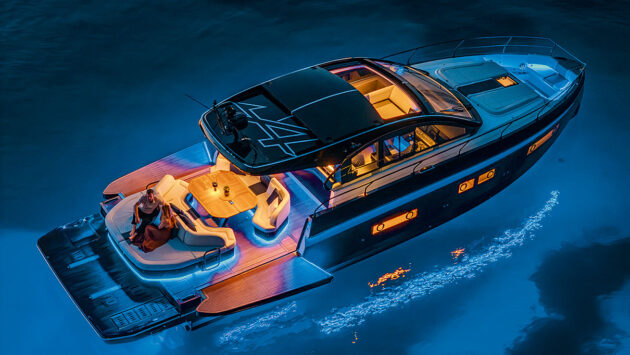
The beach club terraces come as standard
With a fuel flow of about 5.5L per nautical mile, this kind of pace sees the range push on to around 190 miles.
The practicalities at the helm are good too. You get a side window so you can crouch on the side deck and reach through to the joystick when parking solo. The elevated position and one-piece screen are great for visibility and, as a six footer, you can stand with your head through the sunroof and still reach the adjustable wheel with ease.
In the future, it’s reasonable to expect the option of a beefy outboard rig to increase the pace and satisfy the American market. But for now, this is a potent-looking boat with very acceptable performance.
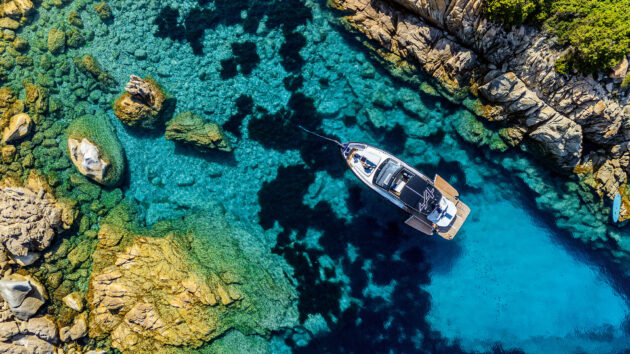
Beneteau GT50 specifications
LOA: 52ft 4in (15.95m)
BEAM: 14ft 8in (4.48m)
DRAFT: 3ft 10in (1.18m)
DISPLACEMENT: 12,961kg (light)
FUEL CAPACITY: 1,300L
WATER CAPACITY: 400L
ENGINES: Twin Volvo Penta IPS-650s
Beneteau GT50 costs and options
Price: From €950,000 ex VAT. Test boat includes the following options…
Hydraulic platform with tender supports
Seakeeper 6 gyro
Glass sunroof
Joystick control
Zipwake tabs system
Alpine trim package
Lumishore lighting package
Verdict
This new Gran Turismo flagship is so far removed from the old GT50 that it’s like a boat from an entirely different product line. But in light of the style and playfulness of the smaller GT35 and new GT40, recently unveiled to the world in Cannes, the distinctiveness of this new platform makes a lot of sense. The aft deck is big and open, the bow lounge is fantastic and the covered helm is a treat. And while it’s built around the idea that life happens outside, rather than inside, the cabins are also remarkably decent. So if you want a cool-looking weekender for entertaining family and friends by day and sleeping comfortably by night, it’s a tempting prospect. But if you want proper indoor day spaces for longer range cruising in all weathers, you’ll need to look elsewhere.