

Hugo Andreae tests Garmin’s new OnBoard wireless engine cut-off and MOB system
Kill cords, or engine cut-off systems as their manufacturers like to call them, are a personal bugbear of mine. How is it that something as sophisticated as a modern boat engine is often reliant on something as basic (and I would argue, fallible), as a plastic coated string to prevent a minor accident turning into a life-threatening one?
The problem isn’t the cord itself, it’s the risk of human error. Forget to attach a kill cord, as all of us have done at times, and it is as useless as an unworn seatbelt.
Thankfully there are more sophisticated alternatives. I’ve been using a wireless kill cord on my boat for almost 20 years. Made by Coast Key, it’s a fob on a lanyard that uses an electronic signal instead of a cord to maintain a virtual link with the engine.
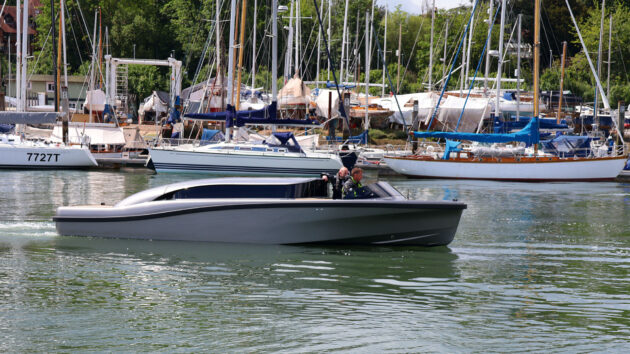
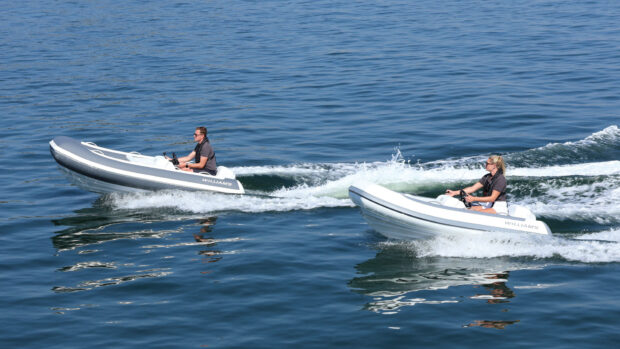
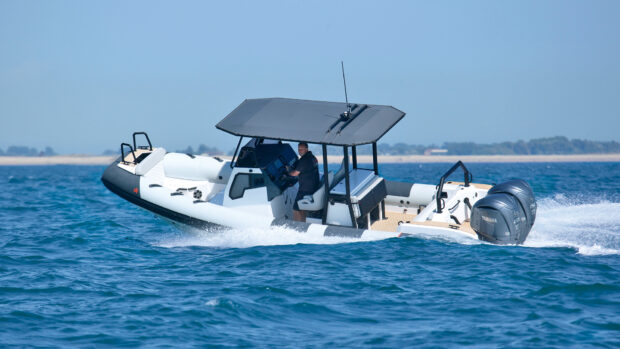
The Pascoe superyacht tender used for the test
If that signal is cut, by falling overboard or moving out of range, the engine stops. It has never gone wrong and I have never forgotten to use it – I can’t because the fob has a remote starter button for the engine, replacing the standard ignition key.
It’s also far more convenient than a kill cord as it allows me to move around the boat to adjust lines and fenders, help with a child’s lifejacket or check a fishing line without having to cut the engine or unclip from the kill cord.
Tag a friend
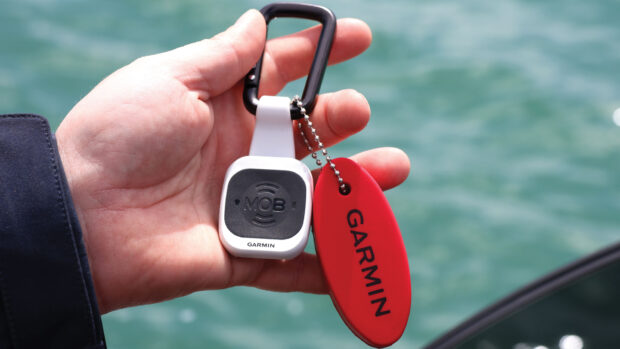
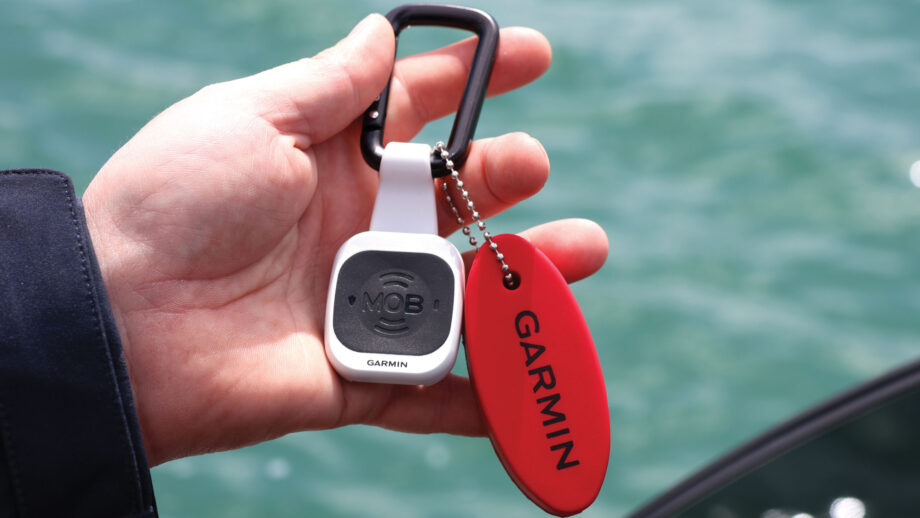
Last year Garmin saw the light too, launching its own combined wireless kill cord/MOB detection system called OnBoard. This comprises a blackbox receiver, known as the GOS 10 Hub, an engine cut-off harness compatible with almost all modern inboard and outboard engines, and one or more programmable tags that you can designate as either Captain or Passenger tags. These can be worn round your wrist or clipped to your clothing/lifejacket using the wrist strap and carabiner supplied.
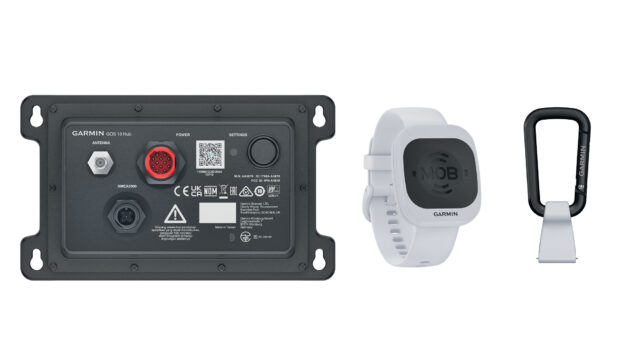
A short-range radio signal allows the tag to act like a wireless kill cord as well as an MOB alarm for crew
The beauty of the OnBoard system is that it integrates with Garmin’s range of plotters/MFDs, so that it not only alerts you of an MOB but also marks the position they fell overboard and plots a route back to it.
If it’s the Captain’s tag, it also cuts the engine, preventing the boat from motoring off without you or, worse still, mowing you down.
That’s the theory at least but until now we’ve never had a chance to test it. That changed when we were invited to trial it on board a Pascoe 8.4m limousine tender, built for ferrying guests to and from a megayacht.
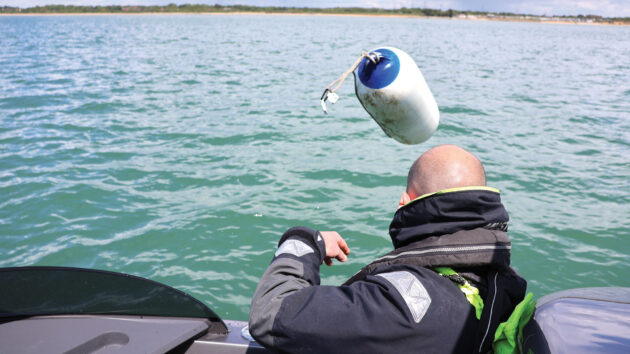
We attached the Captain’s tag to a fender and threw it into the sea from a moving boat to simulate a MOB situation.
Trial by Water
Heading out into Southampton Water, we first went through the process of designating and pairing the tags. The system can cope with up to eight tags but only one of these can be designated as a Captain.
They are powered by a standard lithium cell battery, which can easily be replaced by the user. There’s a small on/off button on the side, a large central one so wearers can trigger an alert manually, and two coloured LEDs.
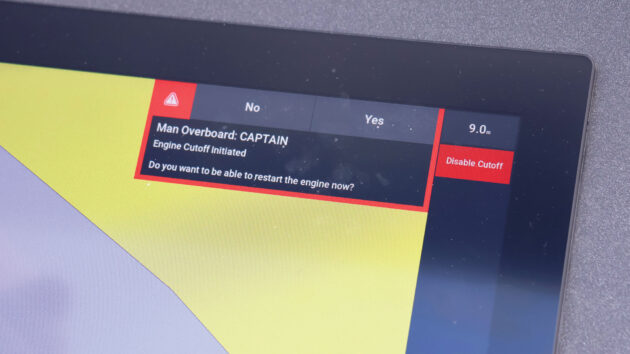
As it was the Captain’s tag, the engine was cut-off in addition to the MOB alert triggered by any of the Passsenger tags.
The one with the shield logo shows the connection status (green is connected and protected, amber is connected but not protected and red is not connected), the one on the right shows the battery status (green is good, amber means replace soon and red is critically low).
Once paired and designated as either a Captain or Passenger tag, they can also be assigned a name and overlaid at the top or bottom of a plotter screen so you can instantly see who’s on board and the status of their tag.
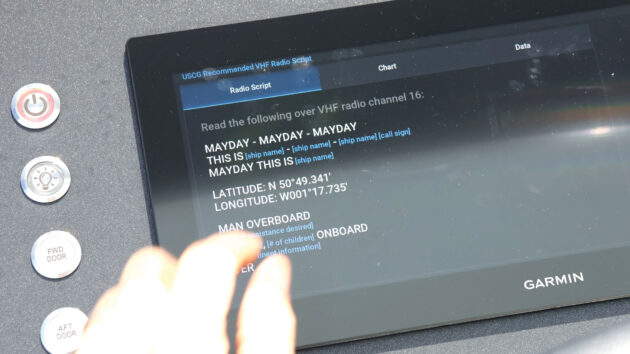
Once you’ve acknowledged the MOB alert, a MAYDAY script appears on screen so you can call it in by VHF radio
If a Passenger falls overboard, the fob’s signal is either cut off immediately by the water or drops out of range at around 20m. As soon as this happens an alarm sounds, an MOB waypoint is placed on the chart with a bearing line back to it, and a window pops up on screen with a script for a VHF Mayday alert should you deem it necessary. The Captain’s tag does all this too but also cuts off the engine.
We wanted to test the full functionality so attached the designated Captain’s tag to a fender and dropped it overboard while motoring along at 20 knots.
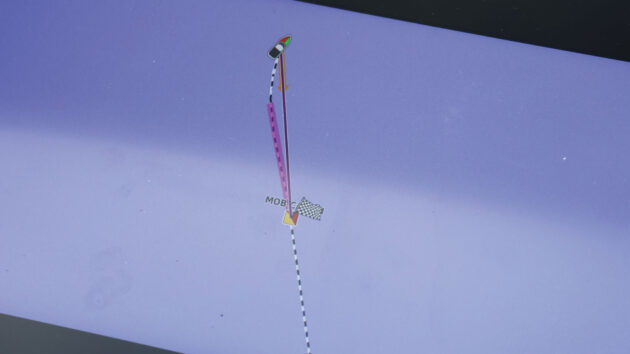
It also places an MOB waypoint on the chart plotter so you can navigate back to where they fell overboard.
Within two seconds of it hitting the water, the alarm sounded and a second or so later the engine cut out. In addition to the Mayday script a message also popped up on screen asking if we wanted to restart the engines. This enables any passengers left on board to restart the engines and motor back to retrieve the skipper.
We repeated the exercise three times, all with exactly the same result. Another handy feature is the ability to temporarily disarm a tag by pressing and holding the power button for two seconds, for example when stepping off the boat to refuel. The tag will then automatically try to reconnect after 15 mins (or longer if you adjust the settings).
Verdict
Perhaps it’s no surprise that one of the first boats to have the OnBoard system fitted is a megayacht tender – it’s never a good idea to lose anyone overboard, least of all a billionaire! Thankfully, the relatively affordable cost of it (£559.99 for the kit and one tag, £149.99 for additional tags) ensures it’s equally accessible to those of more modest means. Personally, I still favour the Coast Key system for use on small open craft due to its remote start function all but eliminating the chance of setting off without it switched on. For larger craft, where the added security of an MOB system for passengers outweighs this, Garmin’s new OnBoard kit seems like a no-brainer.