

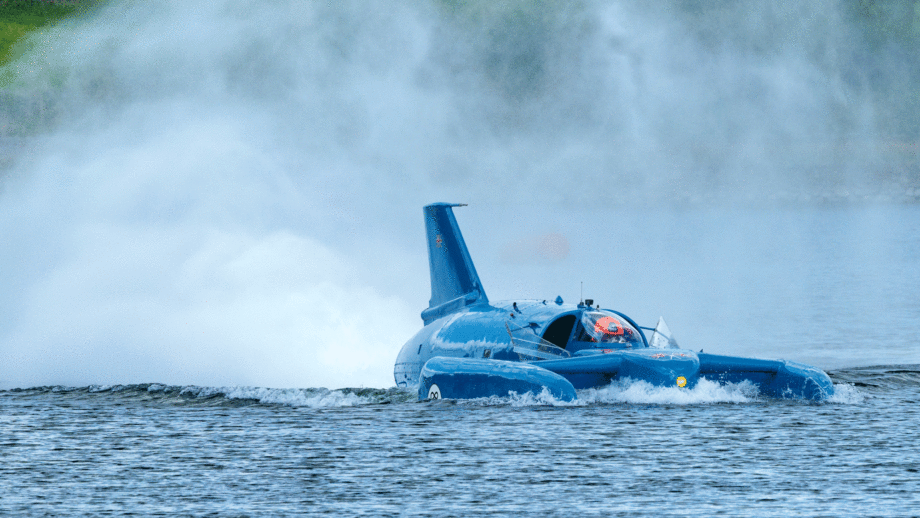
Phil Sampson heads to Coniston to see Donald Campbell’s legendary Bluebird K7 back in action for the first time in 59 years
History and heritage; two terms often interchanged but with distinctly separate meanings. History is an account of the past, while heritage is a celebration of it. Standing on the bank of Coniston Water in mid-May I could certainly feel the weight of history pressing down on my shoulders.
But for the thousands lining the shore for the first, and possibly only, Bluebird K7 Festival, heritage was unquestionably the main attraction.
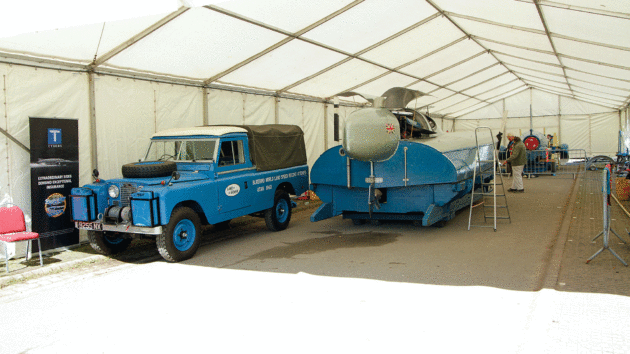
Putting the final touches to K3 in preparation for another fast run. Photo: Phil Sampson
We were all here to witness Bluebird K7 running on Coniston once again after an interval of almost 60 years. Each and every person there, myself included, wanted to witness that event and be able to say, ‘I was there the day Bluebird K7 ran again’. That’s heritage for you.
This is not to say that history has been forgotten, far from it. From numerous conversations with my fellow onlookers I can say with certainty that thoughts of that fateful day, 4 January 1967, when Donald Campbell tragically lost his life in the pursuit of speed, were never far from the collective memory.
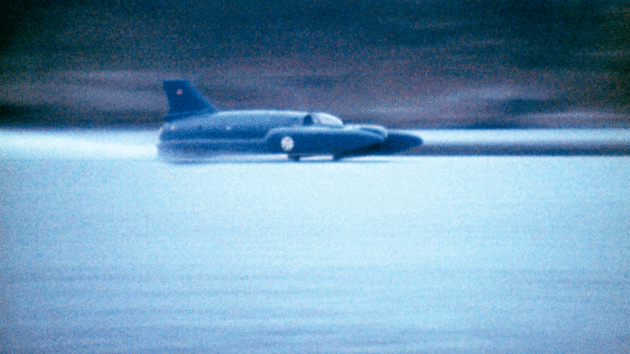
Bluebird K7 running at around 300mph on Coniston Water in 1967 seconds before the crash. Photo: Leo Villa. Inset: The Geoff Hallawell Collection
The Big Crash
Imagine the scene back then: Campbell not only chasing his own World Water Speed Record, which stood at 276.33 mph, but also looking to break 300mph for the first time. Strapped into his jet-propelled Bluebird K7 he had just averaged a tantalisingly close 297.6 mph over a measured kilometre. To qualify as a new world record, the rules required him to complete a second run in the opposite direction within the hour.
If Campbell could push a little harder, he would smash the 300mph barrier and set a new world record. At this point in his career, Campbell had already broken the record seven times in Bluebird K7. Did that make him any less anxious as he lined up for his second run?
We’ll never know, but fuelled by ambition, emotion and adrenaline he spooled up the engine and went for it. Reaching a peak speed just shy of 330mph as he entered the measured kilometre, the record looked well within his grasp. And then, without warning, K7 raised her nose, somersaulted backwards through the air and plunged back into the water, disappearing amidst a plume of spray.
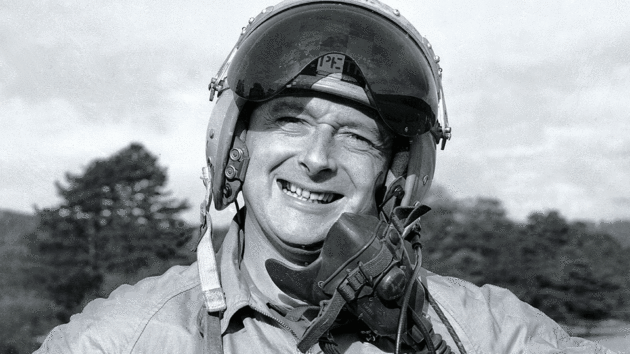
Donald Campbell is still the only man to break both land and water speed records in the same year.
It was all over in seconds but both Bluebird and Campbell’s body would lie at the bottom of Coniston Water for the next 34 years. There are multiple theories about what caused the crash. Some say that Campbell failed to wait long enough for the wash from his first run to subside before embarking on his
return run but many other factors also played a part.
Campbell had decided against refuelling after the first leg, meaning K7 was now significantly lighter with an altered centre of gravity. The engine may also have lost thrust due to a flame-out, causing the nose to pitch violently. Not that this prevented the newspapers from leaping to their own conclusions.
Two days after the crash the Daily Express front cover screamed “This Is Why: Too Little Money, Too Little Patience, Too Little Safety”.
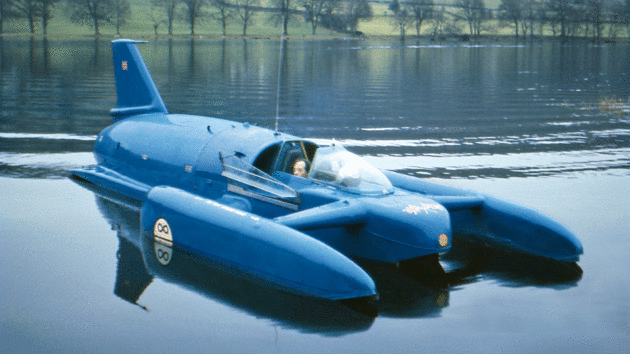
Donald Campbell on Coniston in 1967 shortly before the fatal accident. Photo: Leo Villa
Whatever the cause, or causes, Bluebird K7 and her pilot – the fastest man on both land and water, and still the only man to break the land and water speed records in the same year (1964) – were lost, and would remain so for the next 29 years. It wasn’t until 1996 that a team of divers, led by boat skipper and diver Bill Smith, located the wreck of K7.
The operation to raise it started in 2000 and took almost 18 months to complete. With the permission of Campbell’s heirs, Donald Campbell’s body was also recovered. He now lies at rest in Coniston’s graveyard.
The Build-up
It took the Bluebird Project team a further 17 years to restore K7 to full working order, when she completed a handful of 150mph private test runs on Loch Fad in Scotland.
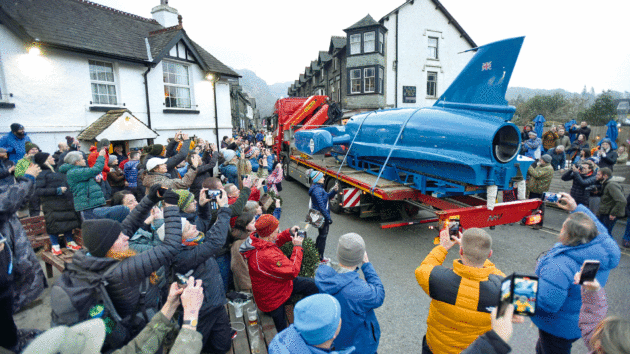
K7 returns to Coniston in March 2024 after being raised and restored over many years. Photo: Asadour Guzelian
While there’s no question that Smith and his team of restorers did a fantastic job in bringing K7 back to life, arguments over who owned what and when she would go on public display delayed the period between her recovery and return to Coniston.
Only in 2024 did she finally make it back to her new home in a specially constructed room at the Ruskin Museum in Coniston. But excitement really hit fever pitch when it was announced that in 2026 she would run on Coniston Water once again.
Pulling in the crowds
“That was always the end-game,” says Ruskin Museum Director, Tracy Hodgson. “We didn’t want her just as a permanent static exhibit; we always said we would put her back on the water.” Given Bluebird’s pulling power, that was a shrewd decision. “The year before she arrived we had 10,000 visitors,” says Tracy. “But in nine months of 2024 we had 63,000 visitors through the door. Why? People remember K7, and Donald was a boyhood hero.”
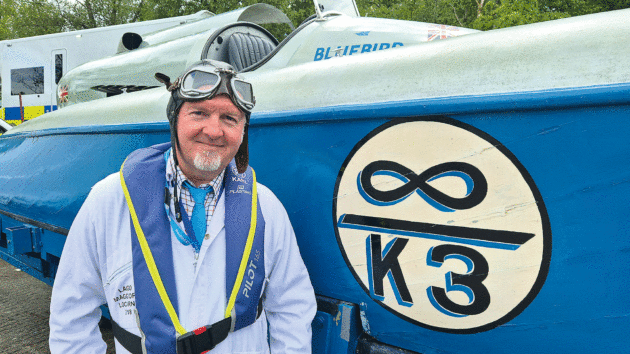
Karl Foulkes-Harbard next to Sir Malcom Campbell’s propeller driven Blue Bird K3
Nor was K7 the only attraction. Bluebird K3, another world waterspeed record-breaking boat driven by Donald’s father Sir Malcolm Campbell, would also be running at speed in the hands of its current owner Karl Foulkes-Halbard. This would be the first time the two boats had ever been seen together and K3’s first time on Coniston.
Spotting that both boats sported an infinity symbol, I asked Karl to explain. “Firstly, the ‘K’ refers to the Lloyd’s Insurance class,” he replied. “Then the infinity sign means unlimited speed, and the digit is the boat’s number. So you had K1 and K2, which were Sir Henry Segraves’ Miss England boats, then K3, Sir Malcolm Campbell’s boat which I now own.
Sir Malcolm also owned K4, and he used all the original running gear from K3 in K4. K5 (an unsuccessful jet-powered hydrofoil built by naval architect Frank Henning-Lee) was called Whitehawk, and K6 was John Cobb’s Crusader, in which Cobb crashed and died in 1952.
Those designations, together with the Bluebird name, are where the similarities between Bluebird K3 and Bluebird K7 end. “They are completely different animals,” said Karl. “You look at them both and you think, there’s less than 20 years between them. But they’re totally different. K3 was primarily timber-built with a very large, powerful piston engine, while K7 is primarily aluminium with a jet engine in it.”
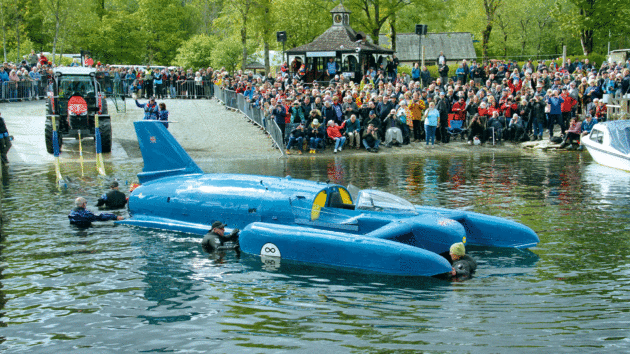
Divers ease Bluebird K7 off her cradle and into Coniston Water. Photo: Phil Sampson. Inset left: Alan Bessant
In technical terms, Bluebird K7 is a hydroplane, meaning it skims across the water rather than running through it. When running at full pelt, Bluebird K7’s three points of contact with the water are said to total just eight square inches between them. Delivering the grunt to push Bluebird K7’s all-up weight of 2.5 tonnes onto the plane is a massively powerful jet engine.
Originally, she was equipped with a Metropolitan-Vickers Beryl engine delivering up to 4,000 pounds-force (lbf) of thrust. This engine powered Donald Campbell through each of his seven record-breaking campaigns. In 1966 the Beryl was replaced by a Bristol-Siddeley Orpheus 701. Lighter and rated
at 4,700 lbf this was the engine used on Campbell’s final run.
It had been taken from a Folland Gnat aircraft, as once used by the Red Arrows. Campbell also added the Gnat’s tailplane to improve high-speed stability for his 300mph attempt.
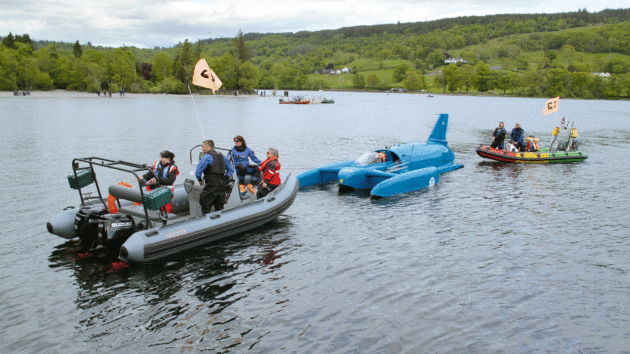
Towing K7 back to shore after one of her aborted high-speed runs. Photo: Phil Sampson
Aussie rules
Each day of the festival a large and expectant crowd turned out to watch pilot Dave Warby try and coax Bluebird K7 up to speed. Dave is the son of the late Ken Warby, the current holder of the world water speed, which he broke in 1977 in his home-built hydroplane, Spirit of Australia. A feat which Dave is now hoping to repeat in a new boat, Spirit of Australia 2.
I asked Dave how the chance to pilot Bluebird K7 came about:
“My father and I built Spirit of Australia 2 before he passed and I’ve been piloting that for a while now. We’re up to about 280mph. It’s got the same Orpheus engine as Bluebird, but a later version. With my experience operating and driving that, the museum asked if I’d be interested in driving K7. Given it’s a boat that inspired my father to break the world water speed record it was an honour I couldn’t refuse.”
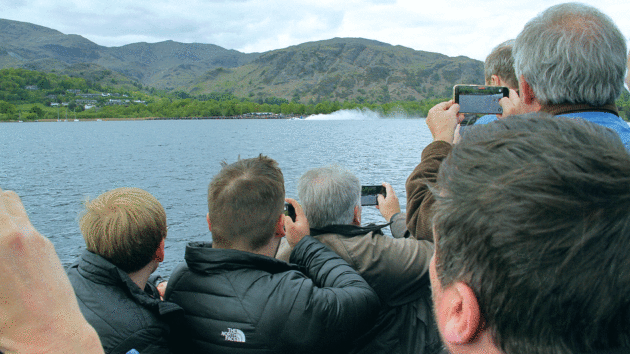
A crowd of onlookers try to capture the moment. Photo: Phil Sampson
So how does he feel when he sits in the cockpit? “It’s a very spiritual thing for me. I’m not normally a spiritual person but there was something about knowing you’re sitting in the boat that Donald Campbell broke so many world records and sadly lost his life in.
“It’s the boat that’s inspired our family to chase world records, because when Donald was in Australia with CN7 (his Land Speed Record car) and K7 they were great ambassadors for Britain and world records.
“That tour inspired my father and it’s really a spiritual thing. I’m really focused on driving the boat and we’re trying to solve some problems at the moment, so I do focus on that, but when everything’s settled down you get home and you’ve really got to pinch yourself.”
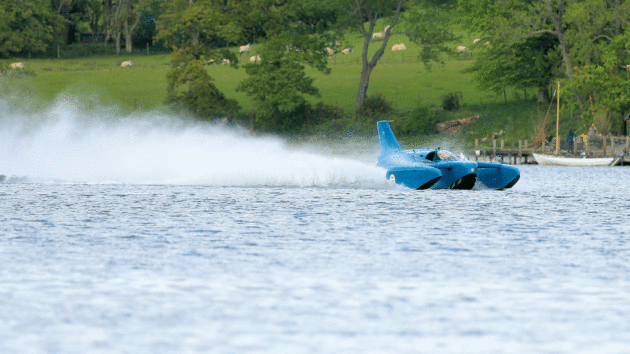
The sight everyone waited so long to see – Bluebird K7 running at speed again in her spiritual home. Photo: Matthew Willis
The search for speed
Frustration was another word which cropped up in my conversation with Warby, after struggling to get Bluebird K7 planing on the first four days of the festival, time was running out for him and the organisers. “We’re going through a fuel starvation issue at around 80 per cent power so they’re just sorting the fuel flow out for us at the moment.”
After sourcing a new pump, the team raced to fit it – no easy task given the complexity of Bluebird’s 1960s’ engineering, as Dave’s chief engineer, known to all as Noddy, explained: “There are 146 screws that have to come out before you can get the covers off to work on the engine. And some of those screws are different lengths – so you’ve got to know what goes where.
“It takes 40 minutes just to get the panels off, and another 40 to get them back on again. Spirit of Australia has just four fasteners!”
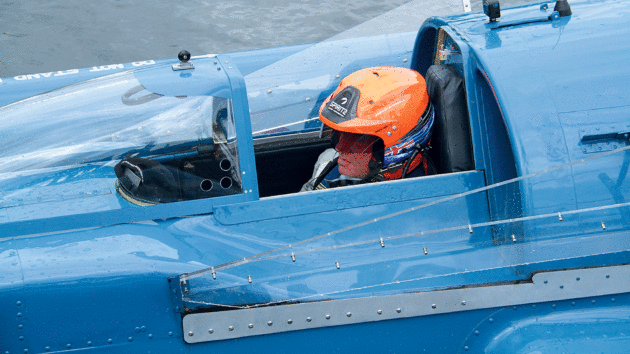
Dave Warby runs through the complex start-up process for the Orpheus jet engine. Photo: Phil Sampson.
Finally, on Friday afternoon, the moment arrived. Bluebird K7 was hauled out of her temporary workshop marquee and gingerly manoeuvred into the water, assisted by a team of divers. Once afloat she was towed out to the start pontoon where an auxiliary power unit provided the compressed air needed to spin up the turbine before the fuel could be introduced and ignited.
In the cockpit Warby methodically ran through the start up process. Tucked into his overalls was Mr Whoppit, Campbell’s lucky teddy bear, which had been found floating on the water minutes after the fatal crash. Final checks completed, K7 roared into life and slowly pulled away from the pontoon.
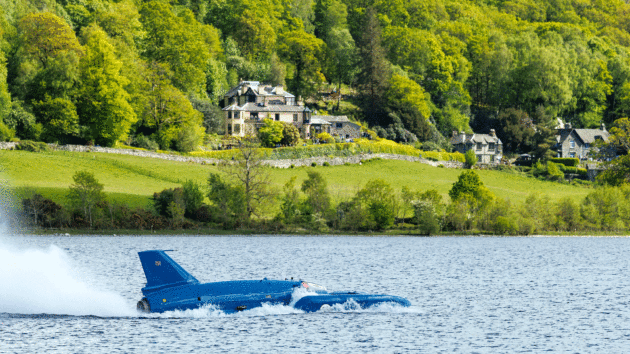
‘Thousands of people stood there in typically British weather conditions in the hope of catching a glimpse of K7 flashing by’ Photo: Ruskin Museum and Neil Draper
From our vantage point aboard the Coniston Launch, Campbell, we could see her steadily gaining speed. Despite the immense power of the jet engine, getting K7 to rise onto the plane has always been a momentous struggle.
Unlike a conventional boat, which generates lift across almost the full length of its hull at relatively low speeds, K7’s much smaller planing pads and heavy jet engine only really come good at much faster speeds. Despite his best efforts, Warby had been unable to get her planing on the previous four days of the festival, but this time, things were looking up…
Article continues below…

World’s coolest boats: Bluebird K7 was as cool as it was fast

Speed record in sight for Spirit of Australia II and Bluebird K7 comes home
The grand finale
As Dave applied more power K7 finally lifted her skirts, as Donald Campbell was want to say, and climbed onto the plane. For the first time since 1967 Campbell’s hydroplane was flying again on Coniston, hurtling along the lake at 100mph with the sound of its jet engine echoing off the surrounding hill sides.
A collective cheer rose from the expectant crowd even as Warby began to back off the power again. A combination of water ingress around the canopy and fuel vapour inside the boat (there had been a small spillage of fuel when the pump was changed) resulted in a milky film forming on the windscreen, obscuring Dave’s view. With no way of cleaning the screen, he aborted the run in the interests of safety.
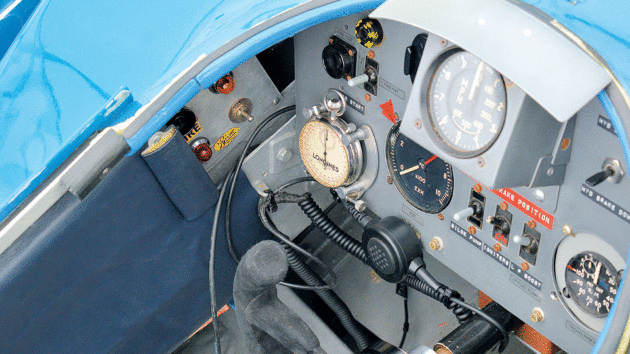
K7’s cockpit still retains many of its original 1960s features. Photo: Alan Bessant
Unfortunately, that’s where it all ended. On Saturday, further attempts to get her up to speed were once again hampered by the canopy windscreen. Our understanding is that overnight the engineering team had applied some additional sealer around the screen but this ended up making it too tight a fit.
Conditions deteriorate
The last day was no kinder. Dave had handed his seat over to the reserve pilot, military aviator David-John Gibbs, but his luck was out too. First, there was a problem with the air supply to the engine, requiring K7 to be hauled out for those 146 screws to come out.
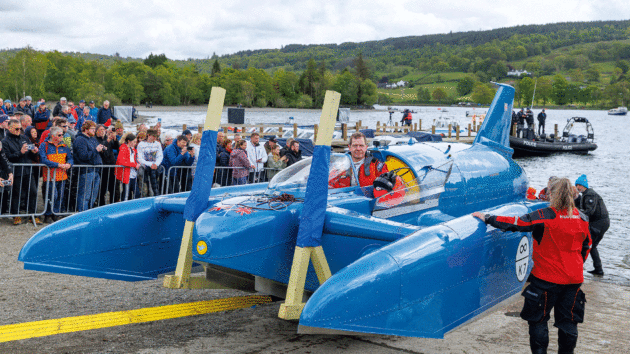
Further attempts to get her running at speed were thwarted by bad weather. Photo: Ruskin Museum and Neil Draper
As the day wore on the weather worsened, fanned by a stiff F4 south-westerly. “I fear conditions are beyond marginal,” announced the commentator. And with that the party was over.
The festival may not have gone entirely to plan but it was a uniquely British event (Aussie pilot notwithstanding)! Hundreds of volunteers had given their time for free to make it happen, and thousands of people stood there in typically British weather conditions in the hope of catching a glimpse of K7 flashing by. Time after time we were told, “I just want to be here, I don’t care about the weather,” and they were true to their word.
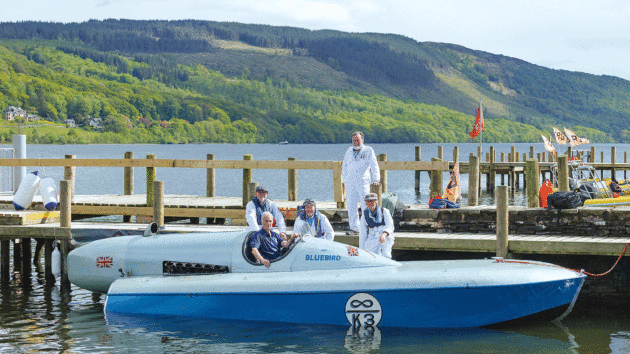
The simpler piston-engined Blue Bird K3 completed a number of quick runs in the hands of its owner. Photo: Neil Draper
Sure it would have been nice to see K7 complete a few more runs at 100-150mph, but being present for that one time she did made it all worthwhile. As Donald Campbell’s daughter Gina said, “I am simply blown away by it all.” And so were we.
Bluebird
K7’S Record-breaking streak
- 202.32 mph: Ullswater (July 1955)
- 216.20 mph: Lake Mead, USA (November 1955)
- 225.63 mph: Coniston Water (September 1956)
- 239.07 mph: Coniston Water (November 1957)
- 248.62 mph: Coniston Water (November 1958)
- 260.35 mph: Coniston Water (May 1959)
- 276.33 mph: Lake Dumbleyung, Australia (December 1964)
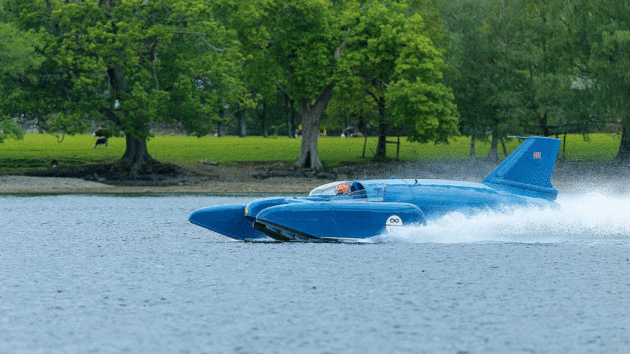
Once planing, the speed builds rapidly. Photo: Ruskin Museum and Neil Draper
The Bluebird Legacy
The name Blue Bird was first coined by Sir Malcolm Campbell in 1912. Inspired by Maurice Maeterlink’s play ‘The Blue Bird’ he named his 1906 Darracq racing car Blue Bird before taking to the track at Brooklands.
Keen to preserve the name while differentiating his record-breaking exploits from those of his father, Donald Campbell modified the name to Bluebird.
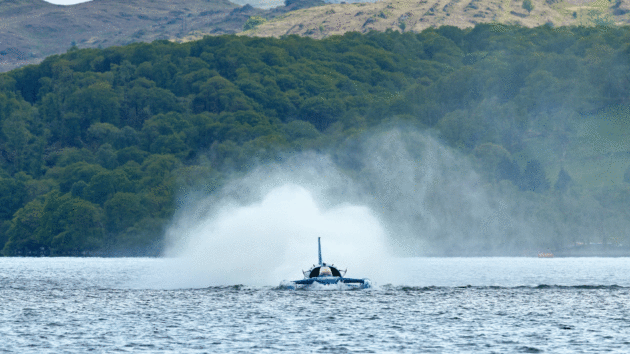
It takes an enormous amount of thrust to push K7 onto her three small planing surfaces. Photo: Ruskin Museum and Neil Draper
Over the years, the name has appeared on 12 Campbell craft; six cars and two boats for Sir Malcolm; Bluebird K7 and CN7 for Donald; In 1984 Gina Campbell (pictured above with Mr Whoppit) took the women’s water speed record in Bluebird II; and in 2000, Sir Malcolm’s grandson, Don Wales, piloted Bluebird Electric to the electric land speed record.
 If you enjoyed this….
 If you enjoyed this….
Motor Boat & Yachting is the world’s leading magazine for Motoryacht enthusiasts. Every month we have inspirational adventures and practical features to help you realise your sailing dreams, as well as tests and news of all the latest motorboats.
Plus you’ll get our quarterly Custom Yachting supplement where we share the last on offer in the superyacht world and at the luxury end of the market.
Build your knowledge with a subscription delivered to your door. See our latest offers and save at least 30% off the cover price.
Note: We may earn a commission when you buy through links on our site, at no extra cost to you. This doesn’t affect our editorial independence.