

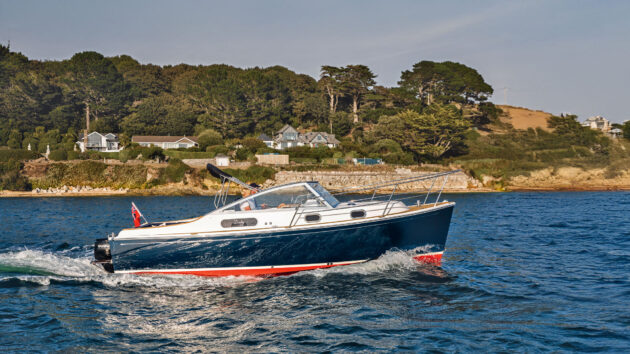
The new Duchy 25 is the first outboard-powered Duchy model from Cockwells, offering a trailerable, high-quality alternative to the established line
Fans of the Cockwells shipyard in Falmouth will be well aware of the Duchy line. Introduced in 2012, its semi-production approach made the builder’s celebrated quality far more accessible to regular boaters than its one-off custom projects had ever been.
As traditional shaft-driven gentleman’s launches with long keels and heavyweight construction, they were still relatively niche and costly but here, in the form of the smallest Duchy yet, the first outboard-powered Duchy ever and the only one designed for trailering, the new Duchy 25 is being touted as the most accessible model to date.
The sociable aft layout has a fold-down backrest so it’s easier to step over
Duchy 25’s user-friendly layout
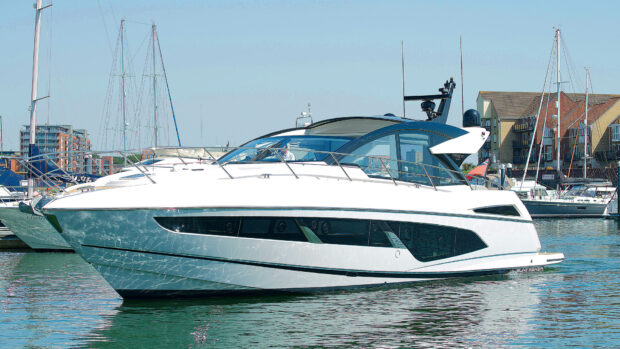
As it nestles at the pontoon, looking for all the world like an open version of the established Duchy 27, the user-friendliness of the design is very clear. In tandem with the 27, with which it shares an identical front end, the bow lifts significantly, adopting a pretty fine entry with a substantial flare and a set of elevated guardrails to protect you as you make your way along the single-level side decks.
In line with the rest of the fleet, those external decks use artificial teak for ease of maintenance but as you get closer to the shelter of the interior, solid wood joinery puts in precisely the appearance you would expect.
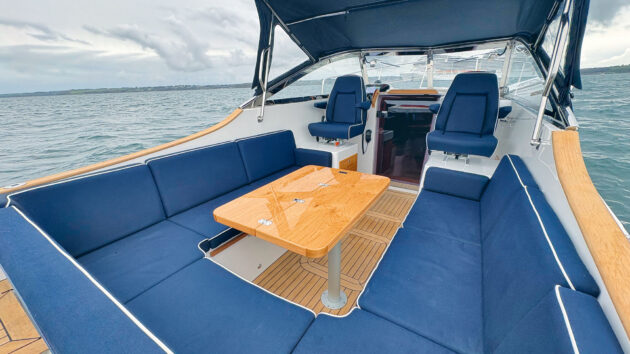
Wraparound bench seating creates a very sociable arrangement
Before we get to that though, it’s worth checking out the stern, which features a pair of small platforms on either side of a Suzuki DF140.
Little extensions to these platforms provide handy stepping points as you make your way on and off. Given the depth of the cockpit, that makes plenty of sense and the backrest for the transom bench also assists with ease of movement by hinging forward, allowing safe and easy access directly into the cockpit without having to climb over it.

This boat is the only Duchy designed for trailering
As for the cockpit itself, it makes best use of the Duchy 25’s modest length by adopting a layout that looks like it’s been borrowed from a classical inland picnic boat. Unbroken wraparound bench seating lines the deck on three sides, facing in toward a central oak table, creating a very sociable arrangement for six or seven people.
The helm and co-pilot seats also spin around to face aft but their relative elevation does inevitably separate them from the goings on down at the cockpit table.
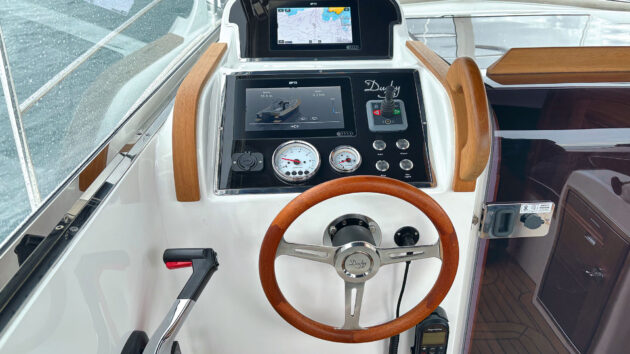
The raised upper dash provides space for a second MFD
That said, there’s a bit more versatility here than you might expect. The two compact swim platforms, for instance, provide access to storage cavities that continue forward beneath the lateral bench seats so storage volume is very good.
There’s also the option of slats and infill cushions so you can remove the table and create one huge sunbed. And the fact that you can extend the spray hood with all-over covers means you can shut the space off in bad weather or even use it as a second double bed so you can sleep two couples rather than one.
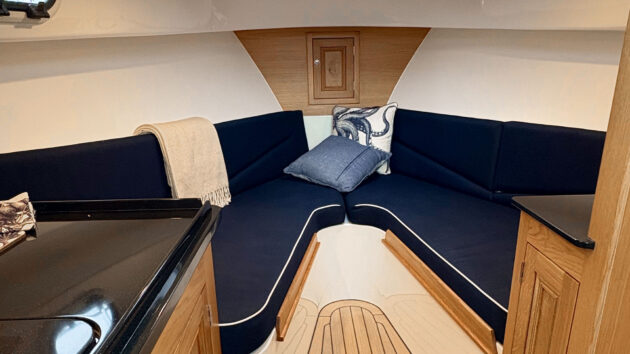
Headroom beneath that raised bow is far more generous than you might expect
Hard-working cabin
Moving forward, there’s some extra storage inside the base of the port helm seat and an optional fridge beneath the starboard co-pilot. And as for the joinery, well if you need evidence that Duchy’s traditional quality has made it unscathed onto this smallest, most accessible model, this is the place to find it.
Beyond the varnished oak table at the heart of the cockpit’s wraparound seating and the solid iroko grabbing points at the helm, you head down below, away from the wind, salt and water, to be greeted with lots of lovely woodwork.
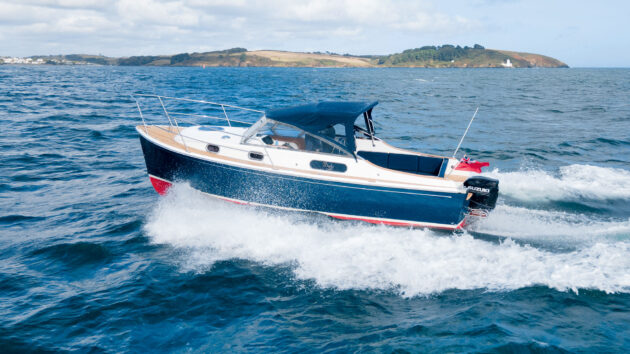
This is the first outboard-powered Duchy ever
While most boats (even premium ones) tend to use a simple glue and screw approach to idiot-proof butt joints on drawers and storage lockers, alongside veneered panels to reduce cost, what we have here is far more pleasing – solid oak joinery throughout, alongside the kind of expertly executed half blind dovetail joints that you just want to show off to your friends.
As for the layout, simplicity is again key. There’s a compact wetbar-style galley next to the companionway steps so you can stand fully upright and take advantage of the extra headroom here. That’s great for light, air and sociability, and it’s also handy for keeping an eye on the horizon and warding off the nausea if you’re forced below in a swell to make a cup of tea.
There’s not much space to play with here, of course. Just a sink and a section that looks ripe for a compact gas or induction hob. But the storage is again very strong, not least in the form of a dedicated cup rack and some automatically lit hanging storage.

The fact that you can use the backrests as the infils for the convertible bed is very useful
The space ahead of this is rigged as a V-shaped lounge and, thanks to the pronounced elevation of the coachhouse roof, there’s plenty of room for a family of six-footers to sit here and chat.
You can also turn it into a double bed for overnighting duties and it’s really good to see that, when you do so, the infills double as backrests for the seats, so you don’t have to waste any storage space during the day.
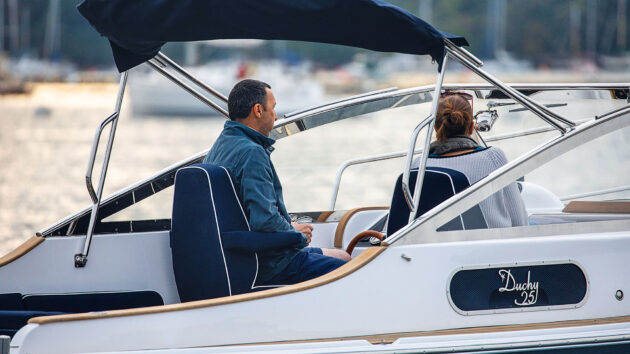
You can augment the ready-rigged spray hood with full cockpit covers
As for the heads compartment, the access door is, by necessity, quite low but it provides everything you need – an opening portlight, an electric toilet on the angle to maximise the space, and an optional shower fitting and deck drain so you can use it as a wet room or as a private place to wash off the sea salt.

While the rotating helm seats are too high to feel natural, the dinette is impressive
Article continues below…
Used Boat Review: Cockwells Custom 32 – A work of maritime art

World’s Coolest Boats: Cockwells Titian Tender – A Modern Masterpiece
Soft and settled at sea
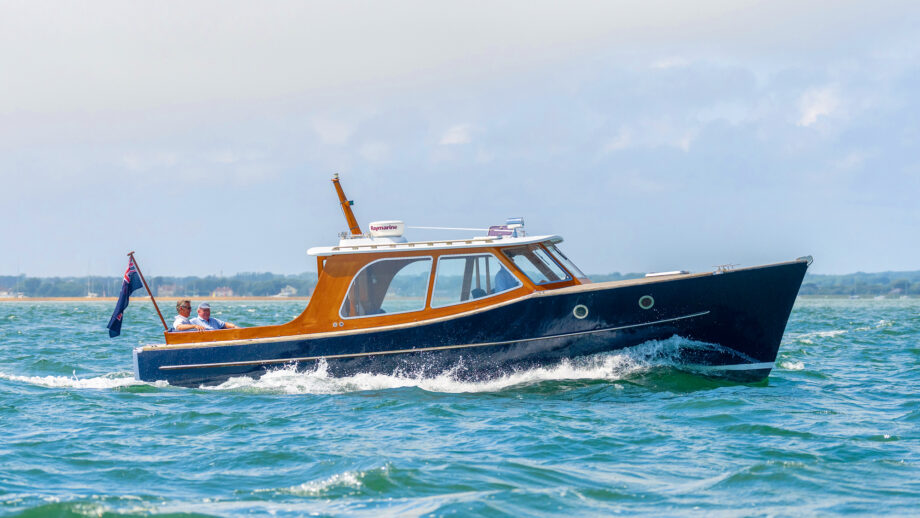
While the established 27 has proven itself to be a very sound sea boat, there are some key differences here. The 25 is a shade shorter and 750kg lighter. It’s also significantly shallower than the 27 and its engine is positioned not beneath the cockpit deck but on top of the transom. None of those things are of great benefit in a chunky sea but the early signs here are actually very good.
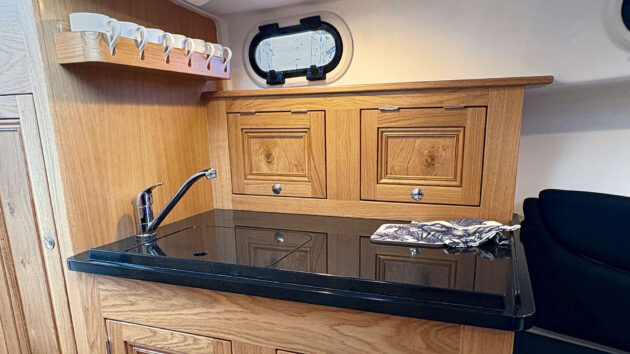
It’s not big but the quality of the solid oak joinery is lovely
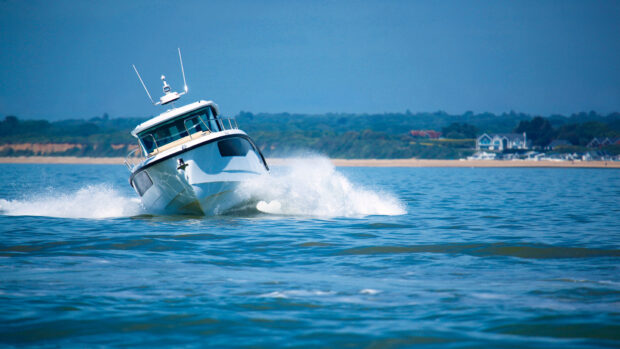
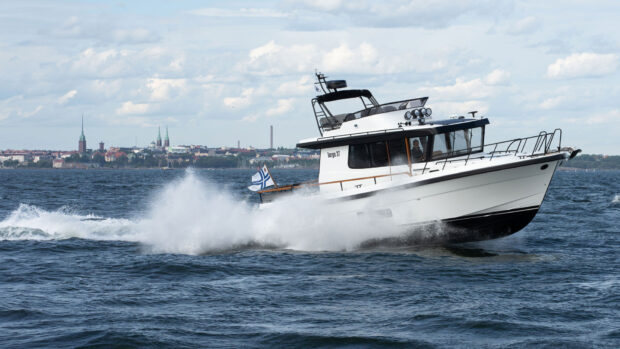
The upward sweep of the sheerline, the elegant flare of the bow and those enormously raised guardrails combine to give you a very reassuring sense of confidence from the helm. It feels commendably soft too; and as the compact bow rides gamely over the west country swells, the dryness is equally striking.
As a semi-displacement hull, travelling at moderate speeds through reasonable chop with a robust wind, you wouldn’t necessarily expect to witness the deflected water clapping its approval 10ft off the beam, but that’s exactly what we’re seeing.
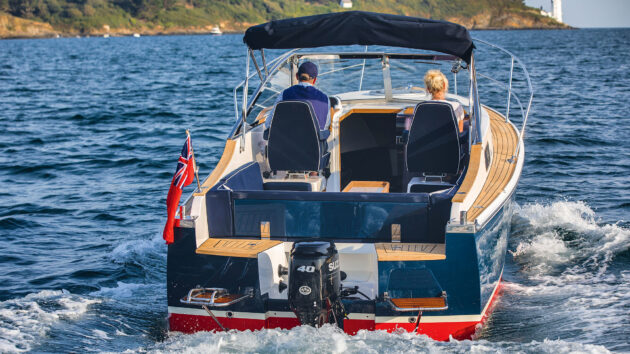
Even a 40hp unit will push this boat along at 8 knots
It’s very quiet at low revs too, without any of the rumble or reverberation of an inboard diesel, so it immediately feels like a very useful boat for low-speed work on the inland waterways. Steady straightline tracking and ‘spin-on-a-sixpence’ manoeuvrability also lend themselves to that kind of application but it does get a shade noisy when you get up beyond 16 knots.
With the pram hood erected and that Suzuki DF140 whirring away at 5,000rpm, sound readings of about 80dB(A) increase to around 85dB(A) at our 21-knot top end. But the engine is, of course, something you can change.

The access door is quite low, but the wetroom-style heads makes great use of modest space
The 25’s transom is designed to operate with anything from 40-200hp and even with the basic 40, you could expect this boat to hit 8 knots so it’s by no means a power-hungry platform.
It makes good sense then that electric propulsion is also on the cards – and there’s plenty of space beneath the cockpit deck for a battery bank to make that relatively simple.
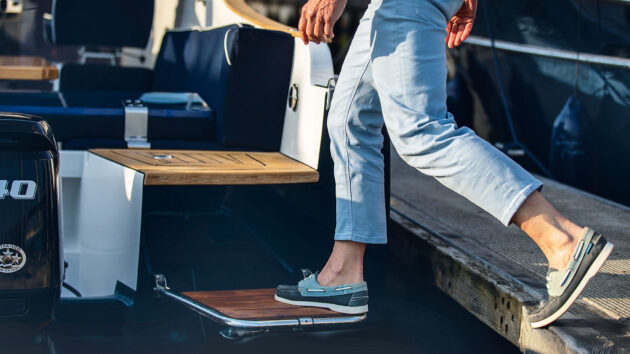
Compact platform extensions make boarding much simpler
 If you enjoyed this….
 If you enjoyed this….
Motor Boat & Yachting is the world’s leading magazine for Motoryacht enthusiasts. Every month we have inspirational adventures and practical features to help you realise your sailing dreams, as well as tests and news of all the latest motorboats.
Plus you’ll get our quarterly Custom Yachting supplement where we share the last on offer in the superyacht world and at the luxury end of the market.
Build your knowledge with a subscription delivered to your door. See our latest offers and save at least 30% off the cover price.
Note: We may earn a commission when you buy through links on our site, at no extra cost to you. This doesn’t affect our editorial independence.
Price as reviewed:
£220,000.00 As tested, ex. VAT
Verdict
With prices from about £189,000 ex VAT (and the test boat adding another £31k to that), this ‘accessible’ new Duchy 25 is actually quite expensive by the standards of your average 25-footer. And if you don’t need to trailer it, then the bigger, heavier, more traditional 27 is still likely to be the better boat for most people. But of course, this isn’t your average 25-footer. As a small, trailerable, outboard-powered platform with lovely quality, surprising versatility and excellent seakeeping from a product line that a great many people quite rightly covet, the Duchy 25 is in fact a very cleverly judged piece of work.
Details
LOA: 25ft 0in (7.62m)
Beam: 9ft 2in (2.80m)
Fuel capacity: 220 litres
Water capacity: 220 litres
Draft: 1ft 10in (0.57m)
Displacement: 2,500kg (light)